



Valine CAS 72-18-4 is one of the amino acids used to build proteins in the human body. In nutritional ingredients, the form normally specified is L-valine.
For a product developer, the starting question is why the formula needs additional valine.
A formula intended to improve its amino acid composition needs an assessment of the protein sources already present. A sports nutrition product making a performance claim needs evidence for that claim. The fact that the body requires valine does not, by itself, answer either question.
Which type of amino acid is valine?
Valine belongs to several categories, each describing a different feature.
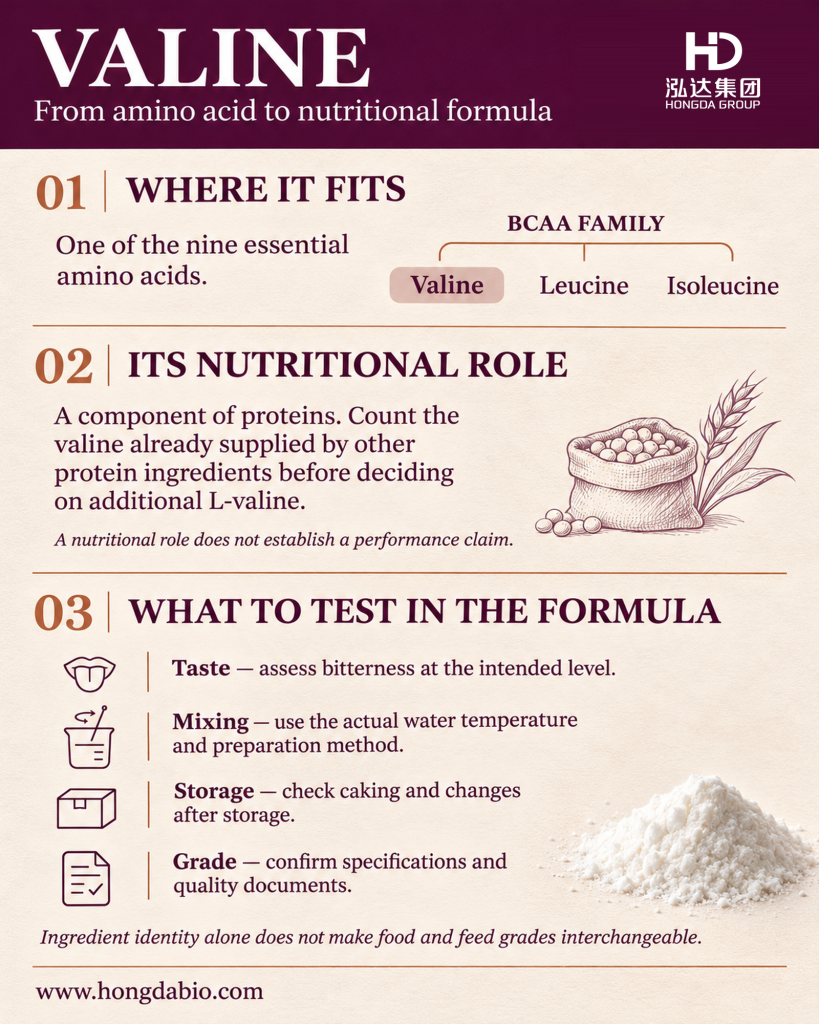
In human nutrition, it is one of the nine essential amino acids. “Essential” means the body cannot make enough to meet its needs, so it must obtain valine from the diet. It does not mean everyone needs a separate valine supplement.
Valine is also a branched-chain amino acid, or BCAA, alongside leucine and isoleucine. These three ingredients often appear together in nutritional products, but they remain distinct amino acids.
Its side chain is classified as nonpolar. This describes one part of the molecule; it should not be interpreted as a statement that the whole ingredient is completely insoluble in water. PubChem: L-Valine
The terms essential, branched-chain and nonpolar therefore describe nutritional requirements, molecular structure and side-chain properties, respectively.
What its structure tells a formulator
Valine has the molecular formula C₅H₁₁NO₂. It has the basic amino acid framework and a branched side chain, which gives the BCAA group its name.
Structure helps explain chemical behaviour, but it cannot replace a formulation trial. The behaviour of an ingredient in a beverage, for example, also depends on its concentration, water temperature, acidity and the other ingredients present.
The “L” in L-valine identifies its spatial configuration. For nutritional sourcing, that designation should remain part of the material specification.
Nutritional function starts with the whole diet
Valine is a component of proteins. Foods such as meat, eggs, dairy products and soy contribute valine as part of their protein content.
Protein synthesis requires a supply of multiple amino acids. If one is insufficient, it can limit the use of the others. Once requirements are met, however, adding more of a single amino acid does not establish that a product will deliver a better result.
For formulation work, this means counting the valine supplied by the existing protein ingredients before deciding whether additional L-valine is needed. Looking only at the amount added separately can overlook a substantial part of the formula’s amino acid supply.
This distinction also matters when discussing valine benefits. Its nutritional role should not be presented as proof of a specific effect from supplementation. The NIH Office of Dietary Supplements reports that studies have not consistently shown that supplemental BCAAs, or their individual components, improve athletic performance, build muscle mass or support exercise recovery. NIH: Dietary Supplements for Exercise and Athletic Performance
A finished product claim therefore needs evidence relevant to that product, its amount of use and its intended consumers.
The practical questions appear in the sample
Once the ingredient has been identified, the next questions concern how it behaves in the finished formula.
For a powdered drink, dissolution time, sediment and changes after standing can all affect the consumer experience. A result obtained with warm water and laboratory mixing may not represent preparation with cold water at home.
Valine also has a bitter taste. Taste should be assessed at the intended inclusion level in the complete formula. A strongly flavoured sample may mask bitterness during early development, while dilution, storage or changes to other ingredients can make it more noticeable.
A useful trial records:
- Whether particles or sediment remain after preparation as directed;
- Whether bitterness is acceptable at the intended inclusion level;
- How other amino acids or protein ingredients affect taste and dispersion;
- Whether storage changes caking, colour or preparation performance.
These observations belong to the tested formula. A general ingredient description cannot guarantee the behaviour of every finished product.
For a nutritional powder intended for cold-water preparation, testing should use the proposed water volume, temperature and mixing method. If the sample only performs acceptably with more water or longer mixing, the formula or preparation directions need further work.
Ingredient identity and commercial grade are separate checks
Food nutrition and animal feed applications have different documentation and quality requirements. A shared chemical name or CAS number helps identify the substance, but it does not establish that grades are interchangeable.
For a material described as food grade or USP grade, buyers should review the specification confirmed by the supplier and the corresponding test documentation. The term “USP grade” should not be treated as proof of independent USP Verified certification.
Acceptance also depends on the intended application. An acceptable assay result does not remove the need to review other relevant quality attributes. Requirements for impurities, microbiological quality and other tests should follow the applicable requirements and the specification agreed between buyer and supplier.
Hongda Group lists an L-valine food/USP-grade product page. It provides a starting point for a product enquiry. Before ordering, the intended grade, quality documentation and agreed specification still need confirmation, particularly when the material will enter a specific nutritional product or export market.
Make the enquiry specific to the application
Alongside quantity and delivery location, a useful enquiry explains the product format, intended market and formulation issue being investigated.
For example, “a powdered nutritional drink under evaluation for cold-water preparation and bitterness” gives both parties more to work with than a request for a valine price alone. It helps identify which documents and sample evaluations are relevant.
For a defined project, submit the application and specification requirements through the Hongda Group contact page, then confirm the sample, documentation and supply terms against those requirements.