



3-Cyanopyridine is a pyridine-based intermediate for organic synthesis. Hongda Group lists agrochemical synthesis among its applications, including the manufacture of insecticides and herbicides.
In a stepwise route to pymetrozine, it supplies the pyridine fragment of the final molecule. The starting material is first converted into pyridine-3-carboxaldehyde, which then reacts with an aminotriazinone intermediate to give pymetrozine. Following these steps shows what changes in the starting material and how the intermediate enters the next reaction.
Product identification
The following information is listed on Hongda Group’s 3-cyanopyridine product page.
| Item | Website-listed information |
|---|---|
| Product name | 3-Cyanopyridine |
| Alternative name | Nicotinonitrile |
| CAS number | 100-54-9 |
| Molecular formula | C₆H₄N₂ |
| Listed product standard | HG/T 4478-2012 |
| Listed packaging | 25 kg/drum |
The pyridine ring provides the ring framework for the downstream molecule, while the attached nitrile group offers a site for further transformation. In the route discussed here, that group is converted into an aldehyde for the subsequent condensation.
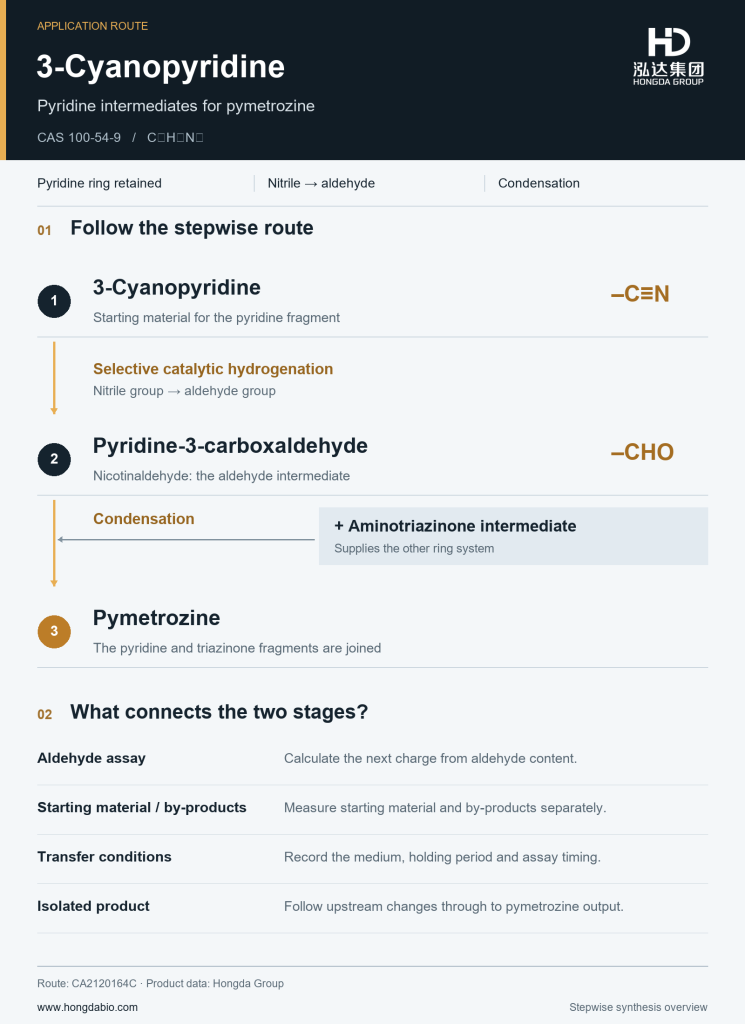
Converting 3-cyanopyridine into the aldehyde intermediate
Pyridine-3-carboxaldehyde, also called nicotinaldehyde, is the pyridine intermediate in this stepwise route:
3-Cyanopyridine → pyridine-3-carboxaldehyde
The pyridine ring is retained as the nitrile group is converted into an aldehyde group. Published routes use selective catalytic hydrogenation to obtain an aldehyde solution for the next reaction. Reported examples also identify pyridin-3-ylmethanol and pyridin-3-ylmethanamine as by-products. Assessing the hydrogenation therefore requires separate measurements of residual starting material, target aldehyde and by-products.
Using the aldehyde to make pymetrozine
The aldehyde group reacts with the amino group of an aminotriazinone intermediate. This condensation forms the connection between the pyridine and triazinone rings:
Pyridine-3-carboxaldehyde + aminotriazinone intermediate → pymetrozine
3-Cyanopyridine supplies the pyridine portion; the aminotriazinone intermediate supplies the other ring system. The hydrogenation and condensation sequence, including examples using an aqueous aldehyde solution in the subsequent reaction, is described in this published synthesis patent.
A stepwise process allows the aldehyde solution to be tested after hydrogenation, with condensation charges calculated from its measured content. A project that purchases pyridine-3-carboxaldehyde directly begins at this intermediate stage of the route.
Connecting hydrogenation with condensation
The amount of aldehyde available in the transferred solution provides the basis for the next charge calculation. Two batches with the same solution mass can contain different amounts of aldehyde. Using the same solution charge for both could change the molar ratio of the condensation reactants.
Analytical results need to be accompanied by the relevant process information. This includes how the assay is expressed, the solution medium and any holding period between sampling and use. If the intermediate is stored before transfer, the need for a fresh assay should be determined from stability data for that particular system.
To evaluate material performance across the route, record both aldehyde formation and the isolated pymetrozine obtained from the next step. This helps establish whether a change made upstream carries through to the final product.
Match the material to the project stage
A project starting with 3-cyanopyridine must connect its conversion with aldehyde preparation and subsequent condensation. A project using the aldehyde directly will focus on condensation and product isolation. Identifying that starting point gives development, production and purchasing teams a clear basis for discussing the material required.
To discuss 3-cyanopyridine for a pymetrozine intermediate project, contact us with the target intermediate, current process stage and product documentation you need.