



2-Cyanopyridine, CAS number 100-70-9, is a chemical intermediate used in further synthesis. Its documented downstream products include picolinamide and picolinic acid.
Several types of information need to be kept distinct when assessing this material. The CAS number establishes substance identity, physical properties help with handling decisions, and the safety data sheet describes hazards. Batch test results establish whether a particular delivery meets the agreed quality specification.
What is the 2-cyanopyridine CAS number?
The CAS number for 2-cyanopyridine is 100-70-9, and its molecular formula is C₆H₄N₂. Other names include picolinonitrile and 2-pyridinecarbonitrile.
The CAS number helps confirm whether different names on a quotation, label or technical document refer to the same substance.
The “2” in the name matters. 2-Cyanopyridine, 3-cyanopyridine and 4-cyanopyridine are different compounds. Sharing a molecular formula does not make them interchangeable in a manufacturing process.
Product information at a glance
| Parameter | Information | Notes |
|---|---|---|
| Product name | 2-Cyanopyridine | Also called picolinonitrile or 2-pyridinecarbonitrile |
| CAS number | 100-70-9 | Used to confirm substance identity |
| Molecular formula | C₆H₄N₂ | Distinguish from 3-cyanopyridine and 4-cyanopyridine |
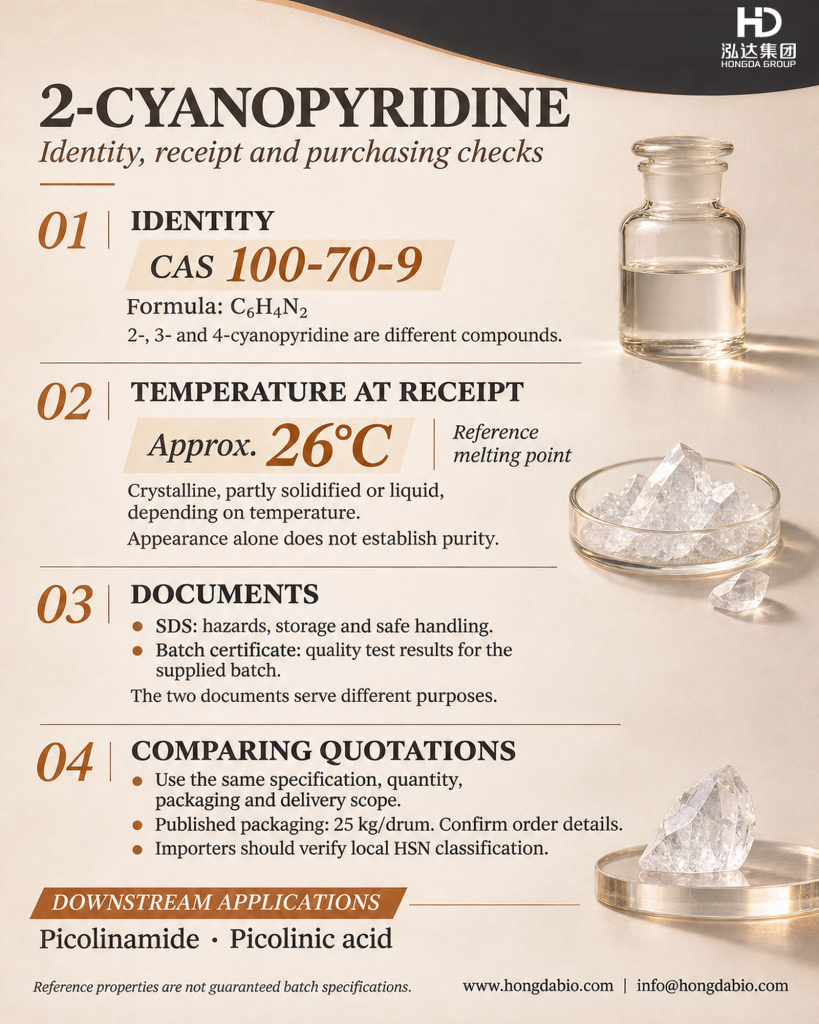
| Melting point | Approximately 26°C | Close to room temperature; physical form can change with temperature |
| Physical form | Crystalline, partially solidified or liquid, depending on temperature | Consider the material temperature when assessing its condition at receipt |
| Hongda’s published packaging | 25 kg per drum | Confirm packaging and delivery arrangements for the order |
The melting point is a reference property, rather than a guaranteed specification for a supplied batch. Batch acceptance should follow the agreed quality specification and test results.
How does the melting point affect receipt and handling?
The reference melting point of 2-cyanopyridine is approximately 26°C. Temperature changes during transport or storage can therefore cause the material to crystallize or become liquid.
A winter shipment may arrive in a different physical state from a summer shipment. If a site has planned to sample or transfer a liquid but receives crystallized material, the handling arrangement needs to be reviewed under its approved procedures.
Crystallization alone does not establish deterioration. A clear appearance does not establish acceptable purity either. Record the material’s condition and temperature at receipt, then assess the batch against the agreed tests.
If production requires liquid charging, discuss suitable conditioning arrangements before ordering. The procedure must account for the container and receiving equipment. An online melting-point value is not an adequate instruction for heating the material.
Which downstream products can be made from 2-cyanopyridine?
2-Cyanopyridine can be used to prepare picolinamide and picolinic acid. Both transformations have been examined in published research.
Reaction with water under suitable conditions can produce picolinamide. Appropriate further conversion conditions can lead to picolinic acid. The intended product affects the choice of process and may also affect the raw-material controls required.
For a buyer, these applications help define the acceptance specification. If water or a particular impurity affects the process, include an appropriate limit and evaluate a sample against that requirement.
Published experimental results do not constitute a performance commitment for a commercial supply batch. Nor does an intermediate’s downstream application establish compliance with the quality requirements for a finished pharmaceutical, food ingredient or other end product.
What should be checked when looking up density and boiling point?
Density changes with temperature. Before using a density value to convert between volume and mass, check the measurement temperature and the physical state described. This is particularly relevant to a material that melts close to room temperature.
Boiling-point information needs a pressure condition. Where published values differ, review the original measurement details rather than comparing the numbers in isolation. Reduced-pressure and atmospheric-pressure results are not directly equivalent.
For metering, storage-capacity calculations or equipment assessment, request suitable technical information. Reference values found online should not be combined into a set of guaranteed supply specifications.
What does a 2-cyanopyridine SDS tell you?
SDS stands for safety data sheet. It describes a chemical’s hazards, storage requirements, protective measures and emergency response information.
2-Cyanopyridine presents acute toxicity hazards. Prevent ingestion and skin contact, and use appropriate eye protection. Detailed precautions should follow the latest SDS applicable to the supplied product and the receiving site’s risk assessment.
Check the product name, CAS number and supplier details first. The revision date and regional applicability also need to be relevant to the shipment. Warehouse and production personnel should have the necessary information before the material arrives.
The SDS and the batch certificate serve different purposes. The SDS supports safe handling; the certificate records quality test results for the supplied batch. Neither replaces the other.
What affects the 2-cyanopyridine price?
Small-pack laboratory prices are not a reliable guide to industrial bulk pricing.
Order quantity, quality specification, packaging and delivery location all affect a quotation. Additional testing, documentation requirements and freight charges can also change what is included in an apparently similar price.
Hongda currently lists 25 kg drums on its 2-cyanopyridine product page. Confirm the applicable specification and packaging arrangements in the order.
For a useful comparison, send suppliers the same acceptance requirements and specify the quantity, destination and delivery scope. If water content or an impurity limit matters to production, raise it in the initial enquiry rather than after a price has been issued.
Can an online 2-cyanopyridine HSN code be used directly?
An HSN code serves a different purpose from a CAS number. The CAS number identifies the substance; customs classification places the goods within a trade tariff.
Complete codes and national subdivisions may differ between markets. A code displayed on a website serving another country should therefore be checked before it is used in a local import declaration.
A supplier can provide a proposed classification. The importer or local customs representative should confirm it against the product composition, supplied form and current tariff. Product names and CAS numbers should also remain consistent across invoices, packing lists and technical documents.
How should buyers assess manufacturers in India?
A business selling 2-cyanopyridine in India may be a manufacturer, importer or distributor. A local sales address does not, by itself, establish that the material was manufactured in India.
If origin is a purchasing requirement, confirm the production location and request origin documentation where needed. If local delivery is the priority, establish the stock location and delivery arrangements.
Quality responsibility also needs to be clear. Identify who issues the batch certificate, answers technical questions and investigates a disputed result. Those responsibilities should be consistent with the contracting party and delivery documents.
Send the supplier the questions that remain open
An enquiry can include the existing acceptance specification and identify unresolved points, such as physical state at delivery, accompanying documents, packaging and quotation scope. This gives purchasing, technical and warehouse teams a common basis for reviewing the response.
To check Hongda’s offering, submit the requirements through Hongda Group’s contact page or email info@hongdabio.com. Retain the agreed specification and delivery terms with the purchase order.