



Corn silage may have a low pH and no visible mold when a silo is opened, yet begin heating after removal. Fermentation quality at opening and stability during exposure to air are different aspects of preservation.
For cattle and sheep producers, a rise in silage temperature is a reason to investigate storage and feed-out conditions. Propionic acid can be considered as part of a preservation program intended to slow aerobic spoilage and reduce losses between silo opening and consumption. Its value needs to be assessed under the conditions in which the silage will actually be used.
Why low-pH silage can heat during feed-out
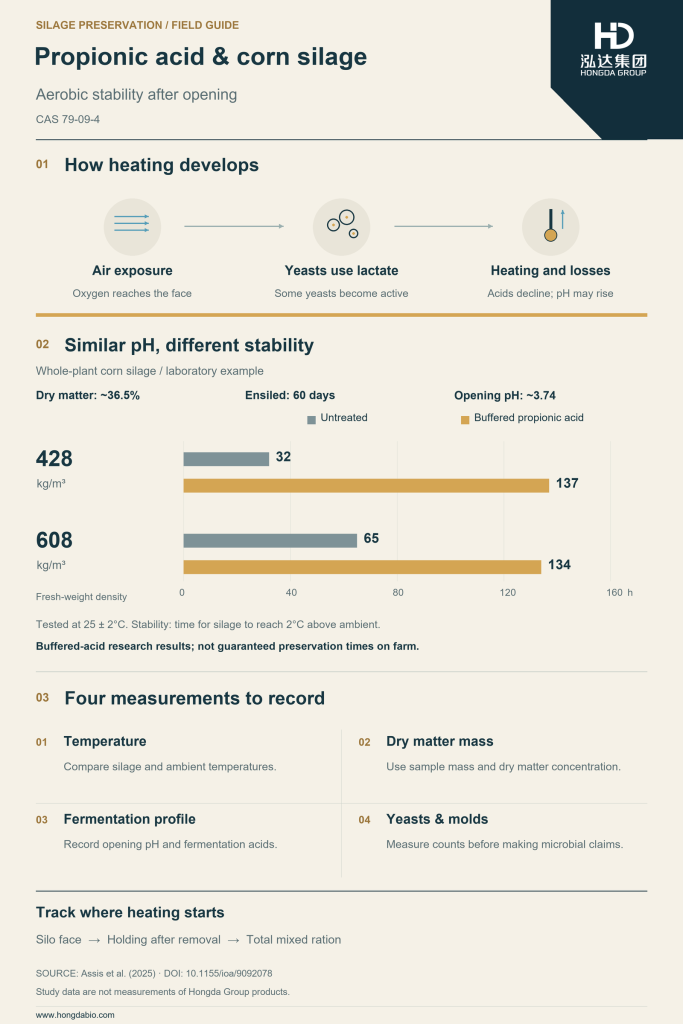
During sealed storage, oxygen depletion restricts the activity of many spoilage organisms. Once the silo is opened, air enters the exposed face. Some yeasts use lactic acid and other available nutrients, releasing heat. As organic acids are consumed and pH rises, conditions can become more favorable for other spoilage organisms.
Lactic acid helps silage acidify rapidly, but some yeasts can use it when oxygen is available. A high lactic acid concentration and low pH at opening therefore do not, by themselves, establish that silage will remain stable during feed-out.
An investigation should also consider how air reaches the feed. A loose silo face, removing too much plastic ahead of feeding, and leaving removed silage in a pile all increase exposure. University of Wisconsin Extension identifies air infiltration and feed-out practices as contributors to poor aerobic stability. Reference: Summer feed storage and feed bunk management.
The role of propionic acid in silage preservation
Propionic acid has the CAS number 79-09-4. Hongda Group’s propionic acid product page lists silage preservation among its applications, including inhibition of yeasts and molds and reduction of aerobic spoilage and nutrient losses after opening.
These uses suggest practical questions for evaluating a suitable propionic acid formulation: Does heating begin later after air exposure? Is less dry matter lost over the same exposure period?
Application timing and assessment timing should be distinguished. Some formulations are applied during silo filling, while their preservation effects are assessed after opening. Evidence of improved stability after opening does not establish that adding acid to silage that is already heating will produce the same result.
A corn silage trial: similar opening pH, different stability
An experiment with whole-plant corn at approximately 36.5% dry matter compared buffered propionic acid at two packing densities. Opening pH averaged approximately 3.74 across treatments:
| Packing density, fresh-weight basis | Untreated | Buffered propionic acid treatment |
|---|---|---|
| Approximately 428 kg/m³ | 32 hours | 137 hours |
| Approximately 608 kg/m³ | 65 hours | 134 hours |
Testing was at approximately 25 ± 2°C; stability meant time to reach 2°C above ambient. Treated silage also lost less dry matter during air exposure. Original study: Propionic Acid in the Fermentation and Conservation of Whole Plant Corn Silage at Two Packing Densities.
These results do not establish guaranteed farm preservation times or demonstrate that lower packing density is preferable.
Assess temperature alongside dry matter losses
Aerobic stability helps identify when heating begins, but it does not describe every aspect of silage quality. An assessment should also document the initial material, fermentation quality and losses.
Record silage temperature alongside ambient temperature. An isolated feed temperature makes it difficult to distinguish environmental warming from heat generated within the silage. When comparing treatments, keep sampling times, sample amounts and exposure conditions as consistent as possible.
Dry matter loss measures the loss of material after accounting for water. Comparing fresh weights alone can confuse water loss with the loss of feed solids. Two samples may lose similar fresh weights while differing in moisture loss and preservation of dry matter.
Useful records include:
| Measurement | What it helps establish |
|---|---|
| Dry matter content, pH and fermentation acid profile at opening | Whether the treatments start from comparable conditions |
| Silage temperature relative to ambient temperature | When heating begins, whether it persists and how treatments differ |
| Dry matter loss over the same exposure period | Whether longer stability is accompanied by less material loss |
| Yeast and mold counts | Whether microbial changes help explain the temperature and preservation results |
If only temperature has been measured, conclusions should remain limited to heating and stability. Claims about reductions in particular microorganisms require measurements of those organisms.
Identify where heating starts
Before changing a preservation program, record where and when heating appears. The pattern can help direct the investigation.
If the exposed silo face is already heating before removal, inspect cover integrity, face condition and exposure time. If freshly removed silage is relatively stable but heats during subsequent holding, record the holding period and environmental conditions. Consider whether the interval between removal and feeding can be shortened.
If silage remains relatively stable on its own but heats after incorporation into a total mixed ration, investigate other wet ingredients and residual feed in the bunk as well. Heating in the mixed ration cannot be attributed to the silage or its propionic acid treatment alone.
These observations also improve the interpretation of additive performance. Changing a formulation and substantially altering feed-out practices at the same time makes it difficult to establish how much each change contributed.
Applying the evidence to a silage project
Where corn silage repeatedly heats after opening or loses dry matter during exposure, a suitable propionic acid formulation may warrant evaluation alongside improvements to preservation and feed-out practices. Record formulation use, packing, sealing and feed-out conditions together so that the results can be interpreted.
For product information and supply inquiries, contact Hongda Group with details of the silage material, dry matter content and the stage at which heating occurs. Confirm the product’s suitability for the intended application and assess preservation performance under comparable on-farm conditions.