



Isobutyric acid can be used directly in cheese and fermented flavor formulations or as a starting material for fruity aroma compounds such as ethyl isobutyrate. In a flavor blend, the task is to balance its acidic notes with the overall aroma. In ester production, the focus shifts to conversion and the odor of the finished material.
2-Methylpropanoic acid is the systematic name for isobutyric acid, CAS 79-31-2. Its molecular formula is C₄H₈O₂, and its condensed structural formula is (CH₃)₂CHCOOH. The carboxyl group can undergo esterification and form salts, allowing the acid to serve as a starting material for several derivatives.
1. Cheese and fermented flavors: adding a distinctive acidic note
Cheese flavor includes more than a milky aroma. Acids and other volatile compounds associated with fermentation contribute to its character. Isobutyric acid supplies part of that acidic, cheesy character.
At an appropriate dilution, isobutyric acid can exhibit cheesy and sweet notes, making it useful in formulations such as cheese and butterscotch flavors. Formulators need to balance those characteristics against its sharp acidic odor. The appropriate proportion depends on the intended flavor profile.
For a cheese-flavored seasoning, one approach is to trial the acid within an existing dairy flavor base and assess whether it brings the fermented character closer to the target. If a higher level makes the sharp acid note dominate, the balance with the other ingredients needs adjustment. A level suited to a mild dairy profile may not suit a mature cheese flavor.
Here, “fermented” describes a sensory impression. Reproducing that impression with a flavor blend does not mean the food has undergone fermentation, nor does it establish nutritional, microbial or preservation benefits.
2. Bakery flavors: checking the balance with sweet and dairy notes
Bread, caramel and butterscotch flavors often combine sweet, dairy and acidic notes. Isobutyric acid can be one component of such a blend; its value depends on the change it makes to the complete flavor.
In a butterscotch formulation, for example, evaluation should consider both the overall sweet aroma and whether the acidic note becomes intrusive. An acceptable odor in a diluted ingredient sample may behave differently once incorporated into a food containing sugar and fat.
Bakery evaluation also needs to extend beyond the mixing stage. The aroma before baking can differ from that of the cooled finished product. A useful comparison is to process a control and trial samples from the same base recipe under identical conditions, then assess their aroma and aftertaste. This helps establish whether the acid contributes to the intended flavor after processing.
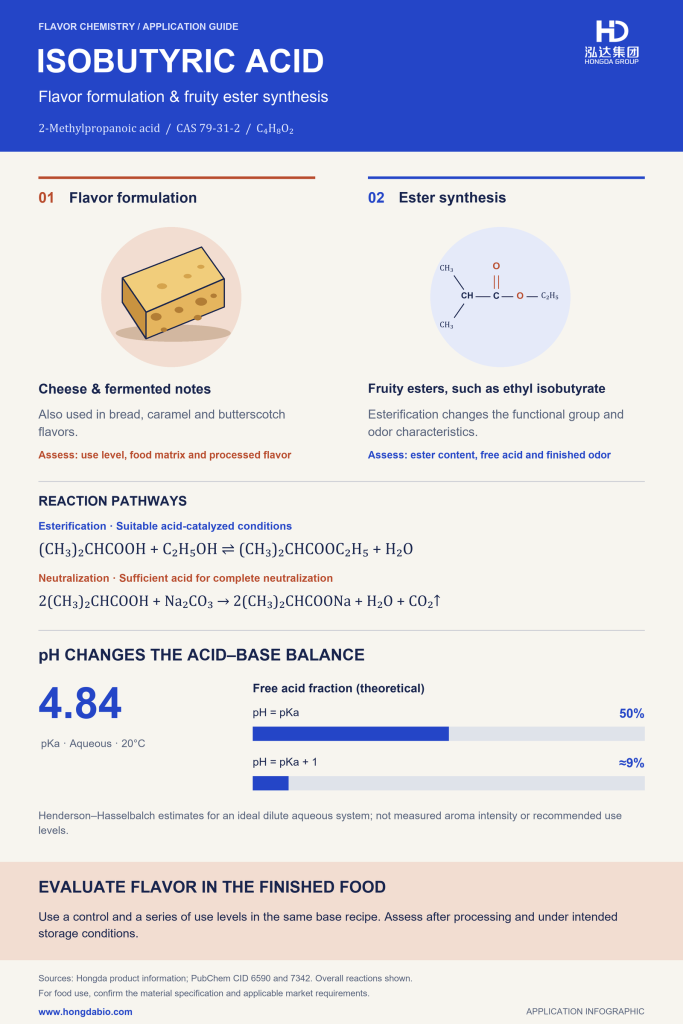
3. Fruity ester synthesis: ethyl isobutyrate as an example
Isobutyric acid is also a starting material for ester aroma compounds. Under suitable acid-catalyzed conditions, it can react with ethanol to produce ethyl isobutyrate and water. The overall reaction is:
(CH₃)₂CHCOOH + CH₃CH₂OH ⇌ (CH₃)₂CHCOOCH₂CH₃ + H₂O
Ethyl isobutyrate, CAS 97-62-1, has a fruity odor. The PubChem record for ethyl isobutyrate describes that odor and its structural relationship to isobutyric acid and ethanol.
Esterification converts the carboxylic acid group into an ester group, changing the molecule and its odor characteristics. Isobutyric acid supplies the acid-derived part of the ester, but adding the free acid to a formulation does not reproduce the effect of adding the corresponding ester.
The reaction is reversible. Process design therefore needs to account for catalysis, equilibrium and separation. Simply mixing the acid with ethanol does not deliver a finished flavor ingredient that meets a defined specification. The resulting material also needs assessment for ester content, residual free acid, residual alcohol and water. For flavor applications, odor evaluation should accompany chemical analysis.
If the finished ester has a noticeable acidic odor, residual free acid is one possible cause to investigate. Odor alone cannot establish the cause. Analytical findings and sensory observations need to be considered together when investigating reaction performance, separation or other impurities.
Ethyl isobutyrate and isobutyl acetate are different compounds. The former corresponds to isobutyric acid and ethanol; the latter to acetic acid and isobutanol. Checking the full chemical name helps prevent errors in formulation and raw material discussions.
4. What pKa and neutralization mean in practice
In water, isobutyric acid exists in equilibrium with its conjugate base, the isobutyrate ion. The PubChem record for isobutyric acid lists an aqueous pKa of approximately 4.84 at 20°C. With other conditions comparable, increasing pH increases the proportion present as isobutyrate.
Using the Henderson–Hasselbalch relationship under an ideal dilute aqueous approximation, the free acid and isobutyrate ion are present in a ratio of about 1:1 when pH equals pKa. At one pH unit above pKa, the free acid accounts for approximately 9% of their combined amount. These are theoretical acid–base estimates, not measurements of aroma intensity in food.
The distinction helps explain why the same total addition can behave differently at different pH values: the free acid fraction changes, which can affect aroma release. Fat, protein and other food components also influence aroma behavior, so pKa alone cannot establish an appropriate use level for a particular food.
When sufficient isobutyric acid is available to fully neutralize sodium carbonate, the products are sodium isobutyrate, water and carbon dioxide. The overall reaction is:
2(CH₃)₂CHCOOH + Na₂CO₃ → 2(CH₃)₂CHCOONa + H₂O + CO₂↑
This neutralization produces a salt. Esterification produces an ester. Neutralization cannot replace esterification when the objective is to make a fruity ester. If the objective is acidity adjustment, evaluation should also account for the resulting pH, the salt introduced and the final flavor.
5. Evaluate the application in the finished food
Start by defining the purpose: adding cheese or fermented notes to a flavor blend, or using the acid to synthesize an ester. Each requires a different evaluation approach.
For direct flavor formulation, a small series of use levels can be tested in the same base recipe alongside a control without the added acid. Records should distinguish the amount of diluted stock added from the actual isobutyric acid content in the finished food. Otherwise, differences in stock concentration can make comparisons misleading.
Evaluation should reflect the intended processing and serving conditions. A fat-containing food may present a different aroma balance from a water-based system, and processing can change the initial impression. Samples that perform well initially should also be assessed under the product’s intended storage conditions to check whether the acidic note, main aroma and aftertaste remain balanced.
For food-related applications, confirm the material specification and suitability for the intended use against the requirements of the target market. A general description of flavor applications does not establish the suitability of a particular supplied grade.
To discuss isobutyric acid for flavor formulation or ester synthesis, contact Hongda Group with details of the intended application, product format and process conditions so that material requirements can be discussed.
Frequently asked questions
1. Are 2-methylpropanoic acid and isobutyric acid the same substance?
Yes. Both names refer to the substance with CAS number 79-31-2 and condensed structural formula (CH₃)₂CHCOOH. The name and CAS number help confirm chemical identity; the specification and suitability for a particular application still need separate confirmation.
2. Why can a strongly smelling acid be used in cheese flavors?
Odor perception depends on concentration and the formulation. At an appropriate dilution, isobutyric acid can contribute cheesy and fermented notes alongside other flavor ingredients. Higher levels may make its sharp acidic odor dominant. Trials in the finished food are therefore more informative than judging the concentrated ingredient alone.
3. Can isobutyric acid replace ethyl isobutyrate in a fruity flavor?
They are not direct substitutes. Isobutyric acid is a carboxylic acid, while ethyl isobutyrate is an ester with a fruity odor. Their sensory roles differ. Adding the acid will not reproduce the ester’s contribution; converting the acid into the ester requires esterification and subsequent separation.