



When comparing niacinamide powder suppliers, the product name alone is not enough to make a purchasing decision. Buyers also need to know what the material is intended for, how much niacinamide it contains, and whether its quality documents match the shipment.
This guide focuses on feed-grade niacinamide for animal nutrition. It explains its nutritional role and the practical checks that help feed manufacturers assess a product before routine use.
Niacinamide, also known as nicotinamide, is a form of vitamin B3. It participates in the normal processes through which animals use carbohydrates, fats, and protein. It supplies a vitamin needed by those processes; it does not replace the energy or protein in a balanced diet. EFSA has assessed nicotinamide as an effective source of niacin in animal nutrition.
Its practical benefit is therefore linked to meeting nutritional requirements. The amount needed depends on the animal, its production stage, and the contribution from the rest of the feed. A diet that already provides enough vitamin B3 should not be assumed to deliver additional production benefits simply because more is added.
Feed-grade niacinamide can be used as an ingredient in vitamin premixes and formulated feeds. A vitamin premix combines small quantities of vitamins with other material to make them easier to distribute through a larger feed batch. Concentrated niacinamide powder and a prepared vitamin premix have different compositions, so their addition rates cannot be exchanged directly.
Hongda’s feed-grade niacinamide product page describes a white or nearly white crystalline powder that dissolves in water, supplied in 25 kg cartons. These details identify the product’s basic form. A purchasing decision should also use the current specification and the documents for the supplied batch.
The following checks provide a useful basis for comparing offers.
| What to compare | What the buyer should confirm |
|---|---|
| Product identity | The exact ingredient name, intended grade, and whether the material is a single ingredient or a blend |
| Niacinamide content | The declared content and the result recorded for the supplied batch |
| Quality requirements | The agreed limits for moisture, impurities, and any other required checks |
| Production suitability | Whether the powder can be weighed, transferred, and mixed reliably using the buyer’s equipment |
| Traceability | The manufacturer, batch number, production date, storage instructions, and shelf life |
A specification and a batch test report answer different questions. The specification states the requirements the product must meet. The batch report records the test results for an identified batch. During receiving checks, the batch number on the report should match the shipment label, and the results should meet the agreed specification.
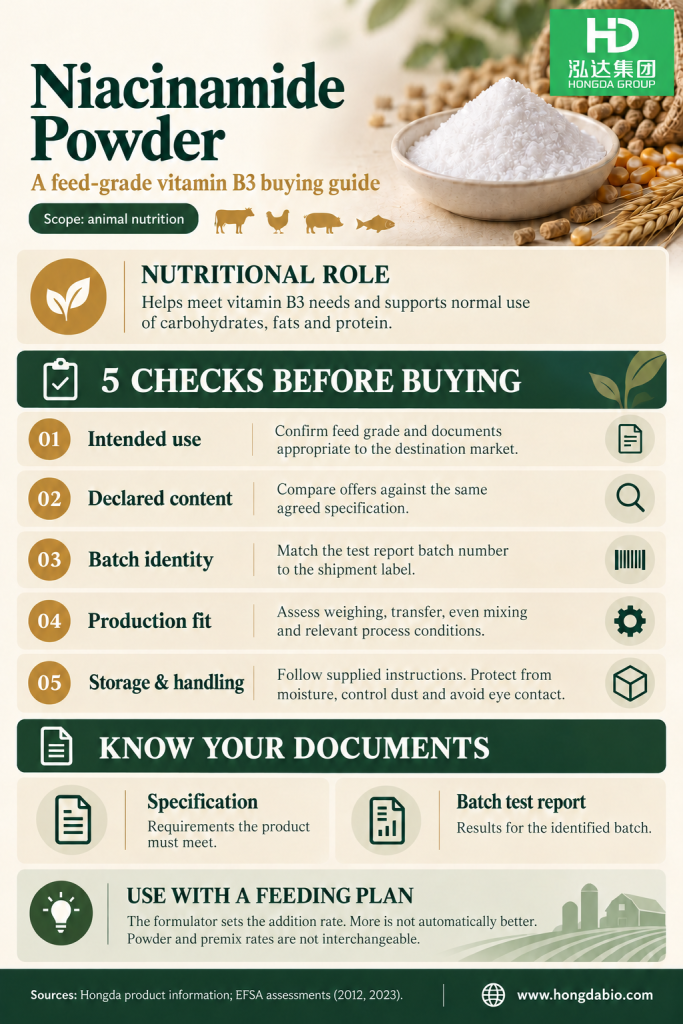
A high declared content is useful information, but it does not describe every aspect of product quality. Buyers still need to confirm suitability for the intended use, packaging condition, and the supporting documents. Offers are easier to compare when they are based on the same agreed requirements.
Grade should also be explicit. Niacinamide is used in several industries, and the ingredient name does not establish that one supplied product is suitable for every application. A material purchased for animal feed needs documentation appropriate to that use and the destination market.
Before changing a supplier or product, a sample assessment can help answer practical production questions. Does the material weigh accurately and transfer smoothly? Does it remain manageable under the proposed storage conditions? Can the mixing process distribute it evenly through the feed?
Where feed undergoes heating or extended storage, buyers should request relevant supporting information and assess the finished feed when necessary. Product behavior should be checked against the actual process rather than inferred from its appearance.
Water solubility also needs to be interpreted carefully. It describes a property of the ingredient, but does not by itself establish suitability for use through a farm’s drinking-water system. That application requires suitable instructions and a separately confirmed feeding plan.
The person responsible for feed formulation should determine the addition rate. The calculation needs to consider the animal’s requirements, the vitamin already supplied by other ingredients or premixes, and the content of the purchased product. Any change in product concentration should be reflected in the formulation.
Storage and handling should follow the supplied instructions. Keep opened packaging properly closed and protect the material from moisture and contamination. During powder handling, control dust and avoid eye contact. EFSA’s 2023 assessment of the niacinamide product evaluated in that application identified eye irritation and likely inhalation exposure as handling considerations.
For a more useful supplier enquiry, include the destination country, animal species, intended feed application, and expected order quantity. Buyers can contact Hongda Group to request the current specification, batch documentation, and supply information for evaluation.
FAQ
Can niacinamide and nicotinic acid be substituted directly?
Both provide vitamin B3, but they are different substances. Before changing ingredients, the person responsible for feed formulation should review the product content and formulation requirements.
Does niacinamide powder guarantee better animal growth?
No. Its nutritional purpose is to supply vitamin B3. Any benefit from additional supplementation needs to be evaluated against the existing diet and actual feeding conditions.
How can buyers check whether a product meets their requirements?
Compare the current specification with the report for the supplied batch. Confirm the ingredient name, declared content, and test results, then check that the batch number matches the shipment label.
How should niacinamide powder be stored?
Follow the supplied storage instructions and shelf life. Reseal opened packaging and protect it from moisture and contamination. Investigate damaged packaging or unusual changes in the material before use.