



Broiler feed needs to retain its quality through processing, transport, and storage. Damp ingredients, condensation inside feed bins, and extended storage can increase the risk of mold. When feed starts heating up, forming lumps, or developing a moldy smell, the cause needs investigation and the affected batch needs assessment.
Propionic acid is an organic acid used to help preserve feed by limiting mold growth. It can help reduce quality losses associated with mold during storage. Hongda Group’s propionic acid product page provides basic product information and describes its feed preservation application. Feed manufacturers and poultry businesses should also confirm the supplied product’s specifications and suitability for feed use in their market.
Propionic acid works by interfering with processes that mold cells need for normal growth. This makes it harder for mold to multiply in feed. However, different molds respond differently, and results also depend on the feed and its storage conditions.
For this reason, propionic acid is best considered as a preventive measure before feed becomes visibly moldy. Adding it to a batch that already contains visible mold does not establish that the feed is safe to use.
Mold and mycotoxins also need to be considered separately. Mycotoxins are harmful substances produced by certain molds, and they may already be present when ingredients arrive at the feed mill. Propionic acid can help control further mold growth, but it should not be treated as a product that removes existing toxins. Suspect ingredients and feed require appropriate sampling and testing; appearance and smell alone cannot establish safety.
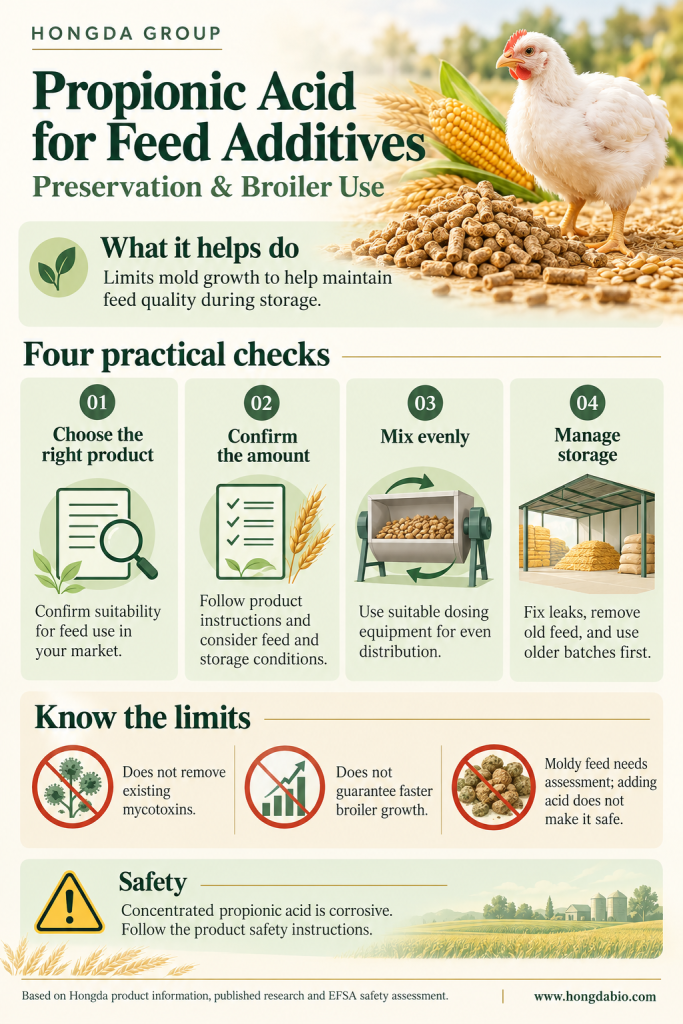
In broiler production, the first step is to identify the storage problem that needs attention. Ingredients transported over long distances and finished feed held for several days may face different conditions. Consider whether materials are likely to absorb moisture, whether storage areas become hot and humid, and how quickly each batch is normally used. A supplier’s application rate needs to be assessed against these actual conditions.
The amount to add depends on the specific product. Products can contain different amounts of propionic acid, so adding one kilogram of one product may not provide the same amount of acid as one kilogram of another. Follow the product instructions and have the person responsible for feed formulation confirm the rate against the ingredients and storage requirements. When changing products or suppliers, review the rate again.
Even mixing is equally important. Liquid propionic acid needs suitable dosing and application equipment so that it is distributed throughout the feed. Uneven treatment can leave some areas insufficiently protected. Before routine use, a small batch can be checked over the intended storage period for mold, heating, and lump formation, with testing where needed.
Broiler feed intake should be observed alongside feed quality. After introducing a new product, check whether birds continue eating normally and whether weight gain or feed consumption changes. If problems occur, review ingredient quality, mixing, and flock management together rather than attributing every change to the additive.
Feed preservation should not be presented as a guarantee of faster growth. In one broiler feeding trial, propionic acid supplied alone did not significantly change weight gain or feed intake. Preserving feed quality and improving bird performance therefore need separate evaluation.
Storage management remains part of the daily routine. Repair leaking bins, remove accumulated old feed, and use older batches first. During prolonged hot or humid weather, inspect bins and conveying equipment for places where moisture or feed can collect.
Handling also requires care. Concentrated propionic acid is corrosive. Storage containers, transfer equipment, and protective clothing should follow the product’s safety instructions, with measures to prevent direct skin and eye contact.
Before using propionic acid in broiler feed, tell the supplier about the feed type, intended storage period, and destination market. Obtain the product instructions, batch test report, and safety information before arranging an application trial. For Hongda product specifications and supply details, contact Hongda Group.