



Reducing soybean meal and adding individual amino acids changes the amino acid profile of a piglet diet. Meeting the lysine target does not establish that valine supply is also adequate.
The decision to supplement L-valine starts with the digestible valine supplied by the revised ingredient mix. That supply must be compared with the requirement for the relevant production stage before an inclusion rate can be calculated.
Feed-Grade L-Valine: Product Information
| Item | Information |
|---|---|
| Product name | L-Valine |
| CAS number | 72-18-4 |
| Molecular formula | C₅H₁₁NO₂ |
| Grade | Feed grade |
| Amino acid classification | Essential amino acid; branched-chain amino acid (BCAA) |
| Appearance | White crystals or crystalline powder |
| Purity stated on the product page | ≥98.5% |
| Standard listed on the product page | GB 7300.104-2022 |
| Packaging | 25 kg kraft paper bag |
| Main purpose | Supplementing dietary valine and adjusting amino acid supply |
Product specifications are taken from Hongda Group’s feed-grade L-valine product page. The page describes purity as “L-type purity” without specifying the analytical method or whether the result is reported on a dry-matter or as-fed basis. Formulation calculations should use the confirmed specification and batch test results.
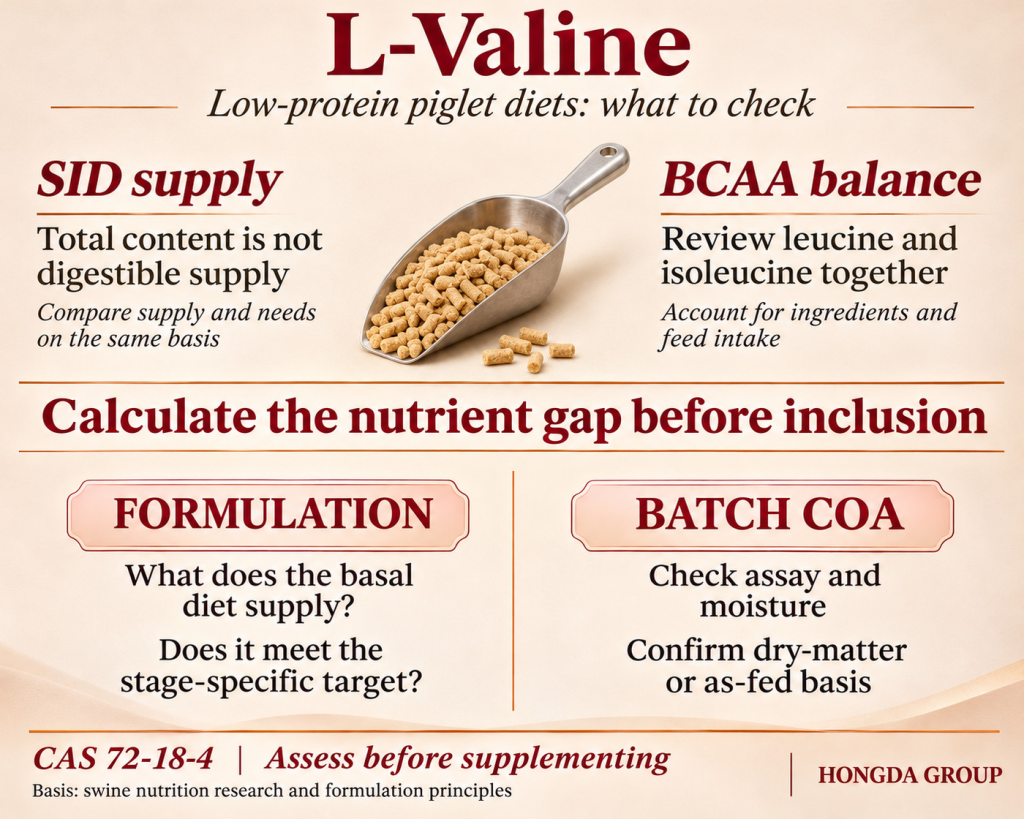
Why Recheck Valine When Soybean Meal Is Reduced?
Soybean meal supplies several amino acids at once. Reducing its inclusion changes the supply of lysine, valine, isoleucine and other amino acids, as well as the diet’s crude protein level. The contribution from replacement ingredients must then be recalculated.
Individual amino acids address specific gaps. Adding lysine does not also replace the valine removed with the protein ingredients.
After a formulation change, each digestible amino acid should be checked against its target. If valine supply falls short, the options include supplementing L-valine or changing the combination of protein ingredients.
Other essential amino acids and energy supply also need attention. Where several nutrients are inadequate, adding valine alone may not improve performance.
A lower crude protein value is therefore not sufficient reason to increase L-valine inclusion. The decision depends on the revised diet’s nutrient supply and the requirements of the pigs receiving it.
Total Valine and Digestible Valine Are Different Formulation Measures
A total valine assay helps describe an ingredient’s composition. Piglet formulation also requires an assessment of its digestible contribution.
Standardized ileal digestible amino acids, abbreviated as SID amino acids, are commonly used in pig nutrition research and formulation. Valine requirements are also frequently expressed relative to SID lysine. Nursery pig research has used this approach and shown that requirement estimates vary with the response measured and the statistical model applied. Research on SID valine-to-lysine ratios in nursery pigs
Supply and requirement must be compared within the same evaluation system. A total amino acid value should not be compared directly with an SID requirement.
Calculating SID supply generally requires ingredient amino acid concentrations together with appropriate digestibility data. A batch certificate of analysis, or COA, reporting amino acid content does not establish SID supply by itself.
The ratio is calculated as:
SID valine ÷ SID lysine × 100%
For illustration, suppose a diet contains 10.0 g/kg SID lysine and 6.8 g/kg SID valine:
6.8 ÷ 10.0 × 100% = 68%
These figures demonstrate the calculation only. They are not an actual formulation, Hongda trial results or a recommended feeding standard. The formulation target must be selected for the pigs’ body weight, production stage, ingredient composition and nutritional reference.
Daily intake also matters. Pigs consuming different amounts of a diet with the same nutrient concentration receive different quantities of valine. Feed intake should therefore be recorded alongside daily gain and feed conversion.
Why Assess Valine Alongside Leucine and Isoleucine?
Valine, leucine and isoleucine are the three branched-chain amino acids, or BCAAs. Their metabolism is connected, so the supply of one should not be assessed entirely in isolation.
A study in approximately 10–20 kg nursery pigs varied dietary leucine, isoleucine and valine. Growth responses to one BCAA depended on the levels of the other two. Research on BCAA interactions in nursery pigs
This is relevant when ingredients are replaced. If the new ingredient mix supplies more leucine, the relative supply of valine and isoleucine should be reviewed, even where valine still meets the original numerical target.
When an imbalance is identified, compare amino acid supplementation with changes to the ingredient mix. Nutrient supply, formulation cost and feeding results all contribute to that decision.
Converting a Nutrient Gap Into an Inclusion Rate
The formulation specifies a valine contribution, while the feed mill weighs a particular batch of ingredient. Before converting one into the other, check the calculation inputs.
| Calculation input | What to confirm |
|---|---|
| Dietary target | Production stage, nutritional reference and whether values are total or SID |
| Basal diet contribution | Valine already supplied by the ingredients |
| Supplement nutrient matrix | The valine contribution assigned in the formulation system and its basis |
| Batch assay and moisture | Test results and whether the assay is reported on a dry-matter or as-fed basis |
Calculate the deficit within one nutritional evaluation system, then convert it into an ingredient inclusion using the appropriate nutrient matrix and assay basis.
If an assay is reported on a dry-matter basis, account for moisture when converting it to an as-fed concentration. The measured assay and the digestible contribution used in formulation should be checked separately.
The purchased grade must also suit the intended application. A shared CAS number identifies the substance; it does not replace checks on specifications, quality documentation or requirements in the destination market.
Checking the Result After a Formulation Change
Accurate weighing and distribution matter when an ingredient is included at a small proportion of the complete feed.
Depending on the equipment and process, premixing or stepwise dilution may be appropriate before the ingredient enters the main mixer. Distribution should be assessed through a mixing-uniformity procedure suitable for the production line. A visually consistent powder does not demonstrate uniform distribution of minor ingredients.
Keep the complete formulations before and after the change, together with records of:
- Average daily feed intake, average daily gain and feed conversion;
- Initial body weight, evaluation period and animal health;
- Ingredient batches and actual addition records;
- Temperature, stocking density and other conditions that could affect results.
If protein sources, energy levels or housing conditions change at the same time, the full response cannot be attributed to L-valine.
Where supplementation does not produce the expected response, first confirm that the original diet was deficient in valine. Other nutritional factors and production steps should then be reviewed before increasing the inclusion rate.
An EFSA assessment of a specific fermentation-derived L-valine product identified it as an effective valine source for non-ruminant species and stressed supplementation according to the animals’ nutritional needs. This supports its nutritional role, but does not establish that adding it to any diet will improve growth or feed conversion. EFSA assessment of L-valine for animal nutrition
FAQ
1. What is feed-grade L-valine used for?
Feed-grade L-valine supplements dietary valine supply. When reducing soybean meal or other protein ingredients leaves a piglet diet below its digestible valine target, L-valine can help fill that gap. Inclusion should be calculated from the deficit, with leucine and isoleucine supply checked at the same time.
2. What type of amino acid is L-valine?
L-valine is an essential amino acid and one of the three branched-chain amino acids, alongside leucine and isoleucine. Each must be accounted for separately in formulation; one cannot replace the other two.
3. What is the CAS number of L-valine, and does it confirm feed grade?
The CAS number of L-valine is 72-18-4, and its molecular formula is C₅H₁₁NO₂. The CAS number identifies the substance but does not establish feed-grade suitability. Buyers should also review the applicable standard, product specification and batch test documentation for the intended feed application.