



When bread develops mold despite containing calcium propionate, the cause may lie in the formulation, cooling, slicing or packaging. Before increasing the addition rate, check the product’s pH and water activity, along with possible contamination after baking and condensation inside the package.
Calcium propionate is a preservative commonly used in bread and other baked goods. It helps control mold growth, but its application also needs to accommodate yeast fermentation, finished-product flavor and production conditions. These should be assessed together in a formulation trial.
Calcium propionate identity and published product specifications
| Item | Information |
|---|---|
| Product name | Calcium Propionate |
| Synonym | Calcium Propanoate |
| CAS number | 4075-81-4 |
| Chemical formula | C₆H₁₀CaO₄, also written as Ca(C₂H₅COO)₂ |
| Relative molecular mass | 186.22 |
| Food additive identifiers | E282; INS 282 |
| Hongda product name | Bio-based Calcium Propionate |
| Published appearance | White crystalline powder with a characteristic odor |
| Applicable standard listed by Hongda | GB 1886.356-2022 |
| Published packaging | 25 kg drums; 200 kg drums |
| Application discussed here | Mold control and formulation assessment in bread |
Chemical identity information is available in the JECFA calcium propionate specification. Appearance, packaging and the listed applicable standard come from Hongda Group’s bio-based calcium propionate product page.
Acceptance criteria such as assay and loss on drying should be checked against the product specification and batch test documentation. A listed raw-material standard does not replace the destination market’s requirements for food categories, conditions of use or labeling.
What does calcium propionate do in bread?
Calcium propionate is used in bread primarily to delay mold spoilage. JECFA also identifies its functions as a preservative, antimold agent and antirope agent.
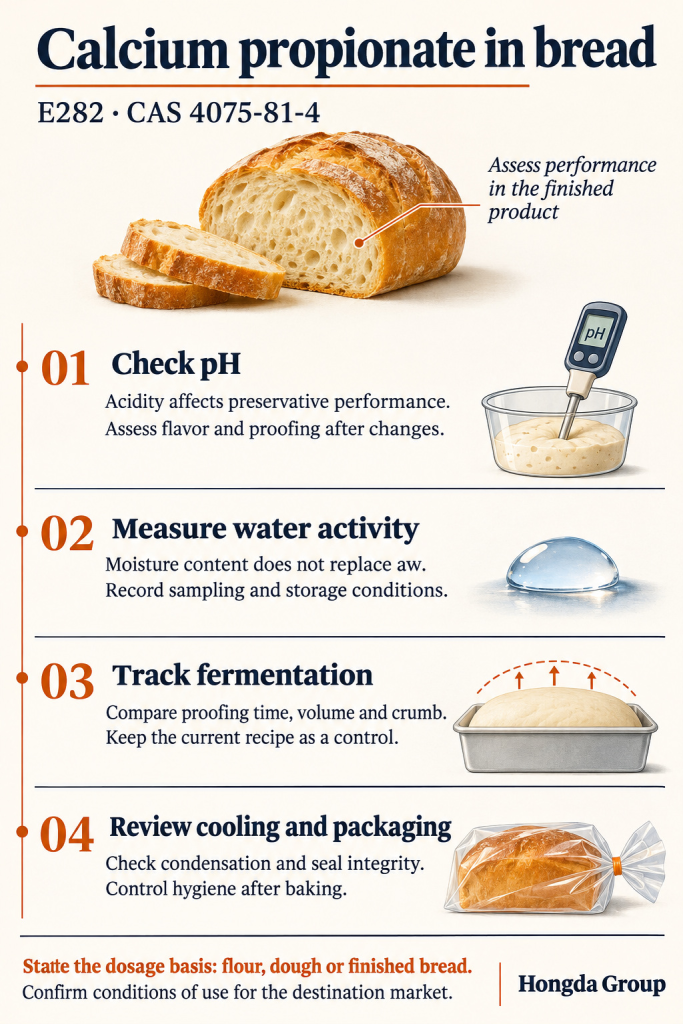
For a bakery, performance needs to be demonstrated in the finished product: does mold appear later under the intended packaging and storage conditions, while fermentation and eating quality remain acceptable?
Results do not transfer automatically between bread types. Sandwich loaves, sweet breads and filled products differ in composition, moisture distribution and processing. A formulation that works in one product needs testing before being adopted in another. Changes to cooling or packaging may also affect storage performance, even when the recipe stays the same.
Why can the same addition rate give different results?
pH affects preservative performance
Calcium propionate’s action in a food system is related to the acid–base equilibrium of propionic acid. Under otherwise comparable conditions, a lower pH generally increases the proportion of undissociated propionic acid. Its performance should therefore not be treated as independent of acidity.
A 2021 study of bread spoilage fungi found that preservative concentration, pH, water activity and temperature affected growth inhibition. The work used a culture system; it does not establish a finished-bread dosage or shelf life. Read the study.
Compare pH using consistent sampling and preparation methods. If acidity is adjusted, assess sourness and proofing behavior alongside mold development.
Moisture content and water activity measure different things
Moisture content measures how much water a product contains. Water activity, or aw, describes how available that water is within the system. One measurement cannot substitute for the other.
A storage comparison based only on moisture content can miss relevant differences. Dissolved ingredients such as sugar and salt affect water availability, while filled or multicomponent products may have local variations. Record where samples were taken so that results from different parts of the product are not treated as equivalent.
Storage temperature also needs to remain consistent when comparing treatments.
Why should a mold-control trial include fermentation measurements?
A calcium propionate treatment becomes part of the dough formulation. Its compatibility with yeast fermentation therefore needs checking.
A study of South African brown bread assessed preservative combinations containing calcium propionate and measured both spoilage control and yeast activity. Treatments produced different outcomes, supporting the need to evaluate fermentation alongside preservation. Study abstract.
For an initial comparison, keep flour, yeast, water addition and proofing conditions consistent. Record the time required to reach the same proofing endpoint, then assess baked volume, crumb structure and flavor.
A treatment that delays mold but also slows proofing or reduces loaf volume may require further adjustment. Storage duration alone does not show whether the formulation suits the production line.
State the calculation basis for every addition rate
An instruction such as “add 0.2%” is incomplete without a calculation basis. Flour weight, total dough weight and finished-product weight produce different addition quantities.
Use a consistent recording method:
Addition rate (%) = mass of calcium propionate added ÷ mass of the stated calculation basis × 100
This is a formulation-recording equation. Regulatory limits may use a different basis, such as finished-food weight or a propionic acid equivalent. Calculate compliance using the applicable rule rather than assuming the production percentage is directly comparable.
The following information belongs in the same trial record:
| Trial item | What to record |
|---|---|
| Ingredient addition | Actual mass, raw-material batch and addition method |
| Calculation basis | Flour, total dough or finished-product weight |
| Formulation conditions | Yeast, acidity-adjusting ingredients and other preservatives |
| Fermentation | Dough temperature, proofing time and endpoint |
| Finished-product testing | pH, aw, sampling location and test method |
| Storage assessment | Packaging, storage temperature, observation period and mold development |
During initial screening, limit the number of conditions changed at once and retain the current formulation as a control. Check the selected treatment across separate production batches before treating a single trial result as reliable production performance.
Cooling and packaging affect mold control too
Packaging bread while its interior is still too warm can cause moisture to condense inside the wrapper. Localized dampness can increase the risk of mold. ASHRAE’s bakery guidance links bread cooling and reduced wrapper condensation with mold control. ASHRAE technical guidance.
When mold develops, review the process after baking: cooling uniformity, slicer and conveyor hygiene, condensation at packing, and seal integrity.
If a treatment performs well in a laboratory trial but gives inconsistent production results, compare the cooling and packaging conditions in both settings. Preservative addition cannot replace hygiene control at these stages.
Shelf-life validation should also reflect the product’s expected transport and storage conditions. Absence of visible mold is one assessment criterion; it does not establish overall product quality or safety.
What should buyers confirm before ordering?
The supplied specification should match the ingredient used in formulation trials. Before comparing quotations, confirm the grade, assay and reporting basis, packaging, and availability of the quality documents required for the project.
Hongda lists its product as bio-based calcium propionate. “Bio-based” concerns the raw-material source; the term alone does not demonstrate stronger mold inhibition. Suitability for a production line still depends on the product specification and finished-product trials.
To discuss specifications or bread application conditions, contact Hongda Group with the bread type, destination market, processing conditions and packaging format.
Frequently asked questions
1. Is calcium propionate the same as E282?
Yes. E282 identifies calcium propionate, which also has the INS number 282. The identifier does not establish permission for use in every food category or mean that requirements are identical across markets.
2. Is calcium propionate safe?
Safety needs to be considered in relation to the intended use and use level. In its 2014 re-evaluation of propionic acid and propionates, EFSA concluded that their maximum permitted concentrations in food did not raise a safety concern under the uses and levels authorized at that time. EFSA assessment.
That conclusion does not permit unrestricted addition. Check the destination market’s current food categories, conditions of use and labeling requirements for the finished product.
3. How should calcium propionate prices be compared?
Confirm that quotations cover equivalent specifications before comparing prices. State the grade, assay and reporting basis, packaging, order quantity and delivery terms.
If a bio-based sourcing declaration is required, include it in the inquiry. The specification approved during formulation trials should also match the specification supplied in bulk orders.