



Descriptions of 2-methyl-1-butanol vary. Some sources emphasize cooked or fruity notes, while others mention malty, alcoholic or solvent-like characteristics. For a formulator working on spirit-inspired flavors, these distinctions are more useful than a broad description such as “fruity.”
2-Methyl-1-butanol, also known as active amyl alcohol, has the CAS number 137-32-6. Hongda Group lists it among its flavor ingredients, with applications in alcoholic, fruity and fermented flavor profiles.
Selecting it involves a practical question: does it bring the formulation closer to the intended flavor, or does the alcoholic note become intrusive? That needs to be assessed in the formulation itself.
Why do sources describe both roasted and solvent-like notes?
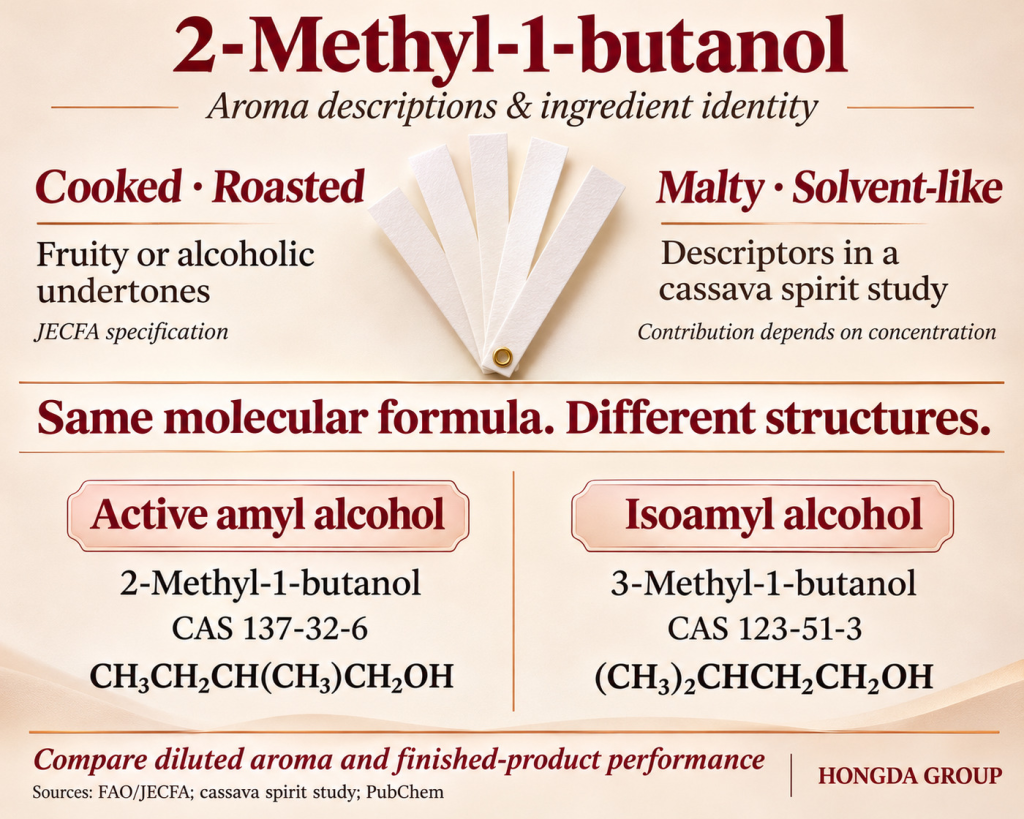
The FAO/JECFA flavoring specification describes 2-methyl-1-butanol as a clear, colorless liquid with a cooked, roasted aroma and fruity or alcoholic undertones. It also lists active amyl alcohol as a synonym.JECFA flavoring specification
A study of cassava-based distilled spirits detected 2-methyl-1-butanol through chromatographic analysis. Its table of volatile compounds lists malty and solvent descriptors for this substance.Original research
These sources serve different purposes. The flavoring specification describes the ingredient’s odor, while the spirit study discusses it within an analysis of beverage volatiles. Different wording does not necessarily make either source incorrect, nor does it mean every descriptor will be apparent in a particular finished product.
Detection also needs to be distinguished from sensory contribution. Finding a compound by chromatography establishes its presence. Assessing its contribution to the overall aroma requires consideration of concentration, perception thresholds and the effects of other components. The cited study was not a dose-response trial in which 2-methyl-1-butanol was added progressively to a flavor formulation, so its measured concentrations should not be adopted as formulation dosages.
For development work, these descriptions identify what to examine: whether cooked and alcoholic notes suit the target, and whether a solvent-like impression becomes prominent.
Does the alcoholic note suit the intended flavor?
Whiskey-inspired, rum-inspired and delicate fruit flavors have different requirements. An ingredient that works in one formulation may be unsuitable in another.
Hongda Group’s 2-methyl-1-butanol product information lists whiskey, rum, yeast and fermented flavor applications. These are starting points for trials rather than predetermined finished-product results.
For example, when developing a rum-flavored baked product, a formulator can vary the level of 2-methyl-1-butanol within a fixed base flavor, compare the cooked and alcoholic notes, and then prepare food samples under matching conditions. If the alcoholic note is suitable in the flavor sample but an unwanted note remains after baking, the adjustment should follow the finished-product result.
The receiving food system matters when using an alcoholic carrier. JECFA lists the ingredient as soluble in ethanol and having low water solubility. Dissolution in an alcoholic carrier does not remove the need to check solubility and dispersion after transfer into an aqueous formulation. Trials should reflect the intended concentration, carrier ratio and other ingredients.
Records should distinguish the ingredient’s proportion in the flavor from the flavor’s addition rate in food. Both are needed to establish the actual level in the finished product.
Active amyl alcohol and isoamyl alcohol have different structures
Active amyl alcohol and isoamyl alcohol have similar names and share the molecular formula C₅H₁₂O, but they are different substances.
| Item | Active amyl alcohol | Isoamyl alcohol |
|---|---|---|
| Chemical name | 2-Methyl-1-butanol | 3-Methyl-1-butanol |
| CAS number | 137-32-6 | 123-51-3 |
| Condensed structural formula | CH₃CH₂CH(CH₃)CH₂OH | (CH₃)₂CHCH₂CH₂OH |
The identity and structure of isoamyl alcohol can be checked against its PubChem record.
The difference is the position of the methyl branch. In 2-methyl-1-butanol, numbering starts at the hydroxyl-bearing end: the hydroxyl group is at carbon 1 and the methyl branch is at carbon 2. A skeletal formula omits some carbon and hydrogen labels but must preserve this connectivity.
This matters in purchasing and formulation records. “Amyl alcohol” alone is not sufficiently precise, and neither molecular formula nor molar mass distinguishes these two compounds. Before changing ingredients, confirm the identity and compare both diluted odor and finished-product performance.
The word “active” also needs care. Carbon 2 in 2-methyl-1-butanol is attached to four different groups, creating one stereogenic center and allowing R and S enantiomers. The common name does not establish the enantiomeric composition of a supplied product; the JECFA entry itself uses the designation “(±).”
If stereochemical composition matters to a project, specify it separately and use an appropriate chiral analytical method. A conventional assay does not establish the enantiomeric ratio. NMR under ordinary achiral conditions generally cannot determine that ratio on its own either.
How should ingredient consistency be assessed?
Correct identity is the starting point. Repeat purchasing also requires a way to compare new batches with the approved material.
A useful approach is to retain an approved reference sample, compare new samples under the same dilution conditions, and review the batch certificate of analysis alongside the odor assessment. If the odor changes, check sample preparation, carrier and evaluation conditions before deciding what further analysis is needed. Odor alone cannot identify or quantify an impurity.
The origin of analytical documents also matters. Published NMR, infrared or chromatographic reference data can help establish what a substance is. Results for the supplied batch relate to the material actually received.
For food flavor projects, confirm suitability for the intended use and target market. The occurrence of a compound in food does not prove that a commercial product is naturally sourced. A published flavoring specification likewise does not establish the quality of a particular supplied batch.
The SDS provides hazard, handling and storage information. The certificate of analysis reports batch test results. Review both against the product name, CAS number and actual supply information.
For 2-methyl-1-butanol, ingredient selection is best supported by an identified sample, traceable batch documents and evaluation in the intended formulation. Providing the target flavor, food matrix and processing conditions when requesting samples makes the technical discussion more specific.
Frequently asked questions
1. What is the CAS number of 2-methyl-1-butanol?
Its CAS number is 137-32-6. It is also known as active amyl alcohol. Record the full chemical name and CAS number together in purchasing and formulation documents.
2. Can isoamyl alcohol replace active amyl alcohol in a formulation?
Do not assume a direct replacement at the same level. Active amyl alcohol is 2-methyl-1-butanol, while isoamyl alcohol generally refers to 3-methyl-1-butanol, CAS 123-51-3. Compare diluted odor and repeat trials in the intended food before approving a substitution.
3. Where can I obtain a 2-methyl-1-butanol SDS?
Request the latest SDS for the purchased product from the actual supplier. Check the chemical name, CAS number and supplier details. Suitability for food flavor use and batch quality require the corresponding specification and analytical documents as well.