



L-tryptophan, commonly abbreviated as Trp, is an essential amino acid in animal nutrition. In feed formulation, its main purpose is to fill a shortfall in the tryptophan supplied by the basal diet.
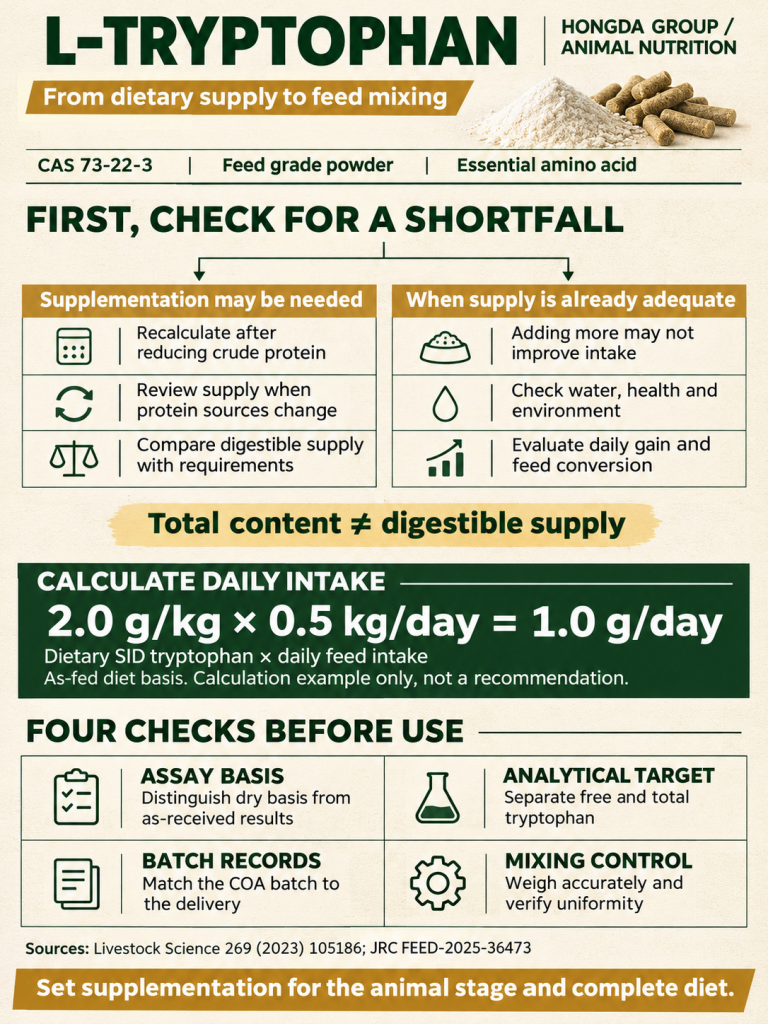
Whether supplementation is needed depends on ingredient composition and animal requirements. Reducing crude protein, changing protein sources or moving to another production stage can change the amount of tryptophan the diet provides. The supplementation rate should then be recalculated.
Adding more tryptophan to a diet that already meets requirements does not necessarily improve feed intake or daily gain. Product assay matters, but so does the diet in which the ingredient will be used.
L-Tryptophan Product Information
| Item | Product information |
|---|---|
| Product name | L-Tryptophan |
| Common abbreviation | Trp |
| CAS number | 73-22-3 |
| Molecular formula | C₁₁H₁₂N₂O₂ |
| Product category | Amino acid ingredient for animal nutrition |
| Appearance | White to yellowish-white crystals or crystalline powder |
| Standard listed on the product page | GB/T 25735-2010 |
| Packaging listed on the product page | 25 kg kraft paper bag |
| Assay and other quality parameters | Subject to the agreed specification and batch-specific certificate of analysis |
The appearance, standard and packaging above are based on Hongda’s published product information. Requirements for an individual order should be confirmed in the purchasing documents.
Why Can Inadequate Tryptophan Affect Growth?
Animals need several amino acids to synthesize body protein. If one essential amino acid is undersupplied, an adequate supply of the others cannot fully compensate.
Inadequate tryptophan can also be accompanied by reduced feed intake. A piglet study found that lower intake was an important cause of growth depression under tryptophan-deficient conditions. That finding relates to the deficient diets tested; it does not mean that all piglets will eat more when given additional tryptophan. Research on tryptophan requirements in piglets
Crude protein alone is therefore insufficient for assessing tryptophan supply. Diets with similar crude protein levels can differ in tryptophan content and digestibility because their protein sources differ.
When feed intake falls, water supply, temperature, health, palatability and feed transitions also need investigation. Low intake by itself does not establish a tryptophan deficiency.
What Should Be Recalculated When a Low-Protein Diet Changes?
Reducing dietary crude protein usually involves changes to protein ingredients. Those changes affect the supply of individual essential amino acids as well as total protein.
L-tryptophan can fill a tryptophan shortfall, but it cannot replace an assessment of the complete diet. Lysine, threonine, sulfur-containing amino acids and other essential amino acids still need to be evaluated.
Distinguish Total Content from Digestible Supply
Total tryptophan in an ingredient analysis describes its composition. Formulation also needs to account for how much the animal can digest.
Pig diets are commonly formulated using standardized ileal digestible amino acids, abbreviated as SID. If requirements are expressed on an SID basis, supply should be assessed on the same basis. Total tryptophan values should not be compared directly with SID requirements.
Ingredient databases, laboratory results and nutrient recommendations need consistent units and evaluation bases before they are used together.
Account for Daily Feed Intake
The same dietary concentration can provide different daily amounts when feed intake differs.
For example, suppose a diet contains 2.0 g of SID tryptophan per kilogram on an as-fed basis, and an animal consumes 0.5 kg of that diet daily. Calculated daily SID tryptophan intake would be:
2.0 g/kg × 0.5 kg/day = 1.0 g/day
These figures illustrate the calculation only. They are not a recommended requirement for a particular production stage. Formulation targets should reflect species, body weight, production stage and the nutrient recommendations being used.
Review Supplementation When Ingredients Change
Reducing soybean meal, introducing another protein source or changing cereal proportions can alter tryptophan supply.
After an ingredient change, recalculate the digestible tryptophan provided by the basal diet before deciding on supplementation. An unchanged crude protein value does not establish that tryptophan supply is unchanged.
Does Supplementing L-Tryptophan Always Increase Feed Intake?
It does not.
Tryptophan participates in protein synthesis and is a precursor of metabolites such as serotonin. These metabolic roles alone do not demonstrate that a particular inclusion rate will improve animal performance.
A trial published in 2023 tested additional tryptophan, threonine or both at 20% above Danish nutrient recommendations in weaned piglets. Under the conditions tested, average daily feed intake and average daily gain did not differ significantly among dietary treatments. Study of additional tryptophan and threonine in weaned piglets
Correcting an inadequate supply and adding more to an already adequate diet can therefore produce different results.
A practical evaluation should consider several measurements together:
| Assessment area | What to examine |
|---|---|
| Basal diet | Whether tryptophan was undersupplied before supplementation and whether other amino acids met requirements |
| Feed intake | Changes in intake and any concurrent feed transitions, illness or environmental changes |
| Growth | Changes in average daily gain and whether they persist |
| Feed utilization | Changes in feed conversion ratio alongside intake and growth |
| Economics | Whether production returns justify the additional ingredient cost |
Starting weight, observation period and housing conditions should also be recorded. When several factors change at once, final weight gain alone cannot establish the effect of tryptophan.
Claims concerning stress, immunity or gut health likewise need evidence tied to defined conditions and measurements. They should not be presented as guaranteed effects across all products and diets.
How Should Buyers Read an L-Tryptophan Powder Assay or COA?
“L-tryptophan powder” describes physical form. A product name or photograph does not establish its grade or show that it can replace another product directly.
First confirm that the material is suitable for the intended feed application. Then compare agreed quality parameters, including how assay results are expressed.
Keep Dry-Basis and As-Received Results Separate
A dry-basis result is expressed relative to dry matter. An as-received result relates to the sample in the condition received. Values reported on different bases should not be compared directly.
Feed dosing uses the actual mass of product added. If assay is reported on a dry basis, use the relevant analytical definition and supporting data to convert it to the basis required for formulation.
Price comparisons should follow the same approach. Comparing cost per tonne without accounting for the amount of active ingredient can misrepresent purchasing cost.
Choose Free or Total Tryptophan According to the Analytical Purpose
An L-tryptophan additive, a premix and a compound feed have different compositions and may require different analytical measurements.
Free tryptophan excludes the fraction still bound in protein. Total tryptophan includes both free and protein-bound forms. A European Union Reference Laboratory assessment distinguishes the analytical scope and sample applications of methods used for these measurements. European Commission Joint Research Centre assessment of tryptophan methods
Before commissioning a test, identify the sample type and the measurement required. Confirm that the laboratory method is appropriate. Results for different analytical targets cannot be used interchangeably to judge dosing accuracy.
Match Batch Documentation to the Delivery
The product name, batch number and test parameters on the certificate of analysis should correspond to the delivery label and purchasing specification. A general sample COA may describe a product, but it does not replace documentation for the delivered batch.
For powders, receiving checks can also record caking, packaging integrity and handling behavior. These observations do not replace chemical analysis, but they can help identify storage, transport or handling problems.
Assay Compliance Does Not Replace Mixing Control
When a small quantity of an amino acid ingredient is incorporated into a large feed batch, weighing errors and uneven distribution can affect the amount delivered.
The need for premixing, choice of carrier and addition sequence should reflect the inclusion rate, equipment capability and validated manufacturing procedure. Differences in particle size, density and flow should also be considered when checking mixing performance.
The tryptophan concentration calculated in a formulation must be carried through to finished feed by accurate weighing and uniform mixing. If performance differs from expectations, review actual addition and mixing records alongside the formulation before attributing the result to the ingredient.
Frequently Asked Questions
What Is L-Tryptophan?
L-tryptophan is an essential amino acid used in animal nutrition. Its common abbreviation is Trp, and its CAS number is 73-22-3.
Is L-Tryptophan Powder Always Feed Grade?
No. “Powder” describes physical form only. Feed suitability must be established through the intended-use designation, quality specification and applicable documentation.
What Does L-Tryptophan Do in Feed?
It supplements an inadequate dietary tryptophan supply and supports normal protein synthesis and related metabolism. Effects on feed intake or growth depend on the basal diet and other nutritional and management conditions.
How Much L-Tryptophan Should Be Added per Tonne of Feed?
There is no single rate suitable for every formulation. Establish animal requirements, calculate the digestible tryptophan supplied by the basal diet and determine the supplement needed using the product’s actual assay. Units, assay basis and nutrient evaluation system must be consistent.
Can L-Tryptophan Replace Soybean Meal Completely?
No. Soybean meal provides several amino acids and other nutrients. L-tryptophan supplies only the tryptophan component. Reducing protein ingredients requires a reassessment of the complete diet.
Can Feed-Grade L-Tryptophan Be Used in Human Supplements?
The same chemical name does not establish suitability for another application. Feed and human supplement uses may have different quality and regulatory requirements. Feed-grade material should be used for its confirmed purpose; human supplement directions or serving sizes should not be applied to it.
For bulk specifications, a batch COA or a sample of feed-grade L-tryptophan (CAS 73-22-3), contact Hongda Group with your intended application and estimated order volume.