



Sodium hyaluronate (CAS 9067-32-7) is the sodium salt of hyaluronic acid and is used as a humectant in products such as serums and creams. Two samples can share the same ingredient name and CAS number yet behave differently in a formula. One serum may release cleanly from a dropper while the other leaves a thread. Start by checking each sample’s molecular weight and how its viscosity was measured.
| Item | Product information and what to check |
|---|---|
| Product | Cosmetic-grade sodium hyaluronate |
| CAS number | 9067-32-7 |
| Appearance | White or nearly white powder or granules |
| Water solubility | Soluble in water, forming a clear solution |
| Listed standard | QB/T 4576-2023 |
| Packaging | 1 kg bags, 20 kg bags or 20 kg drums |
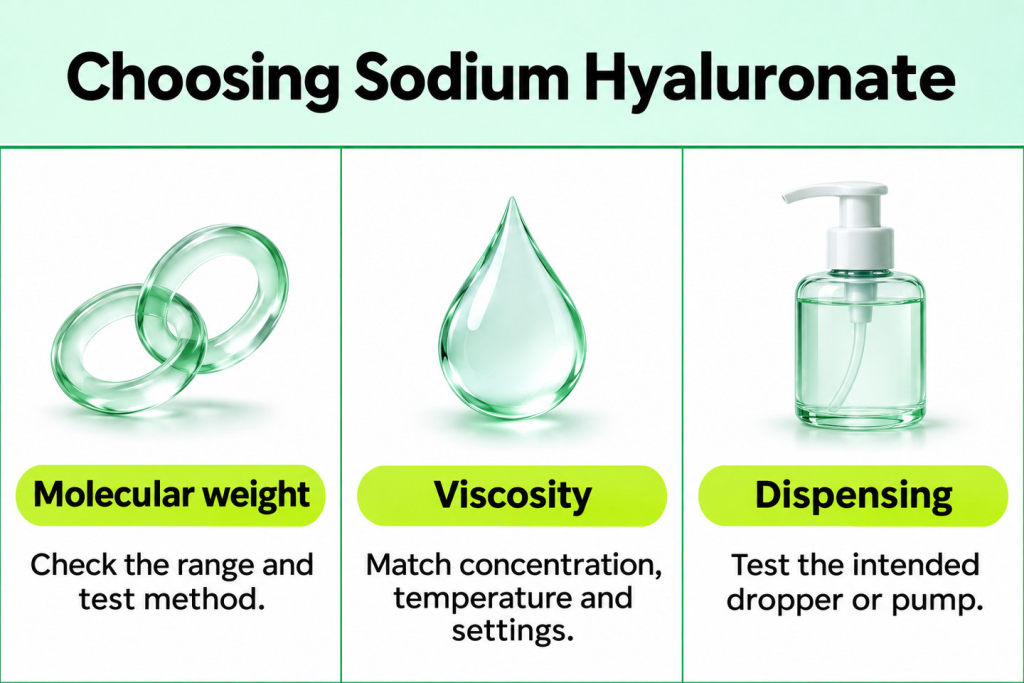
| Molecular weight | Check the range, type of average and test method in the specification for the selected grade. |
| Viscosity | Check the type of viscosity and its unit. For solution viscosity, verify the concentration, test temperature and instrument settings. |
The appearance, solubility, standard and packaging are listed on Hongda’s Cosmetic Grade Sodium Hyaluronate product page. Confirm molecular weight and viscosity against the specification for the selected grade and the corresponding batch documents.
Does Sodium Hyaluronate Have a Fixed Molecular Weight?
No. Sodium hyaluronate is a polymer, and one batch can contain chains of different lengths. A specification typically gives an average molecular weight or an acceptance range for that value, expressed in daltons (Da) or kilodaltons (kDa).
Two suppliers can describe their grades as “high molecular weight” and still specify different ranges. Check which average each supplier reports. Weight-average molecular weight and viscosity-average molecular weight are different ways of averaging a distribution of polymer chain sizes. Even when the units match and the values are close, confirm the type of average and the test method before comparing them.
One study used pharmaceutical-grade hyaluronan samples spanning 60–2,500 kDa. When the researchers tested aqueous solutions at different concentrations, they found that both molecular weight and concentration affected viscosity. That range describes the study samples. It does not define cosmetic-grade molecular weight categories or Hongda’s supply specifications. Study on molecular weight, concentration and hyaluronan viscosity
Sodium Hyaluronate vs. Hyaluronic Acid: What’s the Difference?
Sodium hyaluronate is the sodium salt of hyaluronic acid. You may also see Hydrolyzed Sodium Hyaluronate on a data sheet or an ingredient list. It has a distinct ingredient name. When checking a formula or label, use the name documented for the material; “hyaluronic acid” is often used broadly and may not tell you which form was supplied. Cosmetic Ingredient Review: Assessment of hyaluronates as used in cosmetics
Can You Compare Viscosity Values From Two Suppliers?
First check what was measured. Intrinsic viscosity, often reported in dL/g, characterizes a polymer’s viscosity behavior in dilute solution. Dynamic or apparent viscosity, which can be reported in mPa·s, describes a solution’s resistance to flow under specified conditions. These values describe different properties and cannot be compared directly.
If both reports give solution viscosity, check the concentration, test temperature and instrument settings. For a rotational viscometer, check the spindle and speed as well. A more concentrated solution can give a higher reading, so the higher number alone does not tell you which sample has the greater molecular weight.
A viscosity reading in water is useful for screening samples. After incorporating the ingredient into a serum or cream, measure the finished formula and check how it dispenses from the intended package.
How to Choose a Grade for a Serum or Cream
Start with how the product needs to dispense. A dropper serum should draw up easily and release cleanly. A pump cream should dispense consistently over repeated presses. A formula can look right in a beaker and still be awkward to dispense once it is packaged.
| What you see in the trial | What to check first | How to compare samples |
|---|---|---|
| The serum is hard to dispense or leaves a thread at the dropper tip. | Molecular weight range and viscosity measured under comparable conditions | Keep the use level and the rest of the formula constant. Use the intended dropper to check how easily the serum draws up, whether it releases cleanly and whether it leaves a thread. |
| The cream dispenses differently after a change of supplier. | Molecular weight reporting, viscosity test conditions and batch results for both grades | Use the same emulsion base and process. Measure finished product viscosity, then test dispensing with the actual pump. |
| Two samples disperse differently in water. | Raw material form, addition method and hydration | Use the same addition and hydration conditions. Measure viscosity after both samples have fully hydrated. |
Where possible, change only the sodium hyaluronate sample in the first trial. If you also change the use level, mixing method or another thickener, it becomes harder to tell what caused the difference.
What to Check Before Ordering a Production Batch
Keep the sample ID, trial results and acceptance criteria together. Before ordering, confirm the molecular weight range, viscosity requirement and test methods for the selected grade. When the shipment arrives, match the lot number on the packaging to the certificate of analysis (COA), then compare the results with the agreed specification.
If the COA lists a viscosity result without the test conditions, check the agreed specification. When switching suppliers, confirm that both reports use comparable methods. A change in the reading may come from the test method itself.
Frequently Asked Questions
Is a higher molecular weight always better for a serum?
No. Choose based on how the finished serum needs to flow, feel and dispense. For a dropper serum, compare how easily it draws up, whether the drops release cleanly and how much stringing you see.
Can you determine molecular weight from viscosity alone?
A single solution viscosity reading is not enough. Concentration, temperature and instrument settings can all affect the result. If molecular weight is an acceptance criterion, agree on its range and test method separately.
Is low molecular weight sodium hyaluronate the same as hydrolyzed sodium hyaluronate?
Not necessarily. “Low molecular weight” describes a size range, while “Hydrolyzed Sodium Hyaluronate” is a specific ingredient name. Use the supplier’s ingredient documentation when reviewing the formula or label.
Can food-grade and cosmetic-grade sodium hyaluronate be used interchangeably?
A shared ingredient name or CAS number does not establish that the grades are interchangeable. Check the specification, acceptance criteria and applicable requirements for the intended use. If you are evaluating a switch between Food Grade Sodium Hyaluronate and a cosmetic grade, verify dissolution, viscosity and dispensing in the finished formula.