



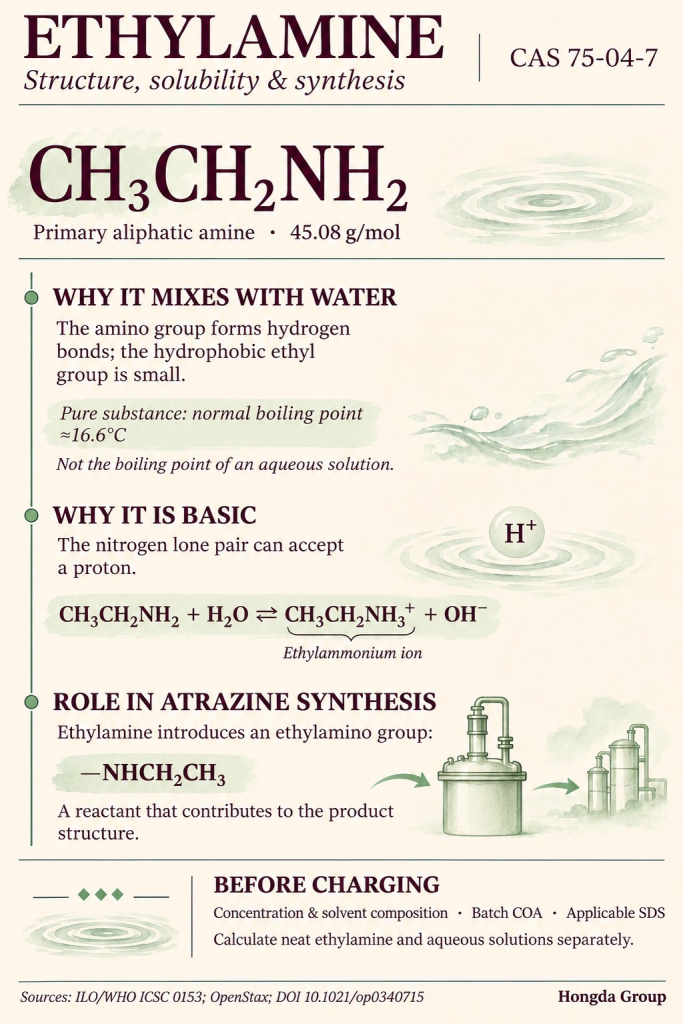
Ethylamine has the condensed structural formula CH₃CH₂NH₂. Its amino group can form hydrogen bonds with water and accept a proton, which helps explain its water miscibility and the basicity of its aqueous solutions. The lone pair on nitrogen also allows ethylamine to participate in nucleophilic reactions and introduce an ethylamino group into other molecules.
These properties matter in industrial synthesis. In atrazine production, ethylamine contributes part of the product’s molecular structure. When calculating a reaction charge, the distinction between neat ethylamine and an aqueous solution also matters: both the ethylamine concentration and the water introduced must be considered.
Ethylamine at a glance
| Property | Information |
|---|---|
| Common name | Ethylamine |
| Other names | Monoethylamine, ethanamine |
| CAS number | 75-04-7 |
| Molecular formula | C₂H₇N |
| Condensed structural formula | CH₃CH₂NH₂ |
| Molar mass | Approximately 45.08 g/mol |
| Chemical class | Primary aliphatic amine |
| Normal boiling point of the pure substance | Approximately 16.6°C |
| Water solubility | Miscible |
| Standard listed on Hongda’s product page | GB/T 23962-2023 |
| Commercial concentration and supply form | Confirm against the specific product specification |
The boiling point above applies to pure ethylamine. It should not be used as the boiling point of an aqueous solution. The International Chemical Safety Card documents ethylamine’s boiling point, water miscibility and flammability. Source: ILO/WHO International Chemical Safety Card
Why is ethylamine basic?
Ethylamine can be viewed as ammonia with one hydrogen replaced by an ethyl group. Nitrogen is bonded to one ethyl group and two hydrogen atoms, so ethylamine is a primary amine. “Primary” describes its molecular structure, not its purity or commercial grade.
The lone pair on nitrogen can accept a proton. In water, the following equilibrium is established:
CH₃CH₂NH₂ + H₂O ⇌ CH₃CH₂NH₃⁺ + OH⁻
Proton acceptance produces an ethylammonium ion and a hydroxide ion. This makes the solution basic and explains why ethylamine is a Brønsted–Lowry base.
Ethylamine is classified as a weak base in water because proton transfer is incomplete. That classification does not imply that its solutions are non-corrosive. Source: OpenStax, Basicity of Amines
Why does ethylamine dissolve in water more readily than aniline?
Ethylamine’s amino group can form hydrogen bonds with water, while its hydrophobic portion is a relatively small ethyl group. Together, these features allow ethylamine to mix with water in all proportions.
Aniline also contains an amino group and can form hydrogen bonds with water. However, its larger hydrophobic phenyl group limits its water solubility.
The statement “ethylamine is soluble in water whereas aniline is completely insoluble” therefore needs correction. Aniline has measurable water solubility; it is not miscible with water as ethylamine is. Source: NIOSH Pocket Guide, Aniline
Solubility and basicity should be considered separately. Solubility involves the interaction of the whole molecule with water. Basicity concerns proton acceptance. Base strength alone does not explain every difference in water solubility.
What does ethylamine contribute to atrazine synthesis?
Atrazine is a triazine herbicide containing both ethylamino and isopropylamino groups.
In a synthesis route starting from cyanuric chloride, ethylamine and isopropylamine participate in successive amination reactions. Ethylamine introduces the following group onto the triazine ring:
—NHCH₂CH₃
Ethylamine is therefore a reactant that contributes to the final molecule. Describing it simply as a catalyst or acid scavenger would miss its role in this route.
A study published in Organic Process Research & Development examined reagent addition and reaction heat during atrazine synthesis from cyanuric chloride, isopropylamine and ethylamine. Sodium hydroxide served as the proton scavenger. The work also examined how reagent addition and mixing affected reaction control and selectivity. Source: Atrazine synthesis and reaction calorimetry study
Two aspects of ethylamine chemistry are relevant here. As a base, ethylamine accepts a proton. As a nucleophile, it forms a bond through nitrogen. Its role in a particular reaction depends on the substrate and process conditions.
Neat ethylamine and aqueous solutions require different calculations
Pure ethylamine has a normal boiling point of approximately 16.6°C and is a gas at ordinary room temperature and atmospheric pressure. Aqueous solutions are also commercially available, with different physical properties and storage requirements.
An aqueous solution introduces both ethylamine and water into a reaction. Comparing supply specifications therefore requires checking how the ethylamine content is reported and what water or other solvents are present.
When concentration is expressed as a mass fraction:
Mass of ethylamine = mass of solution × ethylamine mass fraction
The ethylamine mass can then be converted to moles using its molar mass. For volume-based charging, the density must correspond to the actual concentration and temperature.
Equal masses of two ethylamine solutions do not necessarily contain equal amounts of ethylamine. A calculation based only on the product name can overlook both concentration differences and the amount of water entering the process.
Which documents should buyers check?
The CAS number helps distinguish ethylamine from diethylamine and triethylamine. The composition determines whether a supplied material fits the intended reaction.
| Item | What to confirm |
|---|---|
| Product identity | Consistency between the name, CAS number and supply form |
| Assay or concentration | Test method, reporting basis and concentration units |
| Water or solvent composition | Compatibility with the intended synthesis route |
| Impurities | Whether the tested impurities and limits address process requirements |
| Batch documentation | Whether the product name and batch number on the COA match the shipment |
| Safety information | Whether the SDS covers the supplied concentration and composition |
Hongda’s ethylamine product page lists product identification and standard information. An enquiry should specify the required concentration, intended application and quality requirements so that the appropriate supply specification can be confirmed.
A standard listed on a website and a batch test result provide different information. Assessment of a shipment should use the relevant product specification and batch COA.
Ethylamine is flammable and presents irritation and corrosion hazards. Storage, transfer and handling arrangements should follow the SDS for the supplied material and the site’s risk assessment.
Frequently asked questions
What is the CAS number of ethylamine?
The CAS number is 75-04-7. An aqueous solution may also use this number to identify its ethylamine component, so concentration and composition still need to be checked.
Are ethylamine and monoethylamine the same substance?
Yes. Both names refer to ethylamine, which is also called ethanamine. Monoethylamine identifies an amine with one ethyl group attached to nitrogen and distinguishes it from diethylamine and triethylamine.
Why is ethylamine a Brønsted–Lowry base?
Ethylamine can accept a proton to form an ethylammonium ion. In water, this equilibrium also produces hydroxide ions, making the solution basic.
Why is ethylamine miscible with water while aniline has limited solubility?
Both compounds can form hydrogen bonds with water. Their hydrophobic portions differ: ethylamine has a small ethyl group, while aniline contains a larger phenyl group. This contributes to their different water solubilities.
What should be checked in an ethylamine ¹H NMR spectrum?
The methyl and methylene signals and their integration can help identify the ethyl group. The amino protons undergo exchange, so their signal can vary with solvent, temperature and water content. Reference spectra should be compared under suitable measurement conditions.