



Reducing soybean meal or changing the inclusion of cereals and coproducts changes a diet’s amino acid composition. Whether additional L-leucine is needed should be determined by recalculating the basal formulation, rather than by looking only at the reduction in crude protein.
Leucine, valine and isoleucine are the branched-chain amino acids, or BCAAs. Their supply needs to be assessed together. This article focuses on pig diets, including supplementation decisions, BCAA balance and ingredient checks. Formulations for other species require evidence and nutritional targets appropriate to those animals.
L-leucine product information
| Item | Information |
|---|---|
| Ingredient name | L-Leucine |
| CAS number | 61-90-5 |
| Molecular formula | C₆H₁₃NO₂ |
| Amino acid classification | Essential amino acid; branched-chain amino acid |
| Grade listed by Hongda | Feed grade |
| Published appearance | White to off-white powder with a slightly bitter taste |
| Applicable standard listed by Hongda | QB/T 5633.1-2021 |
| Published packaging | 25 kg kraft paper bags |
Grade, appearance, the listed applicable standard and packaging information come from Hongda Group’s feed-grade L-leucine product page.
Assay, loss on drying and other acceptance criteria should be checked against the product specification and batch test documentation. A listed specification standard does not replace confirmation of the destination market’s conditions of use for feed additives.
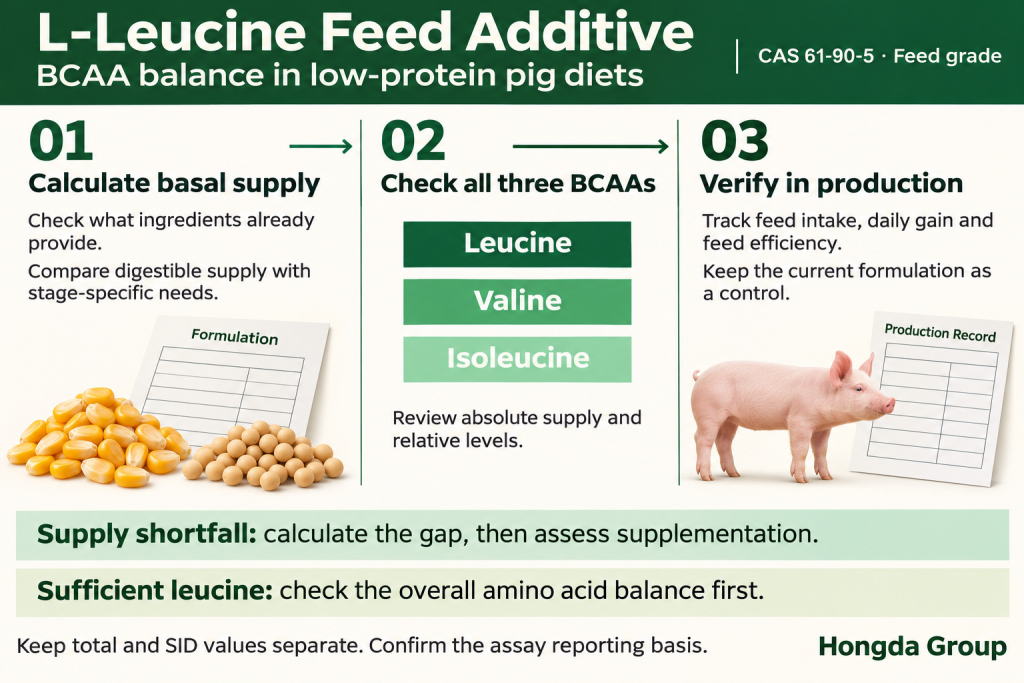
Does reducing crude protein necessarily create a leucine shortage?
No. A reduction in crude protein does not mean that every essential amino acid decreases in the same proportion.
Corn, soybean meal and other protein ingredients already supply leucine. When their inclusion changes, the contribution of the complete diet needs recalculating. Some corn coproducts contribute substantial amounts of leucine, so changes in their inclusion deserve particular attention.
The first question is how much digestible leucine the basal diet supplies and whether that amount meets the requirement adopted for the animal’s production stage. Valine, isoleucine and the other essential amino acids then need checking alongside it.
If the basal diet already supplies sufficient leucine, further supplementation requires a clear rationale. Neither a lower crude protein value nor leucine’s role in protein synthesis establishes an inclusion rate.
Why should all three BCAAs be assessed together?
Leucine, valine and isoleucine are needed for protein synthesis and share enzymes in the first two steps of their breakdown. An excessive supply of one can therefore affect the metabolism and availability of the others.
In a 2019 experiment, Kwon and colleagues studied 40 growing pigs with an initial body weight of approximately 30 kg. Average daily feed intake and feed efficiency declined as dietary leucine increased. The experiment investigated excess supply; its findings should not be applied directly to normal supplementation levels. Read the study.
A 2023 experiment involving approximately 10–20 kg nursery pigs also found interactions among BCAAs. The feed-intake response to increasing leucine varied with valine supply, while combinations of leucine and isoleucine affected growth and feed efficiency. Read the study.
These findings show why checking leucine alone is insufficient. They do not establish one BCAA ratio for every pig population or provide a direct supplementation recommendation for poultry, aquatic animals or ruminants.
When is additional L-leucine worth considering?
Identify a supply gap before deciding how to fill it. Different formulation situations require different responses.
| Formulation situation | What to check first | Direction for assessment |
|---|---|---|
| Basal leucine supply is below the adopted nutritional target | Ingredient data, digestible supply and stage-specific needs | Calculate the gap, then evaluate supplementation |
| Leucine is sufficient, but valine or isoleucine is low | Absolute supply and relative levels of all three BCAAs | Address the actual shortfall |
| Inclusion of corn coproducts or similar ingredients increases | Changes in leucine contribution and BCAA composition | Recalculate the complete formulation |
| Feed intake or growth declines after reformulation | Amino acid balance, energy, ingredient quality and management | Investigate the cause before adjusting leucine |
For example, adding more leucine to a diet that already meets its leucine target may not resolve a valine shortfall. Valine supply and other relevant conditions should be checked first.
BCAA balance is also only part of a low-protein formulation. Lysine, methionine, threonine, tryptophan and the remaining essential amino acids need assessment, together with energy and other nutrient requirements.
Keep total content separate from SID supply
Total leucine analysis helps verify ingredient composition. Pig diet formulation also needs to account for digestible supply, commonly through the standardized ileal digestible amino acid system, abbreviated as SID.
Supply and requirements should be expressed on the same basis. An ingredient’s total leucine content cannot be compared directly with a SID leucine requirement.
Formulators can review SID leucine, valine and isoleucine individually as ratios to SID lysine, while retaining their absolute concentrations. Ratios help compare composition but do not replace dietary concentration or daily intake.
This matters when feed intake changes. Two pigs consuming different quantities of the same diet receive different amounts of amino acids, despite identical nutrient concentrations per kilogram of feed.
The assay reporting basis also needs checking when calculating commercial ingredient inclusion. Dry-basis and as-is values are not interchangeable. Conversion from ingredient inclusion to SID supply should use methods and data consistent with the formulation system.
What should a supplementation trial record?
If formulation calculations identify a need for supplementation, define the purpose of the trial first. Correcting a leucine shortfall and comparing BCAA combinations are different questions and require different interpretations.
Keep other nutritional conditions and management practices as consistent as possible. Retain the current formulation as a control and document the complete trial diets, rather than recording only the amount of added leucine.
For pig diets, useful records include:
- Average daily feed intake, average daily gain and feed efficiency;
- Leucine, valine and isoleucine supply, including the calculation basis;
- Initial body weight, production stage, health status and trial duration;
- Ingredient batches, mixing records and environmental changes during the trial.
Reduced feed intake or slower growth is not specific to leucine deficiency. Water supply, temperature, health and other nutritional factors also need investigation. These observations alone cannot establish either a deficiency or an excess.
A favorable result from one trial should be checked for repeatability in subsequent batches and normal production conditions.
What should buyers check for L-leucine powder?
“L-leucine powder” describes the physical form. It does not, by itself, establish grade, assay or mixing performance.
Before ordering, confirm the intended feed use and agreed specification. Review test methods, the assay reporting basis and batch documentation. The specification used during sample trials should correspond to the specification supplied commercially.
The addition method should suit the inclusion rate and equipment. Low-inclusion ingredients require particular attention to weighing and distribution. Premixing, stepwise dilution or direct addition may be appropriate under a validated process, with suitable mixing-uniformity testing used to confirm performance.
To discuss feed-grade L-leucine specifications, contact Hongda Group with the animal species, production stage, diet type and required documentation.
Frequently asked questions
1. What does an L-leucine feed additive do?
It can supplement the leucine supplied by a diet. Its practical value depends on whether the basal formulation has a shortfall and whether other amino acids are balanced. Leucine’s physiological role does not establish that adding it to every diet will improve growth.
2. What can happen if too much L-leucine is added?
Pig studies show that excess leucine can affect the utilization of the other BCAAs and adversely affect feed intake and feed efficiency. Assessment should consider the complete diet and production stage, rather than a single analytical value.
3. Are L-leucine and L-isoleucine the same?
No. They share a molecular formula but have different structures and must be calculated separately in a formulation. L-leucine has CAS number 61-90-5; L-isoleucine has CAS number 73-32-5. They are not interchangeable.
4. Can feed-grade L-leucine powder be used in human supplements?
A shared name or CAS number does not establish that grades are interchangeable. Feed and human nutrition products have different intended uses, quality requirements and applicable rules. Human supplement projects require separate confirmation of the appropriate ingredient grade, specification and documentation.