



L-isoleucine is an essential amino acid and one of the building blocks of human proteins. It also participates in energy metabolism and is commonly included in amino acid powders, sports nutrition supplements and nutritional foods.
Whether additional supplementation is useful depends on what the diet already provides, alongside training demands and nutritional goals. When reviewing l-isoleucine benefits, it also matters whether a study tested isoleucine alone, a combination of branched-chain amino acids or an intact protein. These interventions answer different questions, and their results are not interchangeable.
1. What is L-isoleucine?
L-isoleucine has the CAS number 73-32-5 and molecular formula C₆H₁₃NO₂. Together with L-leucine and L-valine, it forms the group known as branched-chain amino acids, or BCAAs.
“Essential” means the body cannot produce sufficient amounts and must obtain it through food. Protein-containing foods such as meat, fish, eggs and milk provide isoleucine, so supplements are only one possible source.
Hongda Group’s L-isoleucine product information lists its chemical identity, white or off-white crystalline powder characteristics, and applications in nutritional supplements and food formulations.
| Identification item | Information |
|---|---|
| Ingredient name | L-Isoleucine |
| CAS number | 73-32-5 |
| Molecular formula | C₆H₁₃NO₂ |
| Nutritional category | Essential amino acid; branched-chain amino acid |
| Relevant formulation uses | Amino acid blends, sports nutrition supplements and nutritional foods |
Isoleucine and leucine have similar names but are different substances. Check the complete ingredient name when reviewing specifications, formulations and research. Findings about leucine should not automatically be attributed to isoleucine.
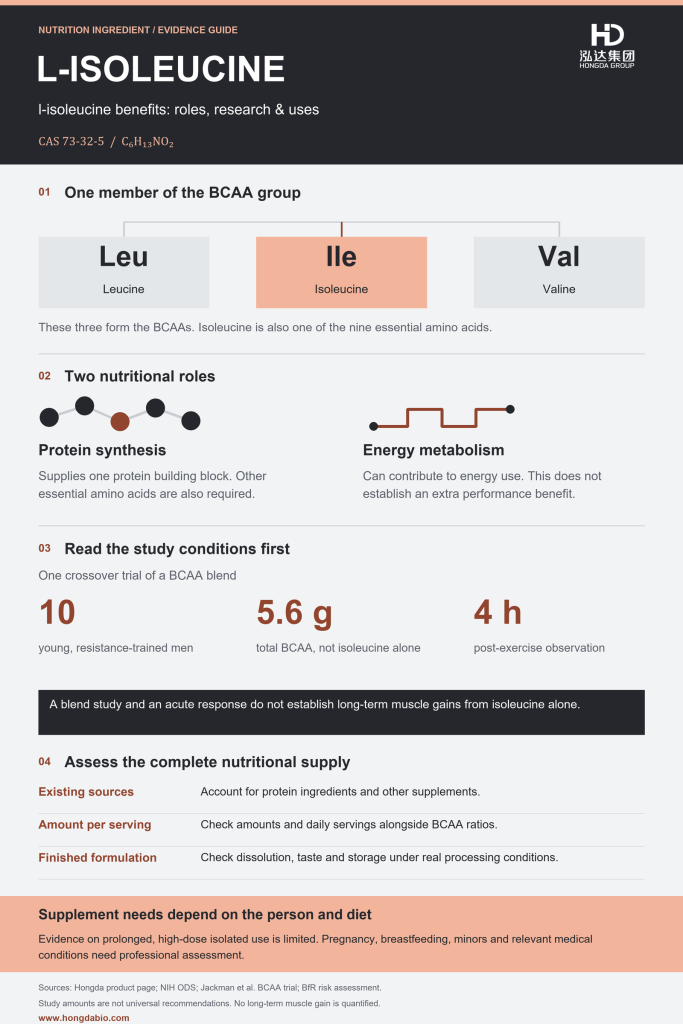
2. What are the nutritional benefits of L-isoleucine?
Providing a building block for protein synthesis
The body continually renews its proteins. Maintaining and repairing tissues, including muscle, requires an adequate supply of amino acids. Isoleucine provides one of the essential building blocks needed for this process.
In a nutritional formulation, its role is to contribute part of the essential amino acid supply according to the product’s composition and intended users.
Muscle protein synthesis also requires the other essential amino acids. Assessing a product therefore involves its total protein content, amino acid composition and contribution alongside the diet. Increasing isoleucine alone does not replace the need to consider the overall nutritional supply.
Participating in energy metabolism
BCAAs can be metabolized in skeletal muscle and contribute to energy production during exercise. However, participation in a metabolic pathway does not establish that extra supplementation improves endurance or reduces fatigue.
The US National Institutes of Health Office of Dietary Supplements (NIH ODS) reports limited evidence that BCAA supplements improve endurance performance. Evidence is also inconsistent on whether they stimulate muscle protein synthesis beyond what sufficient dietary high-quality protein can achieve. NIH ODS: Dietary supplements for exercise and athletic performance
Isoleucine’s physiological roles help explain its inclusion in sports nutrition formulations. Whether a finished product provides an additional benefit requires evidence relevant to its composition and conditions of use.
3. Do BCAA studies establish the benefits of isoleucine alone?
The first question to ask about a supplement study is what the participants actually consumed.
A human crossover trial involved 10 young men with resistance-training experience. After exercise, participants consumed either a drink containing 5.6 g of BCAAs or a placebo. Researchers measured myofibrillar muscle protein synthesis over the following four hours and found a higher synthesis rate in the BCAA condition. Study of BCAA ingestion and post-exercise muscle protein synthesis
The finding provides short-term physiological evidence under specific conditions:
- The intervention contained all three BCAAs.
- Participants were young, resistance-trained men.
- The outcome was protein synthesis over a period of hours.
It does not establish the effect of taking L-isoleucine alone or quantify long-term muscle growth. The study’s 5.6 g was the total BCAA amount, not a recommended isoleucine intake.
When using research to describe a product, check whether the tested ingredients match the formulation. Two products labeled “BCAA” may differ in composition, amount per serving and directions for use.
4. How is L-isoleucine used in nutritional formulations?
Isoleucine can serve a role in several nutritional systems. Formulation decisions should begin with the product’s purpose, followed by the contribution required from each ingredient.
| Formulation type | Role of isoleucine | Points to assess |
|---|---|---|
| BCAA blend | Contributes to the combination of leucine, isoleucine and valine | Amount of each amino acid per serving, daily servings and existing dietary intake |
| Essential amino acid blend | Provides one of the nine essential amino acids | Whether the complete composition suits the nutritional objective |
| Protein-containing nutritional product | Adjusts amino acid composition where justified by the base ingredients and product requirements | Existing isoleucine content and the rationale for adding more |
For example, when developing a post-exercise powder, first calculate the amino acids already supplied by its protein ingredients. That calculation helps determine whether additional free-form isoleucine has a clear purpose.
A BCAA ratio should also be read alongside the amount per serving. Products with the same ratio can deliver different total quantities. Comparing ratios alone does not show how much a person will consume.
Confirm processing performance in the complete formulation
For a reconstituted powder, assess dispersion, dissolution and taste. For a liquid product, inspect its condition after processing and during storage. A raw material’s water-solubility description does not replace stability testing of the complete formulation.
If sediment appears, investigate dissolution and the contribution of other ingredients before adjusting the use level or process. Recording the addition sequence, temperature and observation times makes sample comparisons more useful.
Once an ingredient meets the agreed quality specification, the finished product’s nutritional effects still require assessment against its full composition and supporting evidence. Ingredient testing, processing trials and human studies address different questions.
5. Are L-isoleucine benefits different for men and women?
Both men and women need isoleucine. Its basic role in protein synthesis is not exclusive to either sex.
Additional supplementation needs depend on dietary intake, body weight, activity and life stage. Two people who train regularly may have different nutritional needs if one already consumes sufficient protein and the other consistently falls short.
The short-term BCAA trial described above included only young men. It cannot establish the same response in women or show that men routinely need isolated isoleucine supplements. Claims aimed specifically at men or women should be supported by research in the relevant population.
Pregnancy and breastfeeding require separate consideration. Germany’s Federal Institute for Risk Assessment (BfR) identifies insufficient safety data for isolated BCAA supplementation in these groups and recommends avoiding such additional intakes through relevant supplements or sports foods. This advice concerns isolated amino acid supplementation, rather than ordinary protein-containing foods. BfR: Risk assessment of supplemental isolated BCAAs
6. What about side effects and intake?
Isoleucine obtained through ordinary foods should be considered separately from prolonged, high intakes of an isolated amino acid.
The BfR assessment notes that human evidence suitable for evaluating isolated isoleucine supplementation is limited. One study reported a slight increase in nausea, although the significance of that finding was uncertain. It should not be interpreted as an expected reaction in every user.
Available evidence also does not establish one supplemental amount suitable for everyone. Assessment should account for food intake and other supplements. Short-term tolerability is not a basis for assuming that progressively higher or prolonged intakes are appropriate.
People with impaired kidney function, those following a medically prescribed low-protein diet and people with disorders affecting BCAA metabolism need professional assessment. Children and adolescents should not simply follow adult supplementation plans.
For product development, document the amount of each amino acid per serving, intended daily servings and target population, then confirm the applicable target-market requirements. Claims such as “accelerates muscle repair,” “improves blood glucose” or “enhances athletic performance” require appropriate supporting evidence.
To discuss L-isoleucine for a sports nutrition or amino acid formulation, contact Hongda Group with the product format, complete formulation and intended use so that material specifications and sample requirements can be discussed.
Frequently asked questions
1. What are the l-isoleucine benefits for men?
Men need isoleucine for protein synthesis and normal metabolism. Whether additional supplementation is useful depends on diet and training. Some BCAA studies in young men have measured short-term increases in muscle protein synthesis, but those findings do not establish the same effect for isoleucine alone.
2. What are the l-isoleucine benefits for women?
Women also require isoleucine as an essential amino acid. Supplemental needs should be assessed against actual nutritional intake rather than sex alone. Safety data for isolated BCAA supplementation during pregnancy and breastfeeding are insufficient, so self-directed use should be avoided.
3. How should l-isoleucine benefits and side effects be considered together?
Start by establishing whether there is a clear nutritional reason for supplementation, then assess the amount and suitability for the intended user. Isoleucine has normal nutritional functions, while the safety of prolonged, high-dose isolated supplementation remains uncertain. A supplement plan should be considered alongside the person’s diet.