



After adjusting the sweetness of a reduced-sugar drink, a developer still needs to check whether crystals appear during refrigeration. Replacing some of the sucrose in a cake also calls for checks on volume and crumb structure. Erythritol can be used in both applications, but the approach depends on the texture and processing characteristics the finished product needs to retain.
Erythritol contributes sweetness and solids. It serves a different role from a high-intensity sweetener, and it is not fully equivalent to sucrose. A custom formulation discussion should start with the food category and sugar-replacement target, then establish whether the requirement concerns the ingredient specification, particle size or the whole sweetening system.
1. What is food-grade erythritol?
Erythritol is a four-carbon sugar alcohol with the CAS number 149-32-6 and molecular formula C₄H₁₀O₄. Commercial food-grade material can be made by fermenting a carbohydrate feedstock, followed by separation, purification and crystallization.
Hongda Group’s food-grade erythritol product information lists its chemical identity, white crystalline appearance and sweet taste, together with beverage, confectionery and bakery applications.
| Identity or formulation property | Information |
|---|---|
| Ingredient name | Erythritol |
| CAS number | 149-32-6 |
| Molecular formula | C₄H₁₀O₄ |
| Ingredient category | Polyol sweetener |
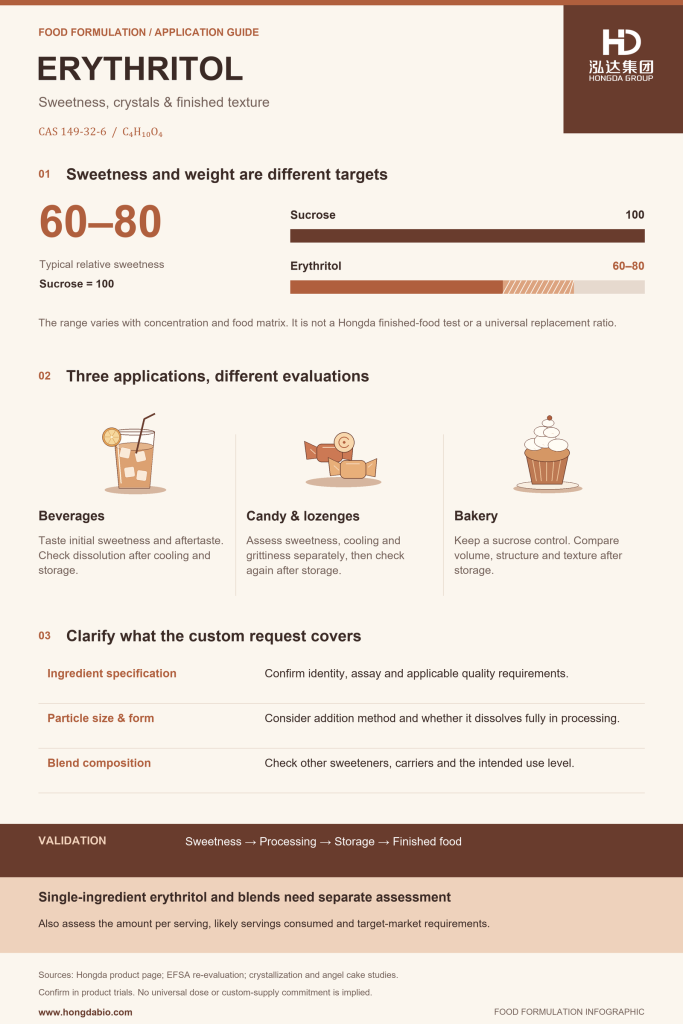
| Relative sweetness | Typically about 60–80% of sucrose; perception varies with concentration and the food system, so this range alone does not establish an equal-sweetness replacement ratio |
| Properties to assess | Cooling sensation, dissolution and crystallization, and changes in solids and texture after sugar replacement |
The sweetness range above comes from the ingredient description included in the European Food Safety Authority’s re-evaluation. It is not a measurement of Hongda’s material in every food application. Replacing sucrose by equal weight will usually change sweetness. If more erythritol is added to compensate, recalculate the formulation’s solids and the erythritol content per serving. EFSA: Re-evaluation of erythritol (E 968)
2. Reduced-sugar beverages: check cooling and storage after adjusting sweetness
Erythritol can provide part of the sweetness in tea-based and flavored drinks. Even when two samples are judged equally sweet, their body and aftertaste may differ.
When combining it with other permitted sweeteners, assess the drinking experience over time: the initial sweetness, how long it persists after swallowing, and any prominent bitterness or other aftertaste. Changes to acidity or flavor composition also call for another evaluation.
A higher mixing temperature may make dissolution easier. The next question is whether the ingredient stays dissolved as the drink cools. A supersaturated solution can crystallize, so a clear, warm sample still needs observation after cooling and under the intended storage conditions.
A study in Crystal Growth & Design examined cooling crystallization of erythritol and other compounds in specified aqueous solutions. It provides evidence about the crystallization process. A finished drink also contains acids, flavors or other ingredients, so the suitable concentration needs confirmation in the complete formulation. Study of cooling crystallization in erythritol and other aqueous solutions
Taste beverage samples at the intended drinking temperature and inspect their condition during storage. If particles appear, distinguish undissolved material from newly formed crystals or other sediment before changing the use level or dissolution process. Making the starting powder finer and reducing later crystallization are separate questions to test.
3. Candy and lozenges: does the cooling sensation fit the flavor?
Erythritol’s cooling sensation can suit mint and other refreshing confectionery or lozenges. Whether it works in a creamy or caramel flavor needs assessment in the finished product.
Record sweetness, cooling and grittiness separately. If cooling is judged to conflict with a creamy flavor, the erythritol proportion in the sweetening system may need adjustment even when sweetness is acceptable.
Particle size needs to be considered in the context of the process. Where crystals dissolve directly in the mouth, it may affect dissolution rate and perceived grittiness. If the material dissolves completely during manufacture, later crystallization also depends on concentration, cooling and the other ingredients. Finer starting material does not resolve every crystallization problem.
Inspect surfaces, cross-sections and mouthfeel after storage as well. This can reveal crystal or texture changes that were not apparent in the first tasting.
4. Bakery products: replacing sweetness also changes the formulation
In cakes and cookies, sucrose affects batter or dough behavior, finished structure and texture as well as sweetness. Those properties need reassessment when erythritol replaces some of the sucrose.
An angel cake study reported that, in its experimental formulation, cake specific volume and baking loss were essentially unchanged when erythritol replaced less than 50% of the sucrose. The researchers also examined egg-white foaming and finished texture. The finding illustrates why replacement level needs to be evaluated alongside food structure; the study’s ratios are not general recommendations for every cake or cookie. Study of sucrose replacement with erythritol in angel cake
During development, retain the original sucrose recipe as a control and increase the replacement level in stages. For cakes, compare volume, crumb uniformity and firmness after cooling. For cookies, compare spread, crispness and texture after storage. Limit other changes in each trial so that the effect of sugar replacement can be distinguished from changes in water, fat or processing.
Recalculate total formulation weight and solids whenever the erythritol level changes. A high-intensity sweetener can adjust sweetness, but its small addition contributes little material by weight. The sucrose removed from the original recipe still needs to be accounted for when balancing water and the remaining ingredients.
5. Custom requirements: ingredient specification, particle size or a blend?
These requests need to be described separately when discussing a food-grade erythritol application.
| Requirement | Information to establish | Relevance to the application |
|---|---|---|
| Single-ingredient material | Assay, applicable quality requirements and supporting documents | Establish whether the selected material suits the food and target market |
| Particle size and physical form | Required size range, whether it will be dissolved, and the addition method | Affects dispersion, dissolution and grittiness in some products |
| Sweetener blend | Composition, target sweetness, food matrix and use level | Affects sweetness, bulk and ingredient labeling |
Confirm the composition of single-ingredient erythritol and erythritol-based blends separately. A blend containing other sweeteners or carriers may have a different erythritol content, sweetness and ingredient declaration at the same product weight.
Alongside a target particle size or assay, tell the supplier what food is being made, how it is processed and what problem the current sample presents. Crystals appearing after refrigeration and uneven distribution during dry mixing call for different investigations. Availability of a particular particle size, blend or packaging arrangement should be established through the agreed specification and supply terms.
6. Evaluate the finished food and the amount consumed
Once a sample reaches the target sweetness, make the finished product using the intended process and assess changes after manufacture and storage. Record the original recipe, replacement approach, processing conditions and observation times so that later trials can be compared meaningfully.
Serving size also belongs in formulation design. The EFSA evaluation cited above considered gastrointestinal tolerance and identified the potential for laxative effects at high intakes. Assess the amount per serving together with the number of servings likely to be consumed.
Confirm “sugar-free,” “reduced-sugar” and energy-related statements against the complete formulation and the requirements of the target market. Replacing part of the sucrose does not automatically establish eligibility for a nutrition claim.
To discuss a food-grade erythritol application, contact Hongda Group with the food category, sugar-replacement target, processing method and storage conditions so that the material specification and sample requirements can be discussed.
Frequently asked questions
1. What is custom food grade sweetener erythritol used for?
Food-grade erythritol can be used in the sweetening systems of beverages, confectionery and baked goods. The application depends on permitted uses, target sweetness and processing. A custom request should also specify whether it concerns the ingredient specification, particle size or a sweetener blend.
2. Can erythritol replace granulated sugar at a 1:1 ratio?
A 1:1 weight replacement is not a universal rule. Erythritol is typically less sweet than sucrose, and its dissolution, crystallization and structural effects differ. Even if a blend achieves similar sweetness, finished volume, texture and storage stability still need checking.
3. Does finer powder always reduce crystallization in the finished product?
No. Starting particle size may affect addition, dispersion and dissolution. Once the material has dissolved, later crystallization also depends on concentration, temperature changes and the complete formulation. First distinguish undissolved particles from crystals that form after cooling, then decide what to change.