



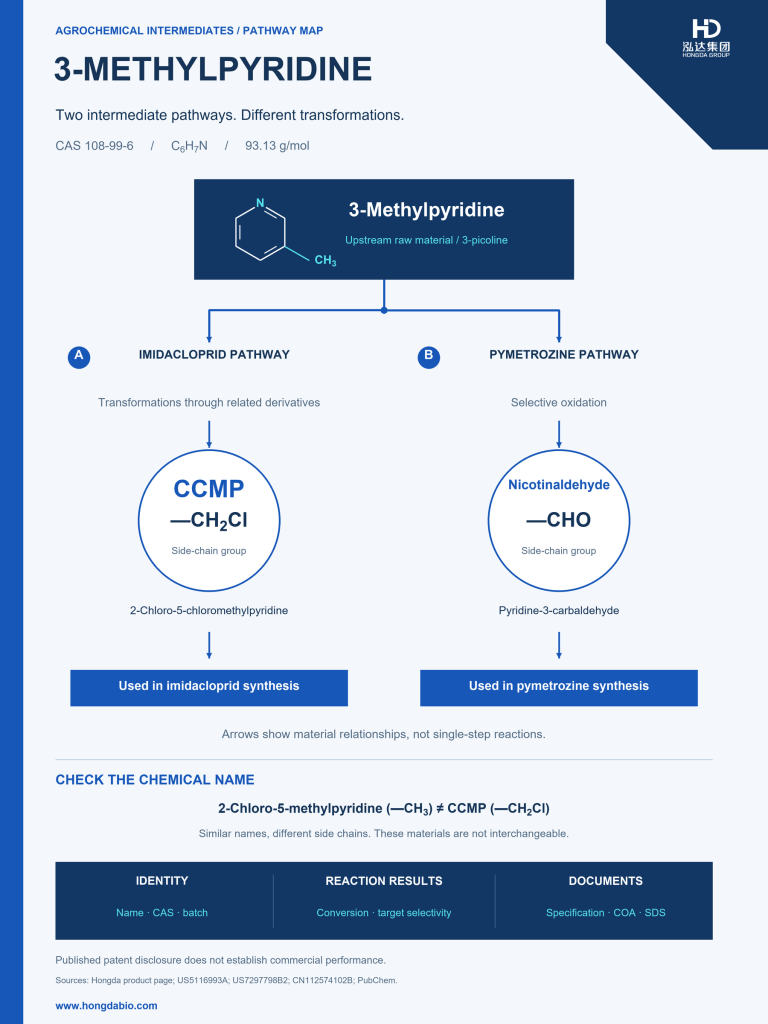
3-methylpyridine can serve as an upstream raw material for different agrochemical intermediates. In routes associated with imidacloprid, further transformations lead to 2-chloro-5-chloromethylpyridine, commonly called CCMP. For pymetrozine, published patent literature also describes the oxidation of 3-methylpyridine to nicotinaldehyde.
These routes require different intermediate structures. Material assessment should therefore reflect the reactions and separation steps used in the intended process.
Hongda Group’s 3-methylpyridine product information lists applications in agrochemical synthesis, vitamin B3 production and other pyridine derivatives. The following discussion uses published technical sources to explain its relationship to these two agrochemical intermediate pathways.
1. Material Identity: 3-Methylpyridine and 3-Picoline
3-Methylpyridine is also known as 3-picoline or β-picoline. Its methyl group occupies position 3 on the pyridine ring, distinguishing it from 2-methylpyridine and 4-methylpyridine.
| Identification item | Information |
|---|---|
| Chemical name | 3-Methylpyridine |
| Common names | 3-Picoline, β-picoline |
| CAS number | 108-99-6 |
| Molecular formula | C₆H₇N |
| Molar mass | Approximately 93.13 g/mol |
| Conjugate-acid pKa | Approximately 5.63 at 25°C |
The names, CAS number and property information can be checked in the PubChem record for 3-methylpyridine.
Molecular weight helps with charge calculations, but it cannot distinguish methylpyridine positional isomers. The 2-, 3- and 4-methylpyridine isomers have the same molecular formula and molar mass. Purchasing and receiving checks still need the specific chemical name, CAS number and appropriate analytical results.
The methyl group’s position matters in downstream synthesis because it affects which pyridine derivative can be obtained. These isomers should not be treated as interchangeable raw materials.
2. Upstream Use in Imidacloprid Intermediate Production
2-Chloro-5-chloromethylpyridine, or CCMP, is an intermediate used in imidacloprid synthesis. 3-Methylpyridine can provide an upstream starting point for its preparation.
Patent US5116993A describes a route that uses 3-methylpyridine as a basic starting compound and proceeds through related derivatives to CCMP. It establishes a synthetic connection between the materials; the actual sequence depends on the chosen process. CCMP preparation patent US5116993A
At the level of starting-material and intermediate relationships, the pathway can be summarized as:
3-Methylpyridine → functional-group transformations leading to CCMP → imidacloprid synthesis
In a subsequent step, CCMP can react with 2-nitroiminoimidazolidine to prepare imidacloprid, as described in patent US7297798B2. The upstream material and the later intermediate occupy different stages of the synthesis and require separate quality assessments. Imidacloprid preparation patent US7297798B2
Two similar names require particular care:
| Intermediate | Structural distinction |
|---|---|
| 2-Chloro-5-methylpyridine | Contains a methyl side chain, —CH₃ |
| 2-Chloro-5-chloromethylpyridine | Contains a chloromethyl side chain, —CH₂Cl |
These compounds differ in side-chain structure. Their names should not be exchanged in purchase orders, analytical reports or process documents. A general description such as “chlorinated methylpyridine” is insufficient to identify the required material.
Assessment of the relevant transformations needs to consider substitution position, degree of chlorination and by-product distribution. Detecting a chlorinated product does not establish that the isolated material meets the requirements for the next reaction. Target-intermediate content and quality after separation still need confirmation.
3. Upstream Use in Pymetrozine Intermediate Production
Nicotinaldehyde, also called pyridine-3-carbaldehyde, is an intermediate used in pymetrozine synthesis. In this application, the relevant transformation converts the methyl group of 3-methylpyridine into an aldehyde group.
Patent CN112574102B discloses the catalytic oxidation of 3-methylpyridine to produce a nicotinaldehyde solution and identifies nicotinaldehyde as an intermediate for pymetrozine synthesis. This supports the reported pathway, but does not establish its extent of commercial adoption or its production cost. Nicotinaldehyde preparation patent CN112574102B
The material relationship can be summarized as:
3-Methylpyridine → selective oxidation to nicotinaldehyde → subsequent pymetrozine synthesis
The arrows describe a synthetic relationship. A working process also includes separation, analysis and acceptance of the resulting nicotinaldehyde solution.
Other methods can produce nicotinaldehyde. The same patent’s background discusses its preparation by reducing nicotinonitrile. Nicotinic acid, nicotinonitrile and nicotinaldehyde are therefore distinct materials, and they should not be presented as compulsory consecutive stages in every route.
When assessing oxidation to nicotinaldehyde, record both starting-material conversion and selectivity to the target aldehyde. High consumption of 3-methylpyridine does not, by itself, show that the desired product formed selectively.
If the next stage uses a nicotinaldehyde solution directly, the acceptance criteria should cover the solution as supplied. Alongside aldehyde content, confirm the solvent composition, residual starting material and acceptable levels of relevant impurities.
4. Assess Raw Material Quality Against the Intended Route
The basic identity of 3-methylpyridine remains the same across these applications. Process suitability, however, cannot be established from a single assay figure.
| Assessment item | What to confirm |
|---|---|
| Material identity | Agreement between the chemical name, CAS number and supplier product code |
| Assay and method | How the reported content was measured and the basis used for calculation |
| Water and relevant impurities | Suitable test results and their compatibility with the intended process |
| Batch traceability | Agreement between the analytical report’s batch number and the delivered material |
| Downstream trial results | Formation, separation and quality of the required intermediate |
If a report uses GC area normalization, confirm which components the method covers. Water and other separately controlled properties require appropriate test results; they cannot be inferred from a chromatographic purity figure alone.
When comparing suppliers or batches, keep the charge basis, analytical methods and reaction conditions consistent where practical. Changing the raw material, catalyst and solvent at the same time makes any difference in results harder to interpret.
The two applications also place emphasis on different outcomes. A CCMP route needs assessment of the target chlorinated structure and separation performance. A nicotinaldehyde route requires attention to oxidation selectivity and the composition of the resulting solution. These results provide a more useful basis for material approval than assay alone.
5. What Do Molecular Weight, Density and pKa Tell You?
Molar mass converts material mass into amount of substance. For 3-methylpyridine, the value is approximately 93.13 g/mol. Production charge calculations should also account for measured content and use a consistent assay basis.
Density supports mass-to-volume conversions, including checks on volumetric charging and estimates of tank capacity. State the temperature, distinguish density from relative density, and use data appropriate to the actual material.
The pKa value relates to acid–base equilibrium. The value listed above refers to the dissociation of protonated 3-methylpyridine, its conjugate acid. It helps explain protonation in acidic aqueous solutions.
This information can assist interpretation of acid–base extraction or salt formation. Actual separation also depends on solvents, salts and other components. The pKa alone cannot determine suitable operating conditions or predict the yield of a non-aqueous reaction.
6. SDS and Batch Reports Serve Different Purposes
Both MSDS and SDS appear in searches for chemical safety information. For purchasing and handling, obtain the latest applicable SDS for the supplied product and destination market. Review the hazard, handling and storage, spill-response and transport information.
A batch analytical report records test results for an identified batch. An SDS explains safety requirements. Neither document replaces the other.
Retain the agreed specification, analytical methods and batch records alongside sample evaluations and receiving checks. These records help connect later production observations to the material actually used.
For specification discussions, contact Hongda Group with the intended intermediate, proposed route and existing acceptance requirements so that the relevant product and batch documentation can be reviewed.
FAQ
1. Can 3-methylpyridine replace CCMP directly in imidacloprid synthesis?
No. They have different structures and perform different roles in the relevant routes. 3-Methylpyridine requires suitable transformations to obtain an intermediate that meets the requirements of the subsequent synthesis.
2. Must 3-methylpyridine be converted into nicotinic acid before it is used in pymetrozine production?
Not necessarily. The cited patent describes oxidation of 3-methylpyridine to nicotinaldehyde. A route should be described using its actual intermediates and reaction sequence, rather than assuming that nicotinic acid is always required.
3. What is the molecular weight of 3-methylpyridine?
Its relative molecular mass is approximately 93.13, corresponding to a molar mass of approximately 93.13 g/mol. Charge calculations should also account for measured material content and use a consistent calculation basis.