



Feed-grade niacinamide supplies vitamin B3, usually through a vitamin premix added to pig, poultry or aquaculture feed. Its role is to help meet the animal’s requirement for available B3 and support normal metabolism. In adult ruminants, microbial synthesis, conversion and degradation in the rumen also affect its use.
Finding niacin in a cereal ingredient does not establish that a diet supplies enough available B3. Formulation needs to account for availability and the contribution from existing premixes. Where a diet already meets requirements, any further improvement in performance from extra supplementation needs supporting trial evidence.
1. What does niacinamide do in animals?
Niacinamide, also called nicotinamide, has the CAS number 98-92-0 and molecular formula C₆H₆N₂O. It is the amide form of nicotinic acid and a water-soluble B vitamin.
Niacinamide is a precursor for NAD and NADP. These coenzymes and their reduced forms participate in cellular oxidation-reduction reactions involved in carbohydrate, fat and amino acid metabolism. Supplementation helps maintain the vitamin supply needed for these processes.
This metabolic role does not replace dietary energy or essential amino acids. Increasing niacinamide cannot compensate for an inadequate supply of those nutrients.
Prolonged B3 deficiency can impair feed intake and growth. Skin or digestive abnormalities may also occur in some species. These signs have several possible causes, so poor growth or diarrhea alone does not establish a B3 deficiency.
2. Niacinamide and nicotinic acid: what matters when choosing a source?
Both compounds can supply vitamin B3 in animal nutrition. They are related, but their structures and some physical properties differ.
| Comparison | Nicotinic acid | Niacinamide |
|---|---|---|
| Other name | Niacin, when used specifically for the acid | Nicotinamide |
| CAS number | 59-67-6 | 98-92-0 |
| Molecular formula | C₆H₅NO₂ | C₆H₆N₂O |
| Relevant functional group | Carboxyl group, —COOH | Amide group, —CONH₂ |
| Water solubility | Lower than niacinamide at room temperature | More readily soluble in water |
| Basic nutritional use | Vitamin B3 source | Vitamin B3 source |
Niacinamide’s higher water solubility can be useful when preparing a solution. In a dry premix, mixing uniformity, product assay and retention after processing also matter. Liquid systems require checks on concentration and storage stability. Solubility alone does not demonstrate better absorption or animal performance.
The word “niacin” sometimes refers broadly to vitamin B3 and its related forms. When reading a formulation or study, check which compound was actually used. General B3 supplementation and the effects reported for a particular nicotinic acid preparation are different questions.
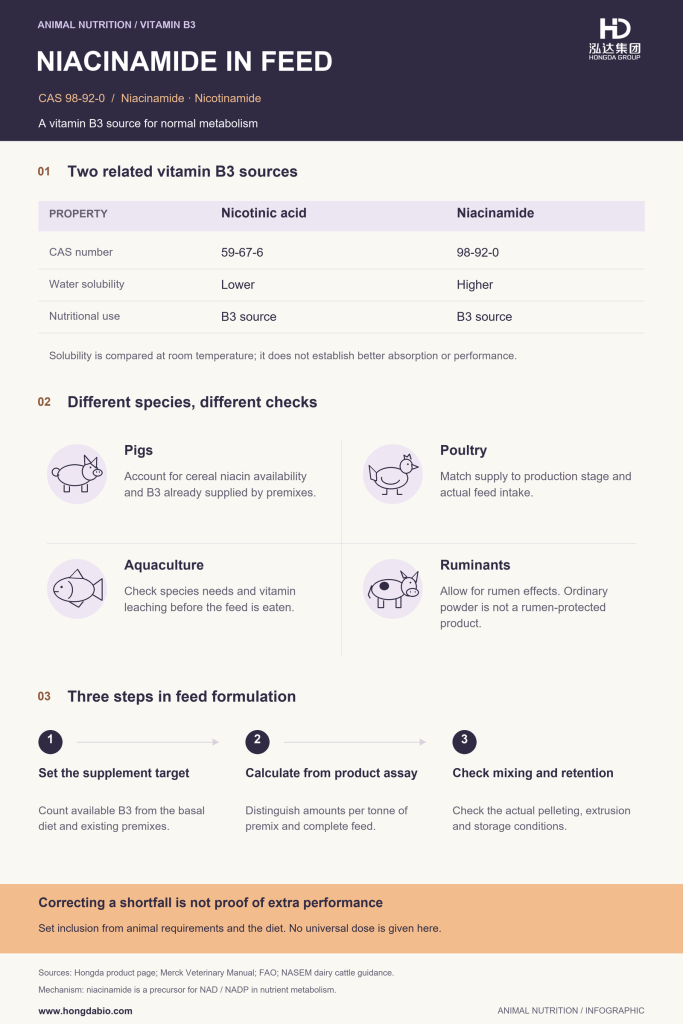
3. What is feed-grade niacinamide used for in different species?
Pig feed: supplement available B3 rather than relying on cereal totals
One reason to include niacinamide in pig diets is that total niacin in ingredients does not directly indicate available supply. Cereals such as corn and wheat contain niacin, but some is present in bound forms that pigs use poorly.
The Merck Veterinary Manual’s guidance on pig nutrition explains that niacin in most cereal grains is unavailable to pigs. Pigs can also convert excess tryptophan into niacin, but the conversion is inefficient. Detecting niacin in an ingredient is therefore not enough reason to remove supplemental B3 from a formulation.
Piglet, grow-finish and sow diets need separate assessments for the relevant production stage, including B3 already supplied by premixes. When changing cereals or cereal by-products, review the available contribution rather than comparing total niacin values alone.
Poultry feed: maintain vitamin supply for the production stage
Niacinamide can supply B3 in vitamin premixes for meat birds, layers and breeders. Formulation needs to reflect the growth, laying or breeding stage, as well as actual feed intake.
For example, if feed intake falls while the dietary concentration remains unchanged, each bird may consume less supplemental niacinamide. The assessment should cover the cause of reduced intake and the overall nutrient supply, rather than focusing on one vitamin alone.
Claims about growth, egg production or hatchability need evidence that identifies the bird type, production stage and B3 status of the basal diet. Those details help distinguish correction of a deficiency from the effects of adding more to an already adequate diet.
Aquaculture feed: account for species differences and losses before ingestion
Niacinamide can serve as a B3 source in vitamin premixes for appropriate fish and shrimp diets. Requirements depend on the cultured species, growth stage and feed composition; pig or poultry formulations should not be transferred directly.
Aquaculture introduces another practical question: how much vitamin remains in the feed until it is eaten? FAO’s fish and shrimp nutrition guidance describes the potential loss of water-soluble vitamins through leaching before ingestion.
An assessment should therefore consider pellet water stability, feeding behavior and feeding method alongside ingredient content. The relevant supply is the amount consumed with the feed.
Ruminant feed: distinguish ordinary powder from rumen-protected preparations
In adult ruminants, rumen microbes can synthesize niacin-related compounds and can also convert or degrade supplemental nicotinic acid and niacinamide. Ordinary niacinamide powder and a protected preparation therefore cannot be compared simply by equal product weight.
The vitamin chapter of Nutrient Requirements of Dairy Cattle discusses ruminal degradation of supplemental niacin and inconsistent production responses across studies. Applications involving transition-cow metabolism or heat stress require closer attention to the compound, protection method and trial conditions.
Check whether a study used nicotinic acid or niacinamide and whether the preparation was rumen-protected. Claims for ordinary niacinamide need evidence relevant to that product form.
4. How to use it: calculate the supplement, then check mixing and retention
Formulation normally starts with the amount of supplemental niacinamide required in the complete feed. Product assay and the premix inclusion rate are then used to calculate the product addition.
For niacinamide itself, before allowing for processing losses:
Product addition (g per metric tonne of complete feed) = intended supplemental niacinamide (mg/kg of complete feed) ÷ product assay as a mass fraction
Consider a hypothetical example. A nutritionist has determined that a formulation needs an additional 10 mg/kg of niacinamide, and the assumed product assay is 99%. The theoretical addition is:
10 ÷ 0.99 ≈ 10.1 g per metric tonne of complete feed.
The 10 mg/kg and 99% values are illustrative. They are neither a recommended inclusion level nor a statement of Hongda’s product specification. Actual calculations should use the formulation target and the selected product’s assay. This equation does not convert nutritional activity between nicotinic acid and niacinamide.
Low-inclusion ingredients need suitable carriers and premixing steps to distribute them uniformly. When niacinamide is supplied through a compound premix, include that premix’s use rate in the calculation. Amounts per tonne of premix and per tonne of complete feed are not interchangeable.
Retention after manufacture also needs checking. Pelleting, extrusion and storage conditions vary, so stability measured at one temperature or in one formulation should not be assumed for every product. Any allowance for processing losses should be based on retention data relevant to the actual process.
5. The practical value: a measurable source of supplemental B3
Niacinamide has a defined composition, allowing its contribution to be calculated from product assay and combined with B3 supplied by the basal diet and other premixes. This is particularly useful where cereal niacin has limited availability.
Performance evaluation should start by checking whether the complete feed meets its intended nutrient specification. If energy, amino acids and several vitamins are changed together, a change in growth or feed conversion cannot readily be attributed to niacinamide alone.
Hongda Group’s feed-grade niacinamide product page provides the ingredient identity, CAS number and basic product information. Selection should also take account of the specification, animal species, processing conditions and applicable feed-use requirements in the target market.
To discuss a premix or feed application, contact Hongda Group with the animal species, production stage and feed-processing method so that the ingredient requirements can be reviewed.
Frequently asked questions
1. What is niacinamide feed grade used for?
It supplies vitamin B3, usually through premixes for pig, poultry and aquaculture feed, to support normal metabolism. Use in ruminants also requires consideration of ruminal synthesis, conversion and degradation, as well as whether the product is protected.
2. Is niacinamide always a better feed ingredient than nicotinic acid?
No. Both provide B3 activity. Niacinamide has higher water solubility, but the choice also depends on species, product form, processing and the formulation objective. Findings for one preparation do not automatically apply to another.
3. How much niacinamide should be added per tonne of feed?
The amount depends on the animal and production stage, available B3 in the basal diet, existing premix contributions and product assay. The 10.1 g per tonne example above only demonstrates the calculation; it is not a general recommendation. An animal nutrition professional should determine the actual formulation.