



Ectoine can be used in moisturizing serums, lotions and creams. It is water-soluble, and published research has investigated its effects on hydration in the stratum corneum, the outermost layer of skin.
Ingredient research is a starting point for product development. Once ectoine is added to a formula, stability, skin feel and moisturizing performance need to be assessed in that finished product. The same concentration in an aqueous serum and a lipid-containing cream may produce different results.
1. Ectoine Identity and Supply Form
Ectoine, also written as ectoin, is a cyclic amino acid derivative with CAS number 96702-03-3.
| Identification item | Information |
|---|---|
| Chemical name | Ectoine |
| Alternative spelling | Ectoin |
| CAS number | 96702-03-3 |
| Molecular formula | C₆H₁₀N₂O₂ |
| Common raw material form | White to off-white crystals or powder |
| Solubility characteristic | Water-soluble |
Hongda Group’s ectoine product information describes its fermentation origin, water solubility and application in products such as serums, creams and masks.
Material identification should include the supply form as well as the chemical name and CAS number. An ectoine powder and an ectoine-containing blend cannot be substituted at the same raw material addition rate without checking their composition. Calculate the ectoine concentration in the finished formula using the actual ingredient composition and assay information.
2. Moisturizing Research Goes Beyond Water Uptake
Stratum corneum hydration involves keratin, natural moisturizing factors and intercellular lipids. Understanding ectoine’s role requires examining how it affects water and related structures within this tissue.
A study published in Biochemistry and Biophysics Reports used human stratum corneum samples to investigate ectoine’s effects on keratin organization and hydration. Ectoine treatment altered keratin bundle dispersion and the mechanical changes associated with drying and rehydration. Responses varied with tissue preparation and humidity conditions. Read the study on ectoine, keratin and stratum corneum hydration.
These findings help explain the ingredient’s potential role in moisturizing formulations. They do not establish how many hours a serum will moisturize skin or the percentage improvement a particular cream will deliver.
For formulation development, the useful next step is to define what needs testing. Does the ectoine-containing product improve skin hydration? How long does the change last? Is there a clear difference from the base formula? Finished-product studies are needed to answer those questions.
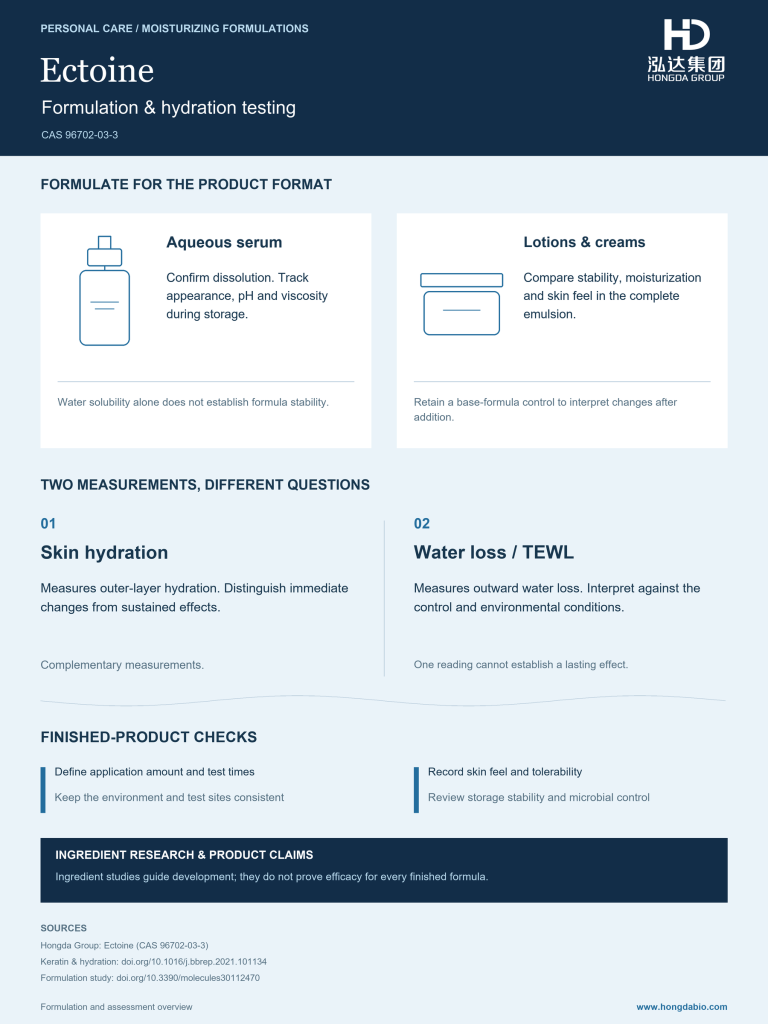
3. What Should Be Assessed in Serums and Creams?
Aqueous serums: continue testing after dissolution
Water solubility makes ectoine a practical candidate for aqueous formulations. Complete dissolution, however, is only one part of the assessment.
Serums often contain thickeners, polyols and other active ingredients. After adding ectoine, record appearance, pH and viscosity, then monitor changes under defined storage conditions. A clear, freshly prepared sample does not establish storage stability.
The addition sequence, temperature and mixing conditions should follow the ingredient’s technical documentation and the requirements of the formula. Recording these conditions during trials also helps investigate differences during scale-up or when changing material batches.
Lotions and creams: compare hydration and skin feel
A cream’s moisturizing performance depends on the complete system. Water-phase ingredients, lipids and emulsion structure all influence its behavior after application.
To assess ectoine’s contribution to a particular cream, retain the base formula as a control and prepare an ectoine-containing version while keeping other conditions as consistent as possible. Changing the lipid ratio, glycerin level and thickener at the same time makes differences difficult to attribute.
Alongside hydration measurements, record spreadability, tackiness and pilling. Recheck appearance and viscosity after storage rather than selecting a formula solely from freshly prepared samples.
4. Combining Ectoine with Sodium Hyaluronate or Panthenol
Ectoine can be formulated with other moisturizing or skin-conditioning ingredients. The choice of combination should follow a defined product objective.
For example, sodium hyaluronate grade and concentration need to be considered alongside viscosity and skin feel. Adding panthenol or another ingredient also calls for continued assessment of the complete formula’s stability and performance. Research supporting each ingredient separately does not establish an additional benefit from combining them.
Where the objective is to evaluate a combination, compare the base formula, individual ingredient versions and the combined version under consistent conditions. Testing only the final combination generally describes that product’s performance; it does not isolate the contribution of each ingredient.
Product descriptions should reflect this distinction. Stating that a formula contains ectoine and sodium hyaluronate requires different evidence from claiming that the two provide synergistic moisturizing effects.
5. Skin Hydration and TEWL Measure Different Things
Stratum corneum hydration and transepidermal water loss, or TEWL, are commonly used in moisturizer evaluation. They provide complementary information and should be interpreted separately.
| Assessment | What it examines | Interpretation point |
|---|---|---|
| Stratum corneum hydration | Hydration of the outer skin layer | Separate immediate changes from sustained effects |
| Transepidermal water loss | Water passing outward through the skin | Consider the environment, test site and residual product |
| Skin feel and tolerability | Tightness, tackiness and discomfort during use | Record separately from instrumental measurements |
| Formulation stability | Changes in appearance, pH and viscosity during storage | Assesses formula quality rather than proving efficacy |
An increase in measured hydration indicates a change under the conditions tested. A TEWL change needs to be interpreted against the control and study design. A single measurement cannot establish long-term moisturization or demonstrate that every aspect of skin barrier function has recovered.
A study published in Molecules compared emulsions containing different ectoine levels and measured hydration, TEWL and other parameters after CO₂ laser treatment. Improvements were reported for some formulations and application conditions. Read the study on ectoine-containing formulations and skin parameters after CO₂ laser treatment.
That study involved a specific setting. Everyday moisturizing serums or creams with different formulas and target populations require their own assessment rather than inheriting those efficacy results.
Before testing, define the application amount, measurement times and control conditions. Temperature, humidity, test sites and acclimatization before measurement should also be consistent. Clear records make the resulting data easier to compare and interpret.
6. Connecting Raw Material Specifications with Product Requirements
When selecting ectoine, review the assay and its analytical method. Check impurities, moisture and microbiological quality against the requirements of the intended product.
During sample trials, record both dissolution behavior and formulation performance. If the batch or supply form changes, confirm that the existing addition process remains suitable and repeat stability assessments where needed.
For water-containing products, formulation changes should also be considered in the assessment of microbiological control. A raw material quality report does not replace validation of the finished product’s preservation system.
To discuss ectoine specifications for a serum, lotion or cream, contact Hongda Group with the intended product format, formulation conditions and quality requirements.
Frequently Asked Questions
1. Does CAS 96702-03-3 identify ectoine?
Yes. CAS 96702-03-3 identifies ectoine, also written as ectoin. Purchasing checks should include ingredient composition and assay, particularly when distinguishing a powder from an ectoine-containing blend.
2. Does a higher ectoine concentration always provide better moisturization?
Concentration alone cannot determine performance. The base formula, application amount and test conditions also matter. Concentrations used in published studies belong to specific experimental designs and should not be treated as the optimum for every skincare product.
3. Are other moisturizing ingredients still needed after adding ectoine?
That depends on the product’s objectives. Ectoine can form part of a moisturizing system, while the formula still needs to balance moisture retention, lipid composition and skin feel. Decisions about other moisturizing ingredients should follow formula comparisons and finished-product testing.