



4-Methylpyridine is a starting material for isonicotinic acid. Selective side-chain oxidation converts its methyl group at the 4-position of the pyridine ring into a carboxyl group.
Isonicotinic acid can then be used to prepare ester derivatives. One example, methyl isonicotinate, has been studied as a thrips lure. For manufacturers evaluating this synthesis route, the practical questions are how much suitable isonicotinic acid the oxidation produces and whether the recovered intermediate meets the requirements of the next reaction.
1. What Is 4-Methylpyridine?
4-Methylpyridine is also known as 4-picoline or γ-picoline. Its CAS number is 108-89-4. The “4” identifies the position of the methyl group on the pyridine ring, opposite the nitrogen atom.
| Identification item | Information |
|---|---|
| Chemical name | 4-Methylpyridine |
| Common synonyms | 4-Picoline; γ-picoline |
| CAS number | 108-89-4 |
| Molecular formula | C₆H₇N |
| Molar mass | 93.13 g/mol |
| Reference boiling point | Approximately 145°C at 760 mmHg |
These identity and property data are available in the PubChem record for 4-methylpyridine. The reference boiling point helps describe the material’s volatility, although separation behavior in a process also depends on pressure and mixture composition.
Hongda Group’s 4-methylpyridine product information identifies it as a pyridine intermediate for pharmaceutical, agrochemical and other fine chemical applications.
The substitution position matters when selecting a feedstock for isonicotinic acid synthesis. Although 2-, 3- and 4-methylpyridine share the same molecular formula, they are different structural isomers. Molecular formula and molar mass alone cannot establish whether a material is suitable for this route.
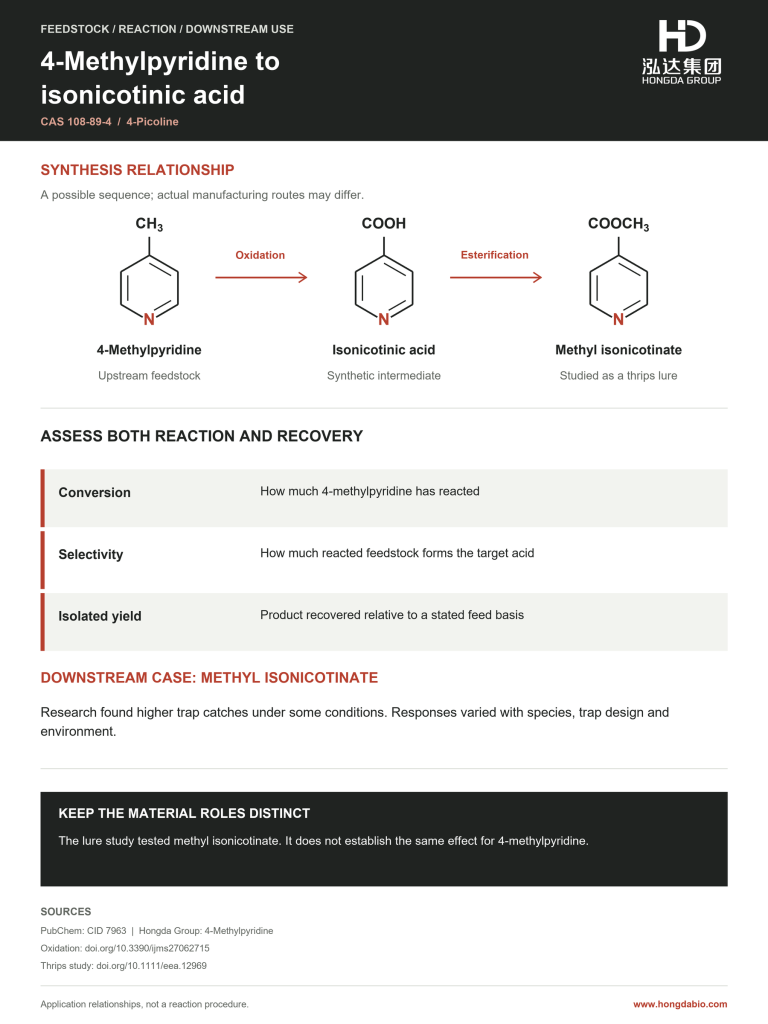
2. How Does 4-Methylpyridine Become Isonicotinic Acid?
The intended transformation oxidizes the methyl group at the 4-position to a carboxyl group while retaining the pyridine ring. The resulting compound is isonicotinic acid, also called pyridine-4-carboxylic acid.
The material relationship is:
4-Methylpyridine → selective side-chain oxidation → isonicotinic acid
Selectivity matters because consumed feedstock does not necessarily become the desired acid. The reaction mixture may contain intermediates or products formed by further oxidation.
A gas-phase oxidation study using vanadium-containing catalysts compared different catalyst compositions and temperatures. The researchers detected intermediates including pyridine-4-carbaldehyde. Within the conditions studied, increasing temperature improved 4-methylpyridine conversion but also intensified deep oxidation. Catalyst composition and temperature therefore need to be assessed together. Read the study on 4-methylpyridine oxidation to isonicotinic acid.
Those findings apply to the catalysts, feeds and equipment used in that experiment. Evaluating a production process also requires information on sustained operation, product recovery and equipment performance. An experimental temperature or conversion figure should not be treated as a universal manufacturing benchmark.
3. Conversion, Selectivity and Isolated Yield
A useful assessment separates feedstock consumption from the amount of desired product obtained.
| Metric | What it describes |
|---|---|
| 4-Methylpyridine conversion | How much of the starting material has reacted |
| Selectivity to isonicotinic acid | How much of the converted feedstock forms the desired acid |
| Isolated isonicotinic acid yield | How much target product is recovered, relative to a stated feed basis |
The calculation basis and analytical methods should be specified before comparing results.
Higher conversion may bring little improvement in acid output if competing reactions also increase. Conversely, conditions with good selectivity may leave enough unreacted feedstock to make recovery and recycling an important part of the process assessment.
Recovery and purification introduce further considerations. Product remaining in the mother liquor, the difficulty of removing impurities and the purity of the recovered acid all affect the final outcome.
For this reason, feedstock and process comparisons should include both reaction analysis and the quality of the isolated product. The practical question is how much isonicotinic acid meets the next stage’s requirements, together with the separation effort needed to obtain it.
4. A Downstream Agricultural Example: Methyl Isonicotinate
The carboxyl group of isonicotinic acid can undergo further reactions to produce derivatives such as esters. Methyl isonicotinate is one derivative that has been investigated for thrips attraction.
A possible synthesis sequence is:
4-Methylpyridine → isonicotinic acid → methyl isonicotinate
This sequence describes a chemical relationship between an upstream feedstock and a downstream compound. It does not establish the manufacturing route used for every methyl isonicotinate product.
A study published in Entomologia Experimentalis et Applicata compared traps with different colors and structures, with and without methyl isonicotinate. The lure increased thrips captures under some tested conditions, but the response depended on the thrips species, trap design and environment. In one white trap design used in the greenhouse, adding the lure produced no substantial additional increase. Read the study on visually and olfactorily enhanced thrips traps.
The compound evaluated was methyl isonicotinate. These findings do not establish equivalent attraction by 4-methylpyridine or isonicotinic acid. Increased trap catches also do not, by themselves, demonstrate field population suppression; that requires appropriate pest management trials and endpoints.
For a 4-methylpyridine user, this example shows a specific downstream connection. Feedstock evaluation concerns synthesis performance and intermediate quality, while the lure’s effectiveness must be assessed under its intended conditions of use.
5. Evaluating Feedstock for Isonicotinic Acid Synthesis
After confirming chemical identity, review how assay and impurities are measured.
Useful questions include whether the reported assay is based on chromatographic area or another defined method, and whether related methylpyridine isomers are measured separately. Any limits for water or other impurities should follow process requirements and supporting trials rather than an unsupported general specification.
When comparing samples, keep the catalyst batch, feed basis, reaction conditions and analytical methods as consistent as possible. Changing the feedstock, temperature and feed ratio together makes differences difficult to interpret.
The comparison should continue through product recovery. Two feedstock batches may perform similarly in the reactor yet differ in recovered acid purity, impurity profile or losses to the mother liquor. If the acid will subsequently undergo esterification, its acceptance criteria should also reflect the requirements of that reaction and the target ester.
Storage, transfer and operating conditions should be established using the relevant product SDS and a site-specific process assessment. Basic properties such as boiling point and density provide useful reference information, but they cannot establish suitability for a particular production unit on their own.
To discuss 4-methylpyridine specifications for isonicotinic acid synthesis, contact Hongda Group with details of the intended route, impurities of concern and downstream quality requirements.
Frequently Asked Questions
1. Are 4-methylpyridine and 4-picoline the same substance?
Yes. Both names refer to the compound with CAS number 108-89-4, also known as γ-picoline. Including the full chemical name and CAS number in purchasing and technical documents helps distinguish it from other methylpyridine isomers.
2. What is the difference between isonicotinic acid and nicotinic acid?
They differ in the position of the carboxyl group. Isonicotinic acid is pyridine-4-carboxylic acid, while nicotinic acid is pyridine-3-carboxylic acid. The target acid discussed in this 4-methylpyridine oxidation route is isonicotinic acid.
3. Can 4-methylpyridine be used directly as a thrips lure?
The study cited here evaluated methyl isonicotinate and does not establish the same use for 4-methylpyridine. In the synthesis sequence discussed, 4-methylpyridine is an upstream raw material. Any substance proposed for direct use in a trapping device requires its own assessment of effectiveness, safety and conditions of use.