



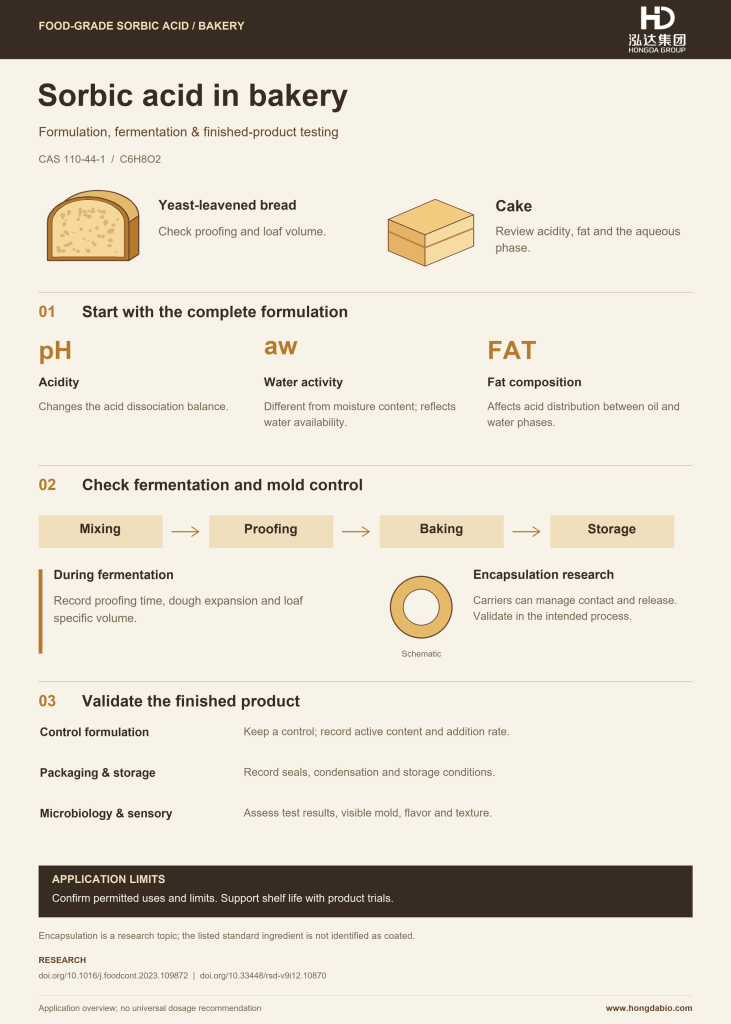
Using sorbic acid in bread requires attention to both dough fermentation and mold growth during storage. Its ability to inhibit yeast can be useful against spoilage organisms, but it may also interfere with the baker’s yeast needed for proofing. In cakes, formulation acidity, fat composition and water activity require particular attention.
A suitable application therefore starts with checking whether sorbic acid is permitted in the intended food category. Trials in the actual formulation can then establish its effect on processing and storage. Results from one bread or cake cannot automatically be transferred to another.
1. What Is Food-Grade Sorbic Acid?
Sorbic acid is an unsaturated organic acid with the molecular formula C₆H₈O₂ and CAS number 110-44-1. It is used as a food preservative to inhibit the growth of molds and yeasts.
Hongda Group’s food-grade sorbic acid product page lists bakery products among its application areas and provides product identification and specification information.
| Item | Information |
|---|---|
| Product name | Sorbic acid |
| CAS number | 110-44-1 |
| Molecular formula | C₆H₈O₂ |
| Application discussed here | Mold control in bakery products |
| Specification standard listed on Hongda’s website | GB 1886.186-2016 |
The designation “food grade” concerns the ingredient’s suitability against relevant quality specifications. It does not establish permission to use it in every food. Permitted food categories, use levels and other conditions must be checked separately.
2. Why Does the Same Addition Rate Produce Different Results?
Sorbic acid is a weak organic acid. Its dissociation changes with pH, and its antifungal performance depends partly on the undissociated acid available in the food’s aqueous phase. The total amount added does not, by itself, predict preservation performance.
Research on bread and cake molds examined the effects of pH, water activity, food composition and mold species. In complex cake systems, accounting for sorbic acid partitioning between the oil and aqueous phases improved predictions. Mold species also responded differently to changes in conditions. Study: Growth/no-growth models of propionic and sorbic acid for bread and cake moulds
These findings have practical implications for formulation trials.
pH affects acid dissociation and product quality
Under otherwise comparable conditions, a lower pH increases the proportion of undissociated sorbic acid. This does not mean that lowering pH will improve control of every mold species to the same extent.
Changing acidity may also affect fermentation, cake structure and flavor. Measure the finished product’s pH and assess these changes alongside its mold-control performance.
Moisture content cannot replace water activity
Moisture content describes how much water a food contains. Water activity reflects water availability and is an important indicator of the conditions supporting microbial growth.
Sugar, salt and other ingredients influence water activity. Two bakery products with similar moisture contents can therefore behave differently during storage. A low water addition or a dry eating texture is not enough to establish resistance to mold growth.
Fat composition affects acid distribution
Bread and a high-fat cake provide different environments for sorbic acid. Its distribution between the oil and aqueous phases can affect the concentration available where it acts.
An addition rate validated in one product should therefore be reassessed when the formulation changes. Laboratory inhibition tests can help screen options, while finished-product trials show how the complete formulation performs after processing.
3. Check Fermentation When Using Sorbic Acid in Bread
Sorbic acid can inhibit yeast. In yeast-leavened bread, this may affect proofing as well as spoilage control.
Possible changes include longer proofing times, reduced dough expansion or lower loaf volume. Whether these occur depends on the amount used, the formulation, the addition method and contact conditions. Sorbic acid should not be assumed to disrupt fermentation under every set of conditions.
Compare a control and trial batches made with the same base formulation. Record:
- Time required to reach the target proofing condition.
- Dough expansion and finished loaf specific volume.
- Crumb structure, firmness and flavor.
- Mold development during storage.
A treatment that improves mold control but reduces loaf volume or disrupts production timing still needs adjustment. Preservation performance and processing suitability should be evaluated together.
4. What Does Encapsulated Sorbic Acid Aim to Improve?
One purpose of coating or microencapsulation is to reduce contact between sorbic acid and yeast during fermentation, with release occurring later in processing. Whether this works as intended depends on the carrier, encapsulation structure and actual mixing, proofing and baking conditions.
A study in loaf bread compared microencapsulated sorbic acid prepared using different lipid carriers. It assessed mold growth alongside texture, moisture and water activity. This provides experimental support for investigating encapsulation as a way to manage fermentation and preservation, but it does not establish equivalent performance for every coated product. Study: Influence of encapsulated sorbic acid addition in loaf bread for shelf-life extension
Before comparing products, establish their active sorbic acid content and release behavior under the intended process. Two calculation issues deserve attention.
Encapsulated product weight is not the same as sorbic acid weight.
The carrier contributes to the product’s mass. Compare active ingredient amounts rather than product addition rates alone. Even at the same active addition, differences in release and distribution may produce different results.
A flour-based addition rate is not the concentration in the finished food.
Research may express an addition as a percentage of flour weight. That figure cannot be treated directly as a finished-food concentration. Calculations need to distinguish active content, the stated addition basis and finished-product mass, following the applicable regulatory requirements.
Carrier materials may also affect processing and sensory properties. Trials should therefore use the intended production conditions. Storage results reported in a paper apply to that study’s formulation and conditions; they are not a shelf-life guarantee for another product.
This section discusses encapsulation research. It does not indicate that the standard food-grade sorbic acid listed on Hongda Group’s website is an encapsulated product.
5. How Should Bakery Preservation Trials Be Designed?
Before testing, define the food category, formulation and intended storage conditions. Once permitted use has been confirmed, compare treatments under controlled conditions.
| Evaluation stage | Suggested records |
|---|---|
| Formulation | Finished-product pH, water activity, fat and sugar composition |
| Processing | Mixing uniformity, fermentation time, loaf volume and internal structure |
| Packaging | Packaging material, seal condition and any condensation |
| Storage | Microbiological results, visible mold, odor, texture and sensory acceptability |
Keep production, packaging and storage conditions consistent between treatments wherever possible. Changing the preservative, acidity, packaging and process at the same time makes it difficult to identify what caused an improvement.
Records should include ingredient batch numbers, actual addition rates, active-content calculations and processing conditions. These details help investigate differences between production batches.
Shelf-life assessment should also extend beyond visible mold. Flavor or texture may become unacceptable before mold appears, while a normal appearance does not replace the relevant microbiological testing. Challenge studies involving deliberate mold inoculation should be designed and conducted by a suitably equipped laboratory.
Preservative use also needs to work alongside hygiene, cooling, slicing and packaging controls. If contamination occurs after baking or packaging seals are unreliable, investigate those causes before changing the formulation.
6. Confirm Ingredient Specifications and Conditions of Use Separately
At purchasing, use the agreed specification and batch documentation to assess ingredient quality. During formulation, check the intended market’s requirements for the food category, permitted uses, maximum levels and calculation rules.
For products sold in China, consult GB 2760-2024 and applicable subsequent announcements. This standard addresses food additive use principles, permitted uses and maximum levels. Its role differs from that of the ingredient specification standard. GB 2760-2024: Standard for Uses of Food Additives — Chinese text
Filled, layered or decorated bakery products may require consideration of the classifications and rules applying to their components. The broad description “cake” is not sufficient to establish every condition of use. Products intended for export require a separate check against destination-market requirements.
To discuss raw material specifications, contact Hongda Group with the intended food type, processing method and sales market. This information helps identify the product documentation needed for further evaluation.
Frequently Asked Questions
1. Are sorbic acid and ascorbic acid the same ingredient?
No. Sorbic acid and ascorbic acid are different substances. Ascorbic acid is vitamin C. Their similar names do not make them interchangeable. Check both the chemical name and CAS number when searching or purchasing.
2. Can encapsulated sorbic acid replace ordinary sorbic acid at the same addition rate?
Not directly by product weight. First check the active sorbic acid content, then evaluate how the carrier and release behavior affect fermentation, processing and mold control. Equal active amounts do not necessarily produce equal performance.
3. How many days of bread shelf life does food-grade sorbic acid guarantee?
No fixed shelf life can be established from the ingredient name or addition rate alone. Formulation, production hygiene, packaging and storage conditions all affect the result. Shelf life should be supported by trials on the intended product, including microbiological, flavor and texture assessments.