



2-Methylpyridine, also known as 2-picoline, has CAS number 109-06-8. It is an organic synthesis intermediate with a methyl group on the carbon next to the nitrogen atom in the pyridine ring. A purchase order that lists only “picoline” leaves the isomer unspecified. Confirm the full name and CAS number before placing the order.
| Item | 2-Methylpyridine |
|---|---|
| Chemical name | 2-Methylpyridine |
| Common synonyms | 2-Picoline, α-picoline |
| CAS number | 109-06-8 |
| Molecular formula | C₆H₇N |
| Molar mass | Approximately 93.13 g/mol |
| Appearance | Colorless liquid |
| Reference density | Approximately 0.944 g/mL at 20 °C |
| Reference boiling point | Approximately 128–129 °C at 760 mmHg (about 101.3 kPa) |
| Product standard listed by Hongda | HG/T 4482-2012 |
| Supply formats listed by Hongda | 190 kg steel drums or bulk supply |
The density and boiling point are published reference values from REMPEC and NOAA CAMEO Chemicals, respectively. Hongda lists HG/T 4482-2012 as the product standard for its industrial 2-methylpyridine. To assess delivered material, compare the results on the batch certificate of analysis (COA) with the agreed purchase specification.
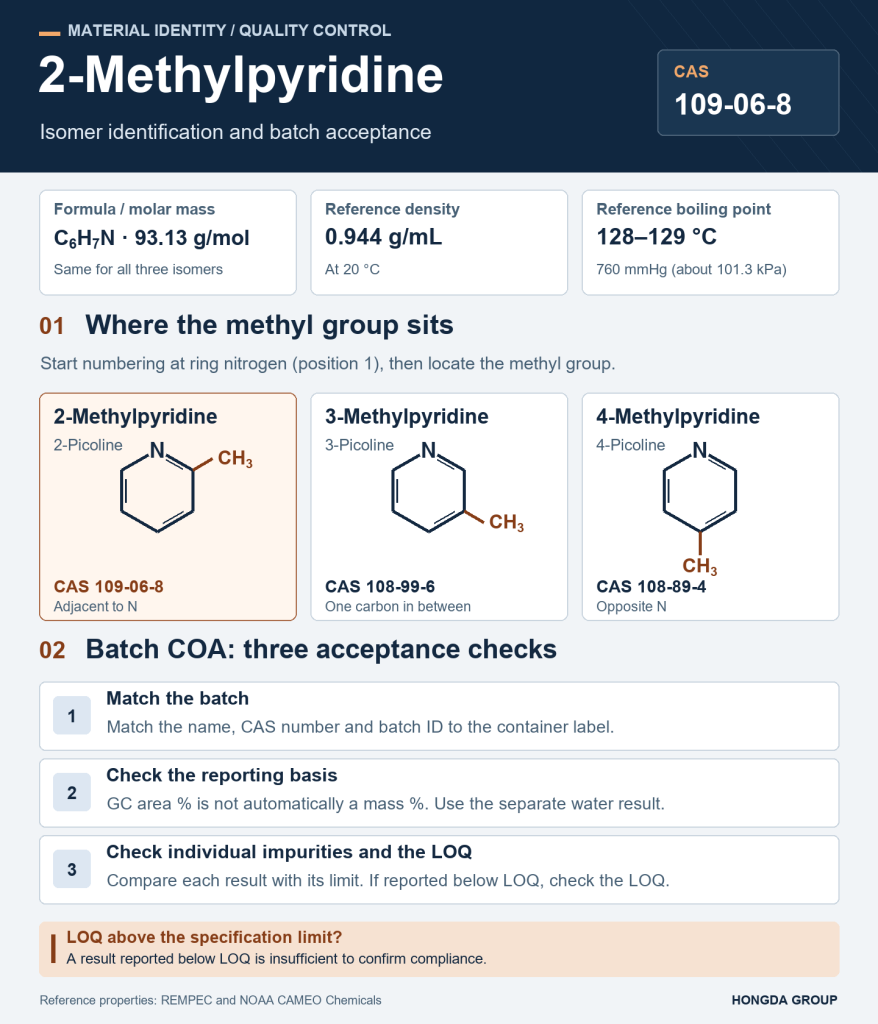
How to distinguish 2-, 3- and 4-methylpyridine
The nitrogen atom is position 1 in the pyridine ring. The number in each name identifies the carbon that carries the methyl group.
| Compound | Common synonyms | Methyl group position relative to ring nitrogen | CAS number |
|---|---|---|---|
| 2-Methylpyridine | 2-Picoline, α-picoline | Adjacent to nitrogen | 109-06-8 |
| 3-Methylpyridine | 3-Picoline, β-picoline | One carbon between the substituted carbon and nitrogen | 108-99-6 |
| 4-Methylpyridine | 4-Picoline, γ-picoline | Opposite nitrogen | 108-89-4 |
All three isomers have the same molecular formula and molar mass. A molecular ion of the expected mass cannot, by itself, establish where the methyl group is attached. That position matters when the methyl group is the site of a downstream reaction. For example, in the conversion of 3-methylpyridine to nicotinaldehyde, the methyl group becomes an aldehyde group, and the substituent remains at position 3 on the ring.
If the purchase order says 2-Picoline and the drum label says 2-Methylpyridine, the names are consistent when both documents list 109-06-8. If a document names 2-picoline but gives the CAS number for 3-methylpyridine, resolve the discrepancy with the supplier before releasing the material for use.
When a single purity result is insufficient
Two batches can have the same reported 2-methylpyridine content and still contain different amounts of individual impurities. If the purchase specification sets a separate limit for 3-methylpyridine, a COA that lists only the main component does not establish whether that limit has been met. The main component result also cannot tell you how much pyridine, 4-methylpyridine or water is present.
Chinese patent CN118258927B illustrates the issue. Its gas chromatogram of a reference mixture identifies separate peaks for pyridine, 3-methylpyridine, 4-methylpyridine and 2-methylpyridine. If two components co-elute under the method being used, the combined peak area alone cannot show how much of each is present. The patent describes a publicly disclosed analytical method; its chromatogram is not a Hongda batch test result.
Three checks before accepting a batch
- Match the batch number. Check that the product name, CAS number and batch number on the COA match the container label. If a shipment contains more than one batch, match each batch to its own COA.
- Check how purity and water are reported. A gas chromatography (GC) peak-area percentage is not automatically a mass fraction. Subtracting that percentage from 100% does not give the water content. If the purchase specification sets a water limit, check the separately measured water result.
- Compare individual results with the agreed limits. Where the specification limits a named impurity, look for a separate result. If the report says “below the limit of quantitation” (LOQ), compare the LOQ with the contractual maximum. If the LOQ is above that maximum, the impurity could still exceed the limit. That entry alone is insufficient for acceptance.
Frequently asked questions
What should a purchase specification say if the supplier lists only “picoline”?
Use 2-Methylpyridine (2-Picoline), CAS 109-06-8. Ask the supplier to use the same identifier on the quotation, container label and batch COA. Adding the formula or molar mass alone will not distinguish the three positional isomers.
Does a difference in density or boiling point mean the wrong material was delivered?
Check the measurement conditions first. Compare density at the same temperature and boiling point at the same pressure. A boiling point measured under vacuum cannot be compared directly with the atmospheric-pressure value in the table. If the discrepancy remains under comparable conditions, confirm the material using the agreed identification method.
What is the difference between the SDS and the COA?
The safety data sheet (SDS) identifies the product and covers its hazards, handling and storage. Check the supplier, product identifier and revision date. The COA reports results for a specific batch. For a first order, a sample COA can show which tests are routinely reported. Use the COA for the delivered batch to make the acceptance decision.
For a sample COA or the current SDS, contact Hongda’s technical team at info@hongdabio.com. If your specification sets limits for individual impurities, include their names and acceptance limits so the team can check whether routine batch testing can verify compliance.