



Riboflavin (vitamin B2, CAS 83-88-5) can be added to animal diets through feed premixes. Nicotinic acid and nicotinamide are common sources of vitamin B3 in feed. All three belong to the B-vitamin group, but their chemical identities and water solubilities differ. Feed formulations account for B2 and B3 separately.
Riboflavin (Vitamin B2) Product Information
| Item | Details |
|---|---|
| Name | Riboflavin, also known as vitamin B2 |
| CAS number | 83-88-5 |
| Molecular formula | C₁₇H₂₀N₄O₆ |
| Relative molecular mass | 376.36 for riboflavin itself. Source: GB 14752–2010, Section 3.4 |
| Listed product grade | 80% riboflavin, yellow to brown granules |
| Listed packaging | 25 kg carton |
The CAS number, molecular formula and relative molecular mass refer to riboflavin itself. The granule appearance and packaging refer to Hongda’s 80% Riboflavin. On receipt, match the lot number on the packaging to the certificate of analysis (COA), then check whether the assay is reported as received or on a dry basis.
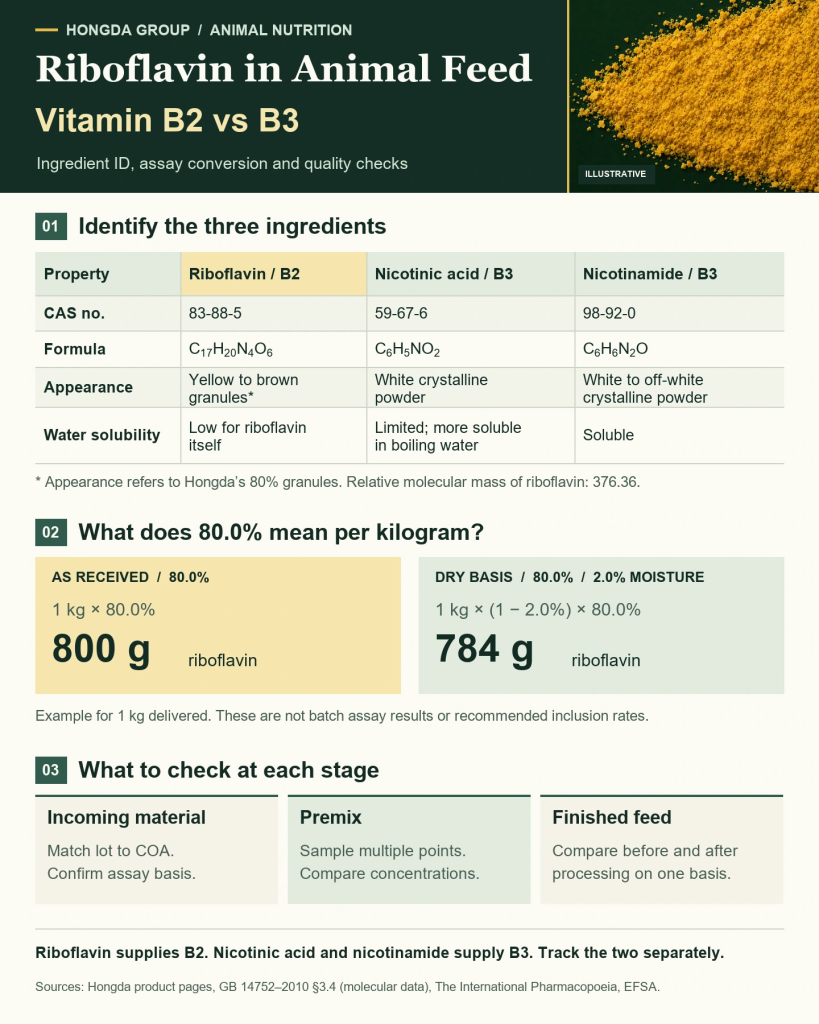
Riboflavin, Nicotinic Acid and Nicotinamide: How Do They Differ?
If a premix purchase order specifies only “vitamin B3,” confirm whether it calls for nicotinic acid or nicotinamide, also known as niacinamide. Nicotinic acid is a carboxylic acid; nicotinamide is its corresponding amide. Each has its own CAS number.
| Property | Riboflavin | Nicotinic Acid | Nicotinamide |
|---|---|---|---|
| Vitamin designation | B2 | B3 | B3 |
| CAS number | 83-88-5 | 59-67-6 | 98-92-0 |
| Molecular formula | C₁₇H₂₀N₄O₆ | C₆H₅NO₂ | C₆H₆N₂O |
| Appearance | Hongda’s 80% product is supplied as yellow to brown granules | White crystalline powder | White or nearly white crystalline powder |
| Water solubility | Riboflavin itself has low water solubility | Limited solubility in water; more soluble in boiling water | Soluble in water |
Appearance is useful as an initial check. Nicotinic acid and feed-grade nicotinamide are both light-colored crystalline powders, so color alone cannot distinguish them. The shade of riboflavin granules does not indicate their assay, either. Use the specific ingredient name on the purchase order, label and COA.
Riboflavin is classified as a water-soluble vitamin, but that does not mean an 80% granular preparation will dissolve quickly in water at room temperature. The International Pharmacopoeia describes riboflavin as very slightly soluble in water and notes that its solutions deteriorate on exposure to light, particularly under alkaline conditions. Those properties apply to riboflavin itself. How a commercial granule disperses in a liquid formulation needs to be tested separately.
How to Read the Assay on an 80% Riboflavin COA
An assay of 80.0% can mean two different amounts of riboflavin per kilogram delivered. An as-received result uses the total sample weight, including moisture. A dry-basis result uses the weight of the dry matter.
Take 1 kg of material as received:
- 80.0% assay as received: The kilogram contains 800 g of riboflavin.
- 80.0% assay on a dry basis, with 2.0% moisture in the same lot: The kilogram contains 980 g of dry matter and therefore 784 g of riboflavin.
These figures illustrate the calculation. They are neither Hongda batch results nor recommended inclusion rates. An EFSA assessment of a riboflavin feed additive shows the distinction in practice: the specification for the preparation under review was stated on a dry matter basis, while the batch results were reported as is. If a COA gives only a percentage, confirm the reporting basis before using it. An as-received assay needs no further moisture correction.
What to Check in the Ingredient, Premix and Finished Feed
For the incoming ingredient, check how much riboflavin is in each kilogram delivered. In the premix, check whether the concentration is consistent across the batch. A composite sample may test close to target even when individual sampling points differ. To assess uniformity, test samples from separate points in the same batch.
To assess whether riboflavin content changes after pelleting or storage, take comparable samples before and after the relevant step. Use the same analytical method, units and moisture basis to compare results. Set the target concentration in the finished feed according to the animal species, production stage and nutritional standard used in the formulation. The 80% ingredient grade does not set that target.
Frequently Asked Questions
Is riboflavin the same as vitamin B2?
Yes. Riboflavin is vitamin B2 and has CAS number 83-88-5. Specify the commercial grade on the purchase order, such as feed-grade 80% riboflavin. The CAS number identifies the compound; it does not specify the grade or assay.
Can nicotinic acid or nicotinamide replace riboflavin in feed?
They cannot meet the vitamin B2 target. Nicotinic acid and nicotinamide supply B3, while riboflavin supplies B2. If a formulation lists only “B vitamins,” check the target for each vitamin before reviewing the premix label.
Can I use loss on drying as the moisture value for a dry-basis calculation?
Check the test method and calculation basis stated on the COA. Loss on drying can include volatile losses other than water. If the certificate does not explain whether the value can be used for the conversion, confirm it with the issuer.