



Trace drug analysis in water often requires an enrichment step before instrumental measurement. An adsorbent that also retains interfering compounds, or holds the target too strongly for effective elution, can complicate the analysis.
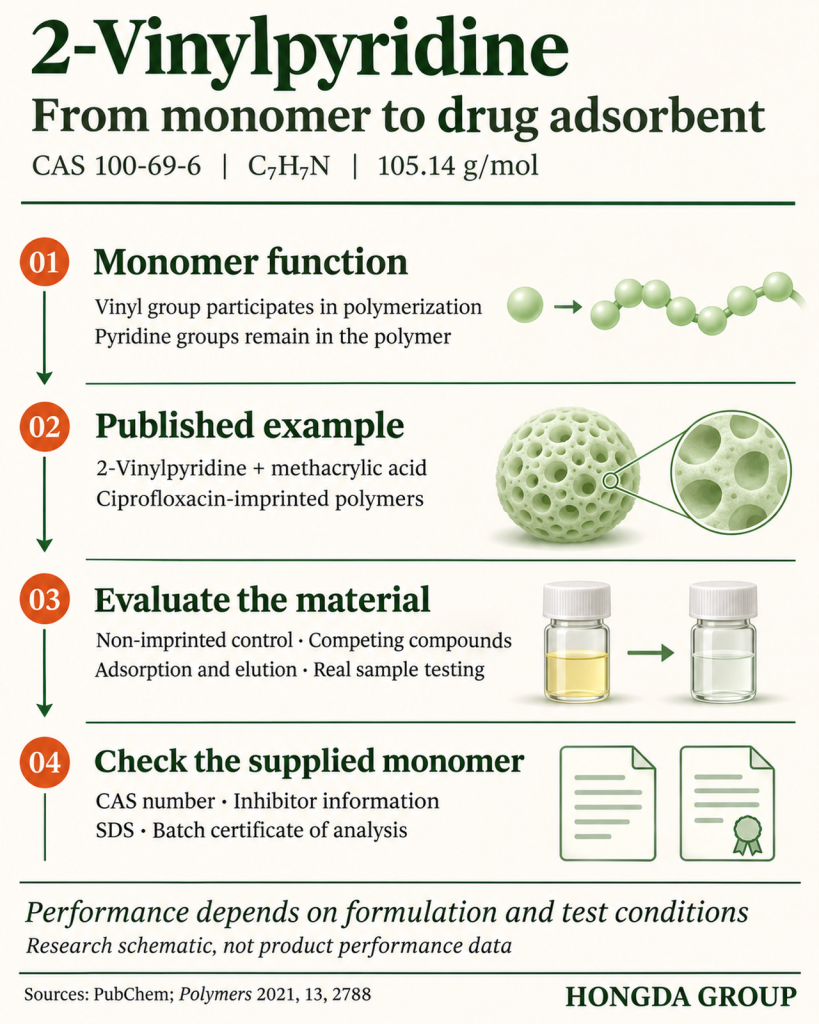
2-Vinylpyridine is one functional monomer investigated for these materials. A published study combined it with methacrylic acid to prepare ciprofloxacin-imprinted polymers for selective solid-phase extraction. Its role depends on both its molecular structure and the polymer formulation.Related research
1. What is the CAS number of 2-vinylpyridine?
The CAS number of 2-vinylpyridine is 100-69-6. Other names include 2-ethenylpyridine and α-vinylpyridine.
| Property | Information |
|---|---|
| Chemical name | 2-Vinylpyridine |
| CAS number | 100-69-6 |
| Molecular formula | C₇H₇N |
| Molar mass | Approximately 105.14 g/mol |
| Structural feature | A vinyl group at the 2-position of the pyridine ring, adjacent to the ring nitrogen |
These identifiers can be checked against the PubChem record for 2-vinylpyridine.
The vinyl group can participate in polymerization, leaving pendant pyridine groups in the polymer. The nitrogen atom and aromatic ring provide opportunities for intermolecular interactions.
Their presence alone does not establish effective adsorption. The target compound must be able to reach the relevant groups, and the polymer’s behavior in the working solvent also matters.
2. Why investigate it for drug adsorption?
Drug molecules differ considerably. Ibuprofen and naproxen contain carboxyl groups, while other drugs have several ionizable groups. Functional monomer selection should account for the target’s state in the working solution.
An experimental and theoretical study examined interactions between 2-vinylpyridine and the acidic pharmaceuticals ibuprofen, diclofenac and naproxen. Such research provides a basis for monomer selection and illustrates why formulations need to be developed around a defined target.Original study
2-Vinylpyridine can be combined with other monomers and crosslinkers. Changing their proportions may affect the concentration of pyridine groups, crosslinking, pore structure and swelling.
When comparing formulations, record both preparation and testing conditions. A single uptake measurement rarely explains why one material performs differently from another.
3. A published example: ciprofloxacin-imprinted polymers
The 2021 study cited above used methacrylic acid and 2-vinylpyridine as dual functional monomers to prepare ciprofloxacin-imprinted polymers. It investigated monomer ratios and included corresponding non-imprinted controls.
Molecular imprinting introduces a target molecule during preparation. After polymerization and template removal, the material is assessed for its ability to bind that molecule again.
The study connects monomer selection with formulation and an analytical application. Its results apply to the prepared polymers and specified test conditions.
Changing the raw material batch, monomer ratio or sample conditions calls for fresh adsorption and elution checks. Published performance figures cannot replace validation of the new material.
4. What should be measured?
An adsorbent for drug analysis must enrich the target and work with the subsequent measurement. The following checks provide a starting point for experimental design.
| Assessment | Question to answer |
|---|---|
| Non-imprinted control | Does the imprinted material offer an additional binding advantage under matched conditions? |
| Competing compounds | Are related drugs or sample components also retained appreciably? |
| pH and solvent conditions | How do changes affect binding and the physical state of the material? |
| Adsorption and elution | Can the target be retained and subsequently released? |
| Real sample testing | Do recovery and repeatability meet the analytical requirements in the intended matrix? |
| Blanks and residuals | Do template residues or extractable substances interfere with measurement? |
A non-imprinted control helps assess the contribution of imprinting. Competition experiments and material characterization are also needed before attributing every difference to specific binding.
Report adsorption capacity, removal percentage and extraction recovery separately. A substantial decrease in target concentration during loading does not guarantee complete recovery in the eluate. Incomplete elution, adsorption to containers and analytical matrix effects can affect the final result.
pH requires experimental assessment as well. It can influence drug ionization, protonation of pyridine groups and polymer swelling. Neither increasing acidity nor increasing alkalinity should automatically be assumed to improve adsorption.
5. What should be checked besides monomer purity?
Before adapting a published method, confirm the inhibitor information for the supplied material.
If the product contains an inhibitor, check its identity and concentration against the intended polymerization method. Any pretreatment should follow a validated procedure and the applicable safety requirements. A method used for another commercial grade may not transfer directly.
Review the SDS and batch certificate separately. The SDS provides hazard, handling, storage and emergency information. The certificate of analysis records the tests and results for a particular batch.
When checking the 2-vinylpyridine boiling point, retain the source and measurement conditions. PubChem lists values around 159–160°C. If another document gives a reduced-pressure boiling point, check the pressure before comparing temperatures.
For product evaluation, consult Hongda Group’s 2-vinylpyridine product page and confirm the supplied specification, inhibitor information and corresponding SDS. Keep the supplier, batch number and pretreatment history in the experimental record to help investigate differences between trials.
Frequently asked questions
1. Are 2-vinylpyridine and 4-vinylpyridine the same chemical?
No. Their vinyl groups occupy different positions on the pyridine ring, making them positional isomers. Check the full name and CAS number when purchasing. Substitution in a formulation requires separate validation.
2. What is the difference between 2-vinylpyridine and poly(2-vinylpyridine)?
2-Vinylpyridine is the monomer. Poly(2-vinylpyridine), commonly abbreviated P2VP, is its polymer. Crosslinked imprinted materials prepared with 2-vinylpyridine may contain other monomers and crosslinkers, giving them a different composition from P2VP.
3. Where can I obtain a 2-vinylpyridine SDS or MSDS?
Request the latest SDS corresponding to the purchased product from the actual supplier. MSDS is an older term that remains common in searches. Handling and storage should follow the current document for the supplied material.