
Propionic Acid for Feed Additives: Preservation & Broiler Use

Broiler feed needs to retain its quality through processing, transport, and storage. Damp ingredients, condensation inside feed bins, and extended storage can increase the risk of mold. When feed starts heating up, forming lumps, or developing a moldy smell, the cause needs investigation and the affected batch needs assessment.

Propionic acid is an organic acid used to help preserve feed by limiting mold growth. It can help reduce quality losses associated with mold during storage. Hongda Group’s propionic acid product page provides basic product information and describes its feed preservation application. Feed manufacturers and poultry businesses should also confirm the supplied product’s specifications and suitability for feed use in their market.

Propionic acid works by interfering with processes that mold cells need for normal growth. This makes it harder for mold to multiply in feed. However, different molds respond differently, and results also depend on the feed and its storage conditions.

For this reason, propionic acid is best considered as a preventive measure before feed becomes visibly moldy. Adding it to a batch that already contains visible mold does not establish that the feed is safe to use.

Mold and mycotoxins also need to be considered separately. Mycotoxins are harmful substances produced by certain molds, and they may already be present when ingredients arrive at the feed mill. Propionic acid can help control further mold growth, but it should not be treated as a product that removes existing toxins. Suspect ingredients and feed require appropriate sampling and testing; appearance and smell alone cannot establish safety.
Propionic Acid for Feed Additives: Preservation & Broiler Use

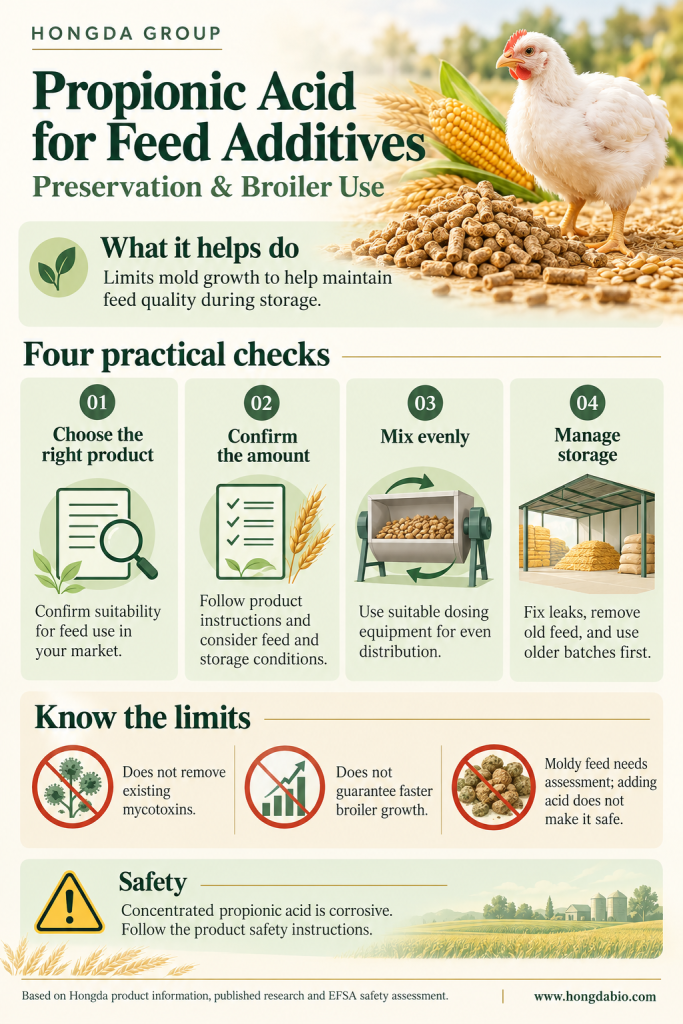
In broiler production, the first step is to identify the storage problem that needs attention. Ingredients transported over long distances and finished feed held for several days may face different conditions. Consider whether materials are likely to absorb moisture, whether storage areas become hot and humid, and how quickly each batch is normally used. A supplier’s application rate needs to be assessed against these actual conditions.

The amount to add depends on the specific product. Products can contain different amounts of propionic acid, so adding one kilogram of one product may not provide the same amount of acid as one kilogram of another. Follow the product instructions and have the person responsible for feed formulation confirm the rate against the ingredients and storage requirements. When changing products or suppliers, review the rate again.

Even mixing is equally important. Liquid propionic acid needs suitable dosing and application equipment so that it is distributed throughout the feed. Uneven treatment can leave some areas insufficiently protected. Before routine use, a small batch can be checked over the intended storage period for mold, heating, and lump formation, with testing where needed.

Broiler feed intake should be observed alongside feed quality. After introducing a new product, check whether birds continue eating normally and whether weight gain or feed consumption changes. If problems occur, review ingredient quality, mixing, and flock management together rather than attributing every change to the additive.

Feed preservation should not be presented as a guarantee of faster growth. In one broiler feeding trial, propionic acid supplied alone did not significantly change weight gain or feed intake. Preserving feed quality and improving bird performance therefore need separate evaluation.

Storage management remains part of the daily routine. Repair leaking bins, remove accumulated old feed, and use older batches first. During prolonged hot or humid weather, inspect bins and conveying equipment for places where moisture or feed can collect.

Handling also requires care. Concentrated propionic acid is corrosive. Storage containers, transfer equipment, and protective clothing should follow the product’s safety instructions, with measures to prevent direct skin and eye contact.

Before using propionic acid in broiler feed, tell the supplier about the feed type, intended storage period, and destination market. Obtain the product instructions, batch test report, and safety information before arranging an application trial. For Hongda product specifications and supply details, contact Hongda Group.
Pyridine: How Its Structure Shapes Its Role in Industrial Synthesis

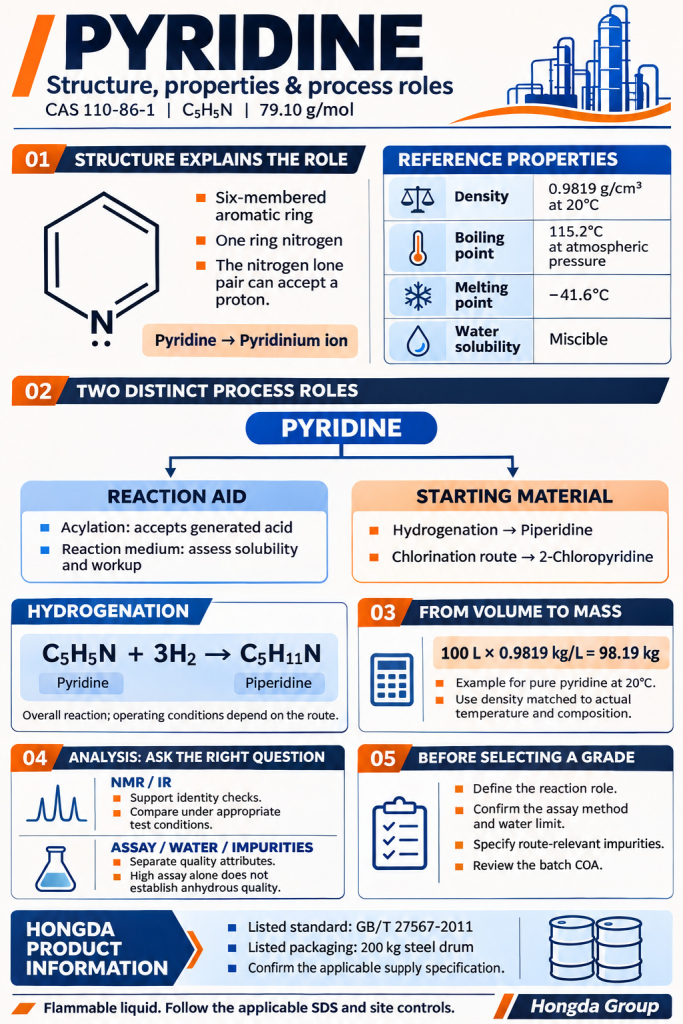
Pyridine can accept acid during acylation, serve as a reaction medium, or undergo hydrogenation to produce piperidine. These roles place different demands on the material. Water content matters in moisture-sensitive reactions, while solvent selection also requires attention to solubility and downstream separation.

Understanding pyridine’s structure and physical properties helps explain its role in a process and which specification data deserve closer attention.

Pyridine at a glance

PropertyInformation
Chemical namePyridine
CAS number110-86-1
Molecular formulaC₅H₅N
Molar mass79.10 g/mol
StructureSix-membered aromatic ring containing one nitrogen atom
AppearanceThe pure substance is typically a colorless liquid with a pronounced, unpleasant odor
DensityApproximately 0.9819 g/cm³ at 20°C
Boiling pointApproximately 115.2°C at atmospheric pressure
Melting pointApproximately −41.6°C
Water solubilityMiscible with water
Standard listed on Hongda’s product pageGB/T 27567-2011
Packaging listed on Hongda’s product page200 kg steel drum

Density, boiling point, melting point, and water miscibility are reported in IARC’s pyridine monograph. The standard and packaging details are listed on Hongda’s product page.

These physical properties are reference values. Assay, water content, and impurity results for a supplied batch should be checked against its analytical report.

Pyridine structure, properties and industrial synthesis roles

What the nitrogen atom changes

Pyridine contains five carbon atoms and one nitrogen atom in an aromatic six-membered ring. Its ring framework resembles benzene, but the nitrogen changes the molecule’s electron distribution.

The nitrogen lone pair is separate from the six-electron aromatic π system. It can accept a proton to form a pyridinium ion, explaining pyridine’s basicity and its ability to accept acid.

This behavior also affects workup. Adding acid converts some free pyridine into a salt and changes its separation behavior. Acid washing in certain processes makes use of this property.

Pyridine also differs from triethylamine and 4-dimethylaminopyridine, or DMAP. Even when these materials appear in similar reactions, their roles and required amounts may differ. Substitution calls for a fresh assessment.

What pyridine does in acylation

An acid chloride reacts with an alcohol to form an ester and hydrogen chloride. Pyridine can accept the acid formed. Preparing cyclohexyl benzoate from benzoyl chloride and cyclohexanol is one textbook example using pyridine. Acid halide reaction reference

For acid acceptance, the charge must account for acid formation. When pyridine also serves as the medium, solubility, mixing, and workup affect the quantity required.

Acid chlorides also react with water. Moisture-sensitive processes therefore need water data for the feed materials, including pyridine.

A starting material for piperidine and chloropyridine intermediates

Hydrogenation converts pyridine’s aromatic ring into the saturated nitrogen-containing ring of piperidine:

C₅H₅N + 3H₂ → C₅H₁₁N

Here, pyridine itself undergoes conversion. A 2024 paper in the Journal of the American Chemical Society discusses pyridine hydrogenation and reports an electrocatalytic approach. Research on hydrogenation of nitrogen-containing aromatic compounds

Beyond hydrogenation to piperidine, pyridine can also serve as a starting material for halogenated pyridine intermediates such as 2-chloropyridine.

For pharmaceutical and agrochemical intermediate projects, material evaluation should follow the actual route. Is pyridine the substrate being converted, or is it a base or solvent used in one step? That distinction helps determine which quality attributes need attention.

Why density and water miscibility matter in practice

Density should be quoted with its temperature. The reference value of approximately 0.9819 g/mL applies to pure pyridine at 20°C.

Using that value, the estimated mass of 100 L is:

100 L × 0.9819 kg/L = 98.19 kg

This is a mass–volume conversion example. Operational calculations should use data appropriate to the material’s temperature and composition. Recovered pyridine or a mixed process stream requires its own density assessment.

Water miscibility affects separation. Mixing pure pyridine with water does not produce an oil-like layer above or below an aqueous layer. In a reaction mixture containing other organic solvents, phase formation and pyridine distribution depend on the overall composition and acid–base conditions.

Solvent evaluation should include removal, recovery, and residual control in the product. Successful conversion does not necessarily mean straightforward workup.

What NMR and IR can establish

Pyridine NMR and IR references help with identity checks and the investigation of residual pyridine after a reaction.

Molecular symmetry gives unsubstituted pyridine three proton environments: positions 2 and 6, positions 3 and 5, and position 4. Coupling produces splitting, so this does not mean three singlets.

NMR comparison should account for solvent, measurement conditions, and protonation. IR assessment should use an overall comparison with a reliable reference spectrum rather than a single absorption band.

Identity testing and batch quality assessment answer different questions. Once identity has been established, assay, water content, and relevant impurities still need to be determined using agreed methods.

Matching the specification to the process

When purchasing pyridine, analytical requirements should reflect the intended application rather than a comparison of assay figures alone.

Item to reviewProcess relevance
Assay and analytical methodSupports charge calculations and meaningful comparison between reports
Water contentParticularly relevant when moisture-sensitive reagents are used
Related impuritiesIdentifies components that need control for the selected route
Batch consistencyRequires comparable methods and acceptance criteria
PackagingMust suit receiving, storage, and handling arrangements

Hongda’s pyridine product page lists the basic product information, GB/T 27567-2011, and 200 kg steel-drum packaging. Projects with specific moisture or impurity requirements should state those limits before comparing the supply specification and batch report.

Pyridine is flammable, and vapor exposure and liquid contact require control. Storage, transfer, and protective measures should follow the applicable SDS and site assessment.

Frequently asked questions

What are the formula and CAS number of pyridine?

Pyridine has the formula C₅H₅N and CAS number 110-86-1. Its molar mass is approximately 79.10 g/mol.

What is the structure of pyridine?

Pyridine is a six-membered aromatic heterocycle containing one nitrogen atom and five carbon atoms. The nitrogen lone pair can accept a proton.

What is the density of pyridine?

A reference value is approximately 0.9819 g/cm³ at 20°C. Temperature and material composition should be stated when density is used for charge calculations.

What are pyridine’s industrial applications?

Pyridine can serve as a base, reaction medium, or starting material in organic synthesis. Examples include acid acceptance during acylation, hydrogenation to piperidine, and preparation of chloropyridine intermediates.

Are pyridine and pyrimidine the same substance?

No. Pyridine contains one ring nitrogen, while pyrimidine contains two. Pyrimidine has the formula C₄H₄N₂. Their identities, specifications, and reaction properties differ.

Does high-purity pyridine mean anhydrous pyridine?

Assay alone does not establish anhydrous quality. Check the measured water content and the water limit defined for the grade.

To discuss material suitability, contact Hongda Group with the intended process role, required quantity, and any moisture or impurity limits so the relevant product documentation can be reviewed.

Academician Zheng Yuguo and His Team Visit Hongda Group

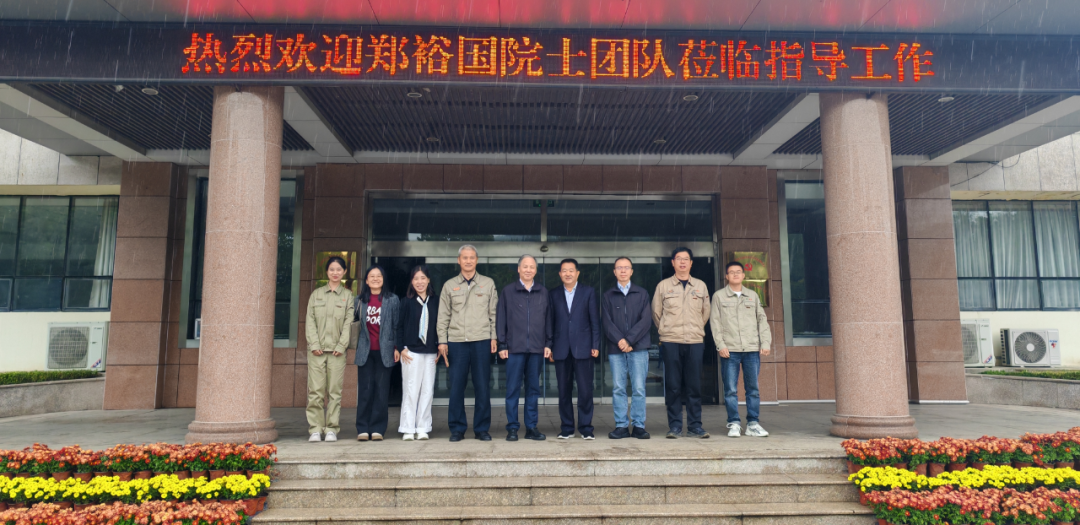
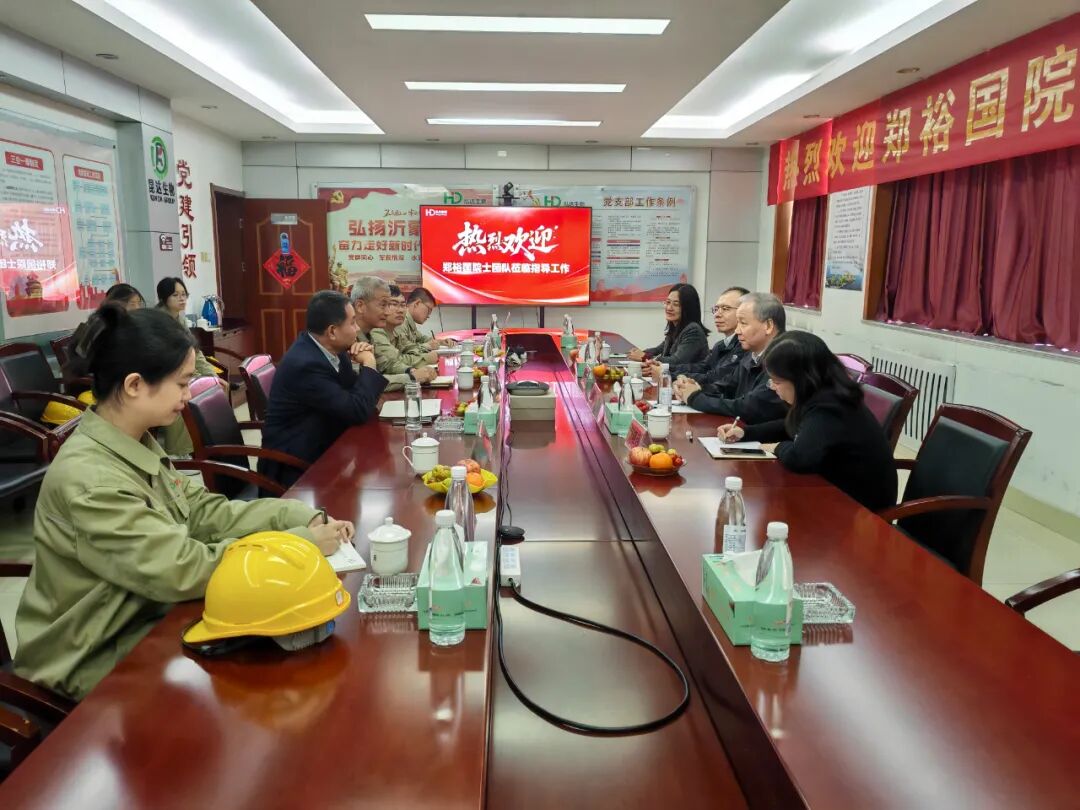
On October 17, 2025, Hongda Group welcomed an important visit. Academician Zheng Yuguo, a leading authority in China’s biotechnology field, led his team to the Group for an exchange and held a productive discussion with Chairman Shi Liliang on strategic cooperation. The visit brought a forward-looking academic perspective to Hongda and created new consensus and momentum for deeper industry–university–research collaboration.

Academician Zheng Yuguo and his team visit Hongda Group

Accompanied by Group Deputy General Manager Zhang Chenghu, Academician Zheng and his delegation first visited Hongda Group’s niacin production base. During the tour, Academician Zheng carefully reviewed the complete innovation chain, from fermentation-process development to quality control. He expressed high recognition of Hongda Group’s breakthroughs in high-quality production and offered valuable suggestions on key technical steps in the process.

The subsequent meeting took place in a practical and forward-looking atmosphere. Chairman Shi Liliang warmly welcomed Academician Zheng and his team and gave a systematic overview of the company’s industrial layout and research achievements in amino acids, antibiotics and other fields. He emphasized that Hongda has always been committed to turning cutting-edge science into practical solutions and serving people’s lives with higher-quality products.

Academician Zheng spoke highly of Hongda Group’s technical path and development strategy. In light of the latest global trends in biotechnology, he offered a series of strategic recommendations on jointly building new technology platforms and optimizing processes. The two sides held in-depth discussions on pathways for integrating industry, universities and research in amino-acid production, reached a number of shared understandings, and initially established a framework of cooperation intentions. They also exchanged views on talent development and the construction of innovation platforms, further deepening their understanding and mutual trust.

Academician Zheng Yuguo and his team visit Hongda Group

The visit by the academician’s team was not only a high-level academic exchange but also a key milestone in advancing industry–research coordination. It marks a new stage in the relationship between Hongda Group and top research teams and injects strong momentum into the company’s innovation-driven development. Next, the Group will use this opportunity to organize and advance the outcomes of the meeting, work with the academician’s team to create a new win-win chapter, and contribute to the high-quality development of the biotechnology industry.

Shandong Hongda Bio Honored on Linyi’s Phoenix Gold Ranking

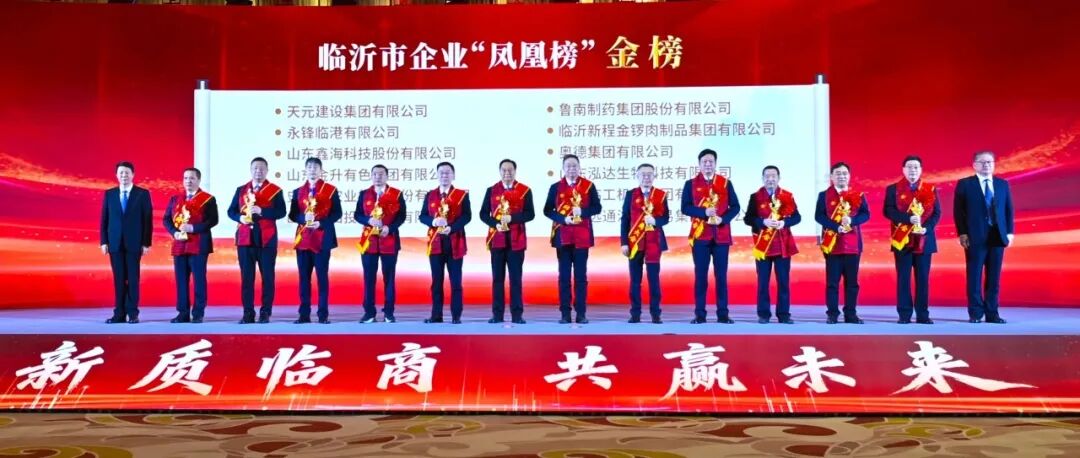
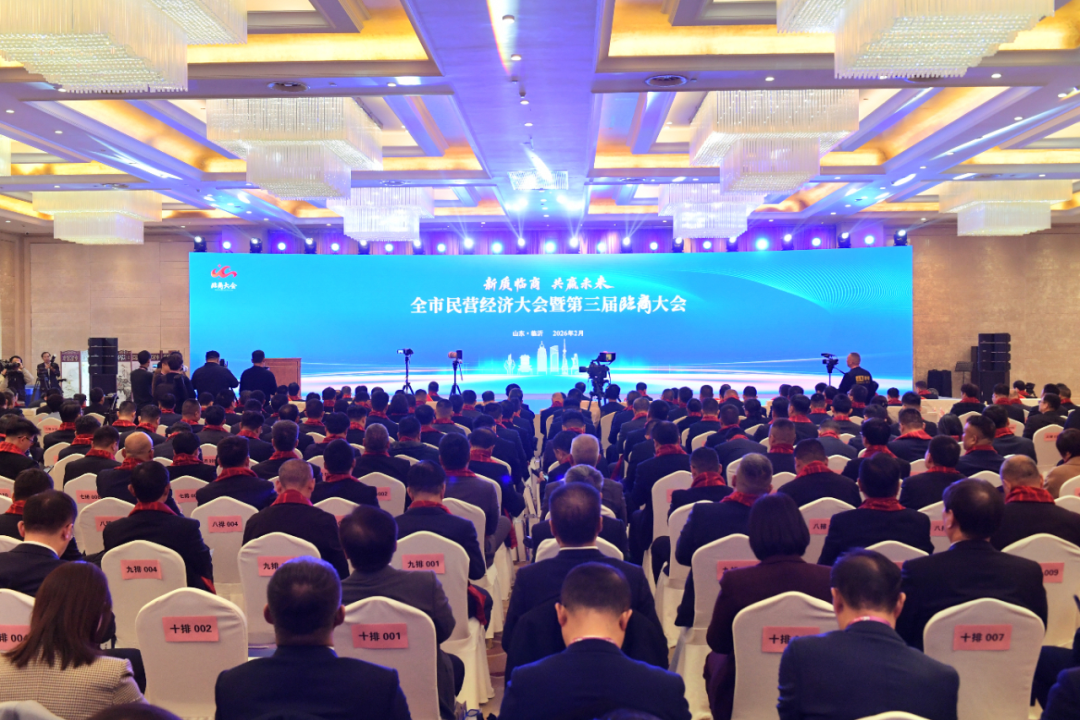
Spring brings new momentum and fresh opportunities. On February 25, Linyi held its much-anticipated “First Conference of the New Year”—the city’s Private Economy Conference and the third Linyi Entrepreneurs Conference. The event released the third Phoenix Ranking of outstanding enterprises. Shandong Hongda Biotechnology Co., Ltd. was honored on the city’s Phoenix Gold Ranking for its outstanding overall strength and powerful innovation momentum.

Shandong Hongda Bio honored on Linyi’s Phoenix Gold Ranking

The selection criteria for the Phoenix Ranking were rigorous. The ranking includes 12 enterprises on the Gold list, 36 on the Silver list, and 91 on the Youth list. Shandong Hongda Biotechnology Co., Ltd. earned a place among the 12 Gold-list enterprises. This is both the highest recognition from the municipal Party committee and government for the company’s achievements over the past year and a strong expression of their expectations for its future potential.

Shandong Hongda Bio honored on Linyi’s Phoenix Gold Ranking

Being named to the Phoenix Gold Ranking is an honor as well as a call to action. As a private enterprise rooted in Linyi and committed to biotechnology, Shandong Hongda Biotechnology Co., Ltd. has always kept pace with the city’s development. In the new year, Hongda Bio will continue to carry forward the fighting spirit of the phoenix rising from the ashes, ride the momentum of the “First Conference of the New Year,” deepen technological innovation, expand its market presence, and strengthen its core competitiveness. With renewed drive, we will advance steadily along the path of high-quality development and contribute even more Hongda strength to the growth of Linyi’s private economy.