



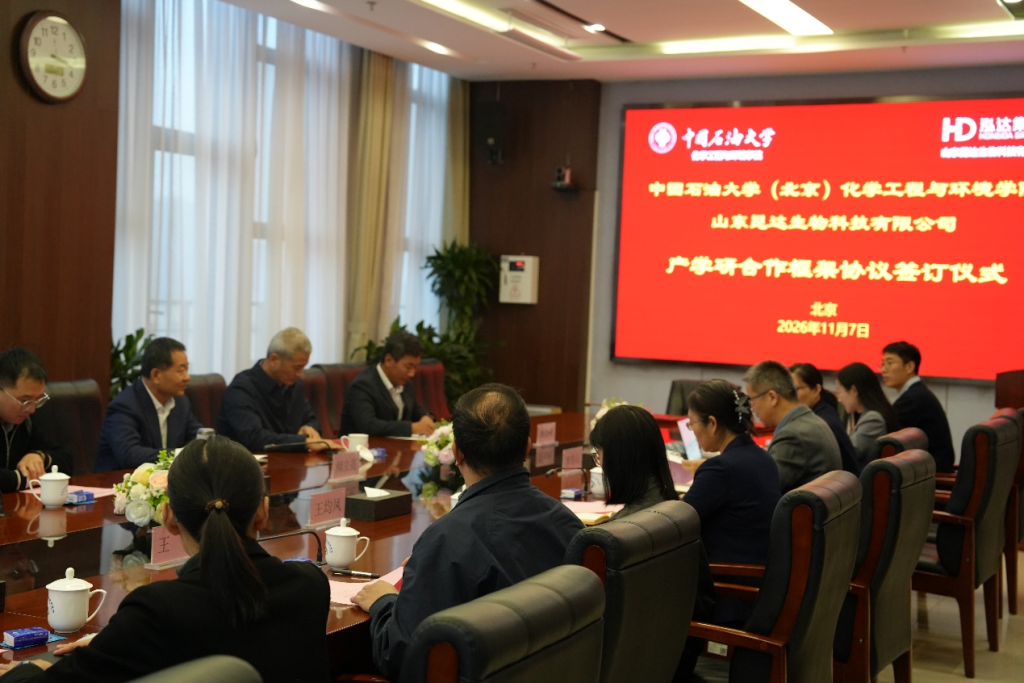
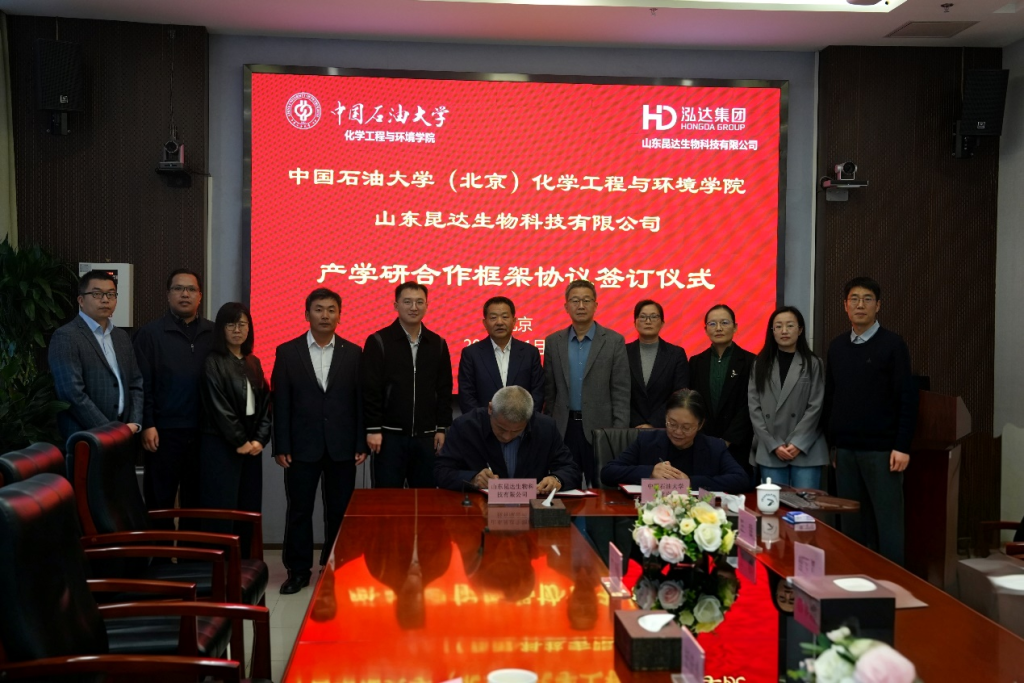
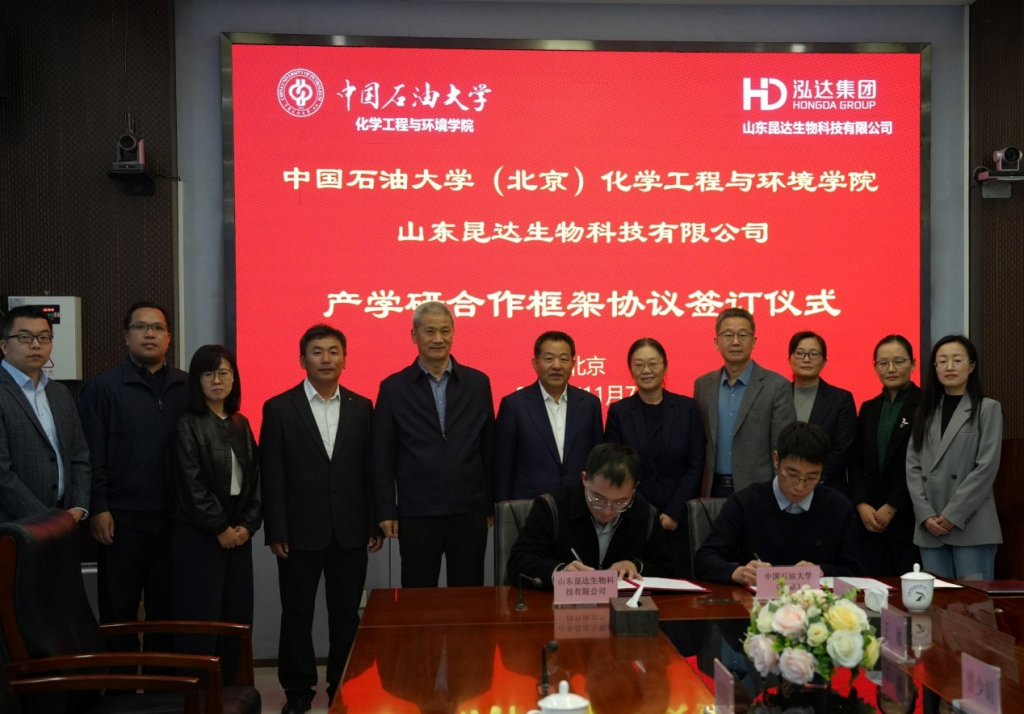
On November 7, 2026, Shandong Kunda Biotechnology Co., Ltd. (“Shandong Kunda”) and China University of Petroleum (Beijing) held a strategic cooperation agreement signing ceremony in Beijing. The two parties will pursue collaborative innovation between industry and academia, focusing on the valorization of pyridine high-boiling fractions, the synthesis of mixed alkylpyridinium salts, corrosion inhibitor formulation, and corrosion inhibition across different oilfield applications. Together, they will advance the recovery and utilization of fine chemical byproducts and the commercialization of new materials for oilfield corrosion protection.
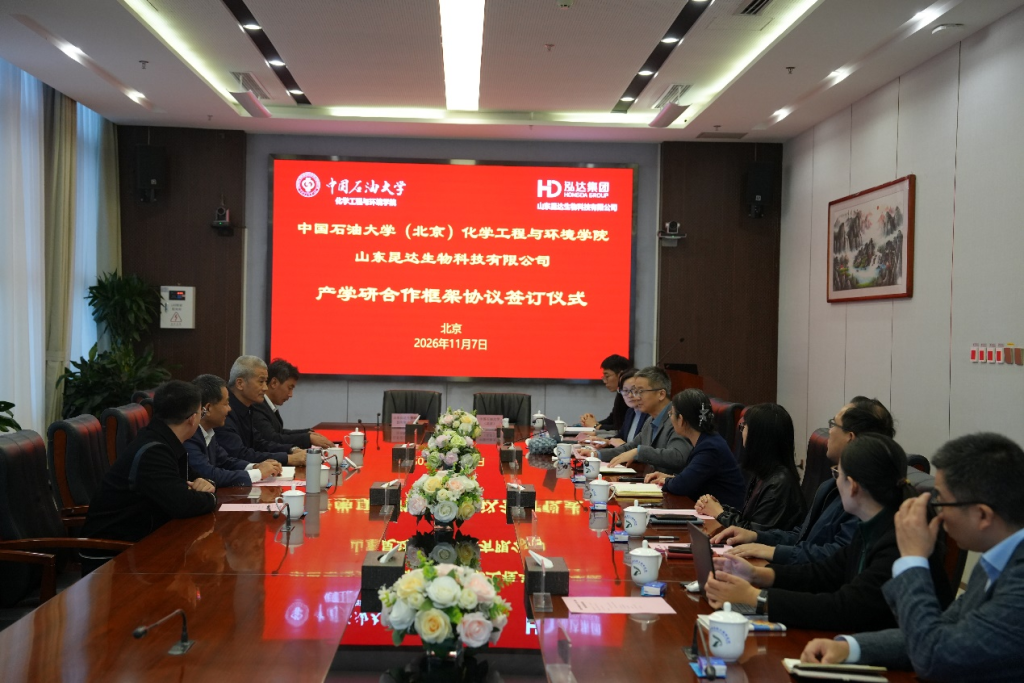
Professor Xiangping Zhang, Dean of the College of Chemical Engineering and Environment at China University of Petroleum (Beijing); Chunshan Li, Researcher and Deputy Director of the Institute of Process Engineering, Chinese Academy of Sciences; and Liliang Shi, Chairman of Shandong Kunda, attended the ceremony and witnessed the signing. Chenghu Zhang, Deputy General Manager of Shandong Kunda, and Dean Xiangping Zhang signed the strategic cooperation agreement on behalf of their respective organizations. Following the signing of the strategic cooperation framework agreement, the two parties held a dedicated discussion and in-depth technical exchange on their main research priority: the valorization of pyridine high-boiling fractions. They also signed a project-specific technology development cooperation agreement, represented by Jianhua Chen, R&D Manager at Shandong Kunda, and Associate Professor Zhenlei Zhang of the College of Chemical Engineering and Environment at China University of Petroleum (Beijing).
The College of Chemical Engineering and Environment at China University of Petroleum (Beijing) has a long academic history. Its predecessor was the Department of Refining at Beijing Petroleum Institute, established in 1953, and the college adopted its current name in September 2018. Guided by its philosophy of building on its heritage and pursuing development through innovation, the college aligns talent development, basic research and engineering translation with major national strategic needs. Through sustained research supported by China’s 973 and 863 Programs, the National Key R&D Program, major and key projects of the National Natural Science Foundation of China, and numerous industry-funded projects, it has produced original research achievements and established a basic research platform for key oil and gas processing technologies. The college serves as a major center for advanced talent development, theoretical innovation, technology development and academic exchange in China’s petrochemical industry. Its theoretical expertise and engineering experience in oilfield chemicals, corrosion and protection, and fine organic synthesis will provide a strong research foundation for this cooperation.
Shandong Kunda Biotechnology Co., Ltd. has long specialized in the further processing of cassava-derived ethanol and continues to extend its downstream fine chemical value chain. It has developed more than 60 high-value-added fine chemical products and established a sustainable production system focused on low-carbon operations and efficient resource circulation. Pyridine production generates high-boiling byproduct fractions with complex compositions that are difficult to separate. Conventional disposal methods waste resources and create environmental pressures. This industry–university collaboration addresses Shandong Kunda’s own need to recover value from these byproducts, establishing an integrated value chain from byproducts to fine chemical intermediates and functional oilfield chemicals.
The central research objective is to convert pyridine high-boiling fractions into pyridinium salts for oilfield corrosion inhibition. These fractions contain a range of alkylpyridine homologues and provide a valuable feedstock for alkylpyridinium salt corrosion inhibitors. However, their mixed composition and numerous impurities can lead to inconsistent corrosion inhibition when used directly in synthesis, limiting large-scale oilfield applications. The partners will jointly address precise fractionation and separation, targeted modification, controlled synthesis of mixed alkylpyridinium salts, and corrosion inhibitor formulation. By characterizing the fractions and applying selective separation and purification, they will retain alkylpyridine components with corrosion-inhibiting activity, optimize quaternization processes and control molecular structures to prepare a series of mixed alkylpyridinium salts. They will systematically evaluate corrosion inhibition efficiency and stability under harsh oilfield conditions, including environments where CO₂ and H₂S coexist. Formulation development for different applications will support a range of corrosion inhibitors suited to oil and gas wellbores, gathering and transportation pipelines, and other operating conditions.
Compared with conventional imidazoline-based inhibitors and single-component pyridinium salt inhibitors, mixed alkylpyridinium salt inhibitors prepared from pyridine high-boiling fractions offer distinct advantages. Their chemical byproduct feedstocks substantially reduce raw material costs and enable the recovery and utilization of solid waste and byproducts, supporting greener chemical production. The multiple alkylpyridinium salt components provide synergistic corrosion inhibition and can form a dense adsorbed protective film on metal surfaces, suppressing steel corrosion in acidic media while offering improved resistance to elevated temperatures and acidic environments. They are also compatible with biocides and scale inhibitors commonly used in oilfields, meeting the requirements for continuous dosing and long-term corrosion protection.
The two parties will use the project-specific technology development agreement to accelerate laboratory trials, scale-up testing and field evaluations, moving the research toward commercial application. The work will help Shandong Kunda turn pyridine high-boiling byproducts into valuable resources and expand its portfolio of high-value downstream pyridine products. It will also provide the oil and gas industry with new corrosion inhibitors that combine lower cost, high performance and improved environmental characteristics, supporting cost efficiency and operational safety. The cooperation brings together a fine chemical producer and a university research platform, advancing both resource circulation in fine chemical production and new materials for oilfield corrosion protection, while supporting greener, lower-carbon development in the chemical and oil and gas industries.