



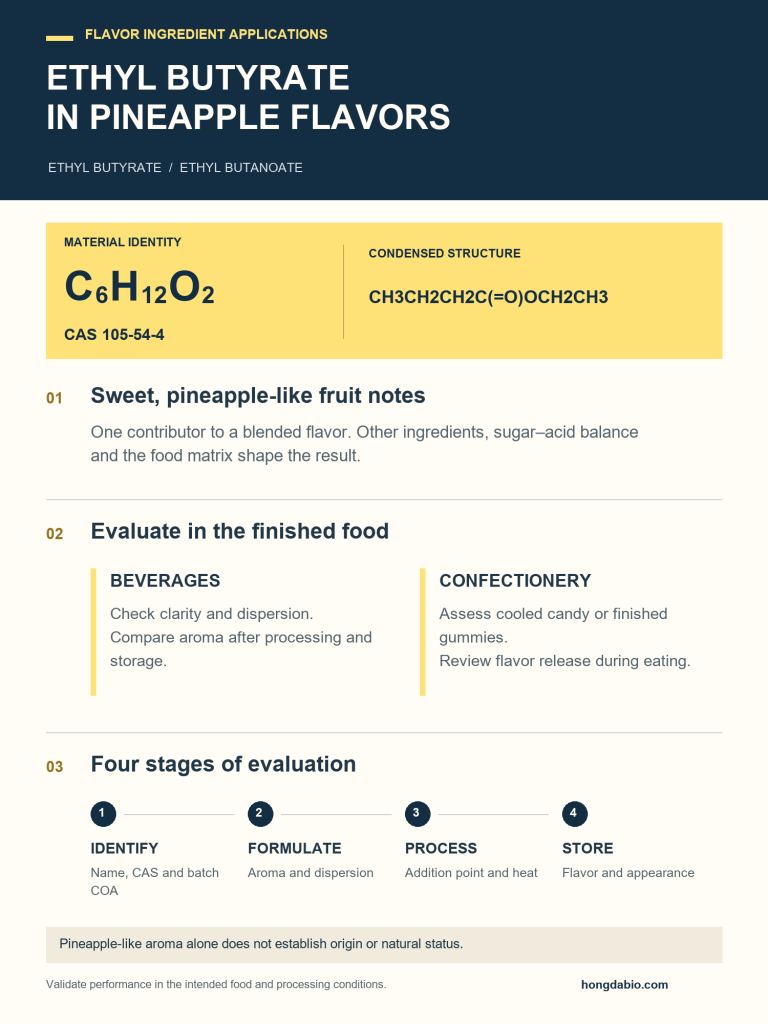
Ethyl butyrate has a sweet, pineapple-like aroma and is used in pineapple, banana, apple, and other fruit flavor blends. In a pineapple formulation, it can contribute a distinct fruity note, while the finished flavor also depends on other aroma ingredients, the sugar–acid balance, and the food matrix.
For beverage and confectionery developers, evaluating the ingredient involves more than recognizing pineapple in a diluted sample. Aroma retention after processing and flavor changes during storage also matter. The same ingredient can differ in perceived intensity and release when used in different foods.
1. Ethyl butyrate: name, formula, and structure
Ethyl butyrate and ethyl butanoate are two names for the same compound. Ethyl butyrate is the common name; ethyl butanoate is the systematic name.
| Identification item | Information |
|---|---|
| Common name | Ethyl butyrate |
| Systematic name | Ethyl butanoate |
| CAS number | 105-54-4 |
| Molecular formula | C₆H₁₂O₂ |
| Condensed structural formula | CH₃CH₂CH₂C(=O)OCH₂CH₃ |
The —C(=O)O— group is the ester group. The acid portion corresponds to butyric acid, and the alcohol portion corresponds to ethanol. PubChem’s ethyl butyrate record documents its chemical identity, molecular formula, and pineapple-like odor.
“Pineapple ester” is an aroma description rather than a unique chemical identifier. Several esters can contribute pineapple-like notes. Sample requests, purchasing specifications, and formulation records should therefore use the full chemical name and CAS number.
Ethyl butyrate should also be distinguished from ethyl isobutyrate. Although they share the same molecular formula, their carbon-chain structures differ. Similar names and fruity odors do not make them interchangeable.
2. What does ethyl butyrate contribute to pineapple flavor?
Hongda Group’s ethyl butyrate product information describes a sweet fruity aroma with pineapple, banana, and apple notes. Its listed applications include pineapple character and blended fruit flavors.
Ethyl butyrate can provide a recognizable pineapple-like fruity note. A complete pineapple aroma, however, involves multiple compounds. Research on different parts of pineapple identified ethyl butyrate, ethyl hexanoate, ethyl 2-methylbutanoate, and other aroma-active substances, with differing contributions to the overall profile. Research on characteristic aroma compounds in pineapple
If a formulation already has a strong sweet fruit aroma but still misses the intended pineapple profile, increasing ethyl butyrate may not resolve the problem. The missing quality could be fresh-fruit character, ripeness, or the relationship between aroma and the sugar–acid balance.
Evaluation should include tasting the finished product. The same flavor blend can seem fresher or riper in beverages with different sugar and acid levels. When comparing ethyl butyrate concentrations, keep the base formulation consistent so that changes can be interpreted.
3. Pineapple-flavored beverages: assess aroma and dispersion
Beverage development requires attention to both sensory performance and physical stability.
Ethyl butyrate has limited water solubility. A suitable aroma in a diluted evaluation sample does not establish that the ingredient will disperse evenly when added directly to water. The flavor carrier and beverage type need to be considered when selecting an appropriate solubilization or emulsification approach.
For clear beverages, assess clarity and check for droplets, an oil ring, or phase separation during storage. For cloudy beverages made with emulsified flavors, examine how the flavor emulsion behaves after dilution, processing, and storage.
A useful bench trial can include a control without ethyl butyrate and several samples containing different concentrations in the same beverage base. Compare the fruit character, then inspect the liquid’s physical condition. If a stronger aroma comes with dispersion problems, the flavor delivery system needs attention alongside the ingredient concentration.
Processing can also change the result. Heating, open mixing, and cooling may affect the retention of volatile aroma compounds. Recording the flavor addition point, processing temperature, and whether equipment is open or closed helps distinguish formulation effects from operating differences.
For acidic, water-based drinks, assess flavor changes throughout storage. Esters can undergo hydrolysis, with the extent influenced by pH, temperature, and time. A freshly prepared sample alone cannot establish performance across the intended shelf life.
4. Confectionery and blended fruit flavors: evaluate the finished food
A concentration that works in a beverage should not be transferred directly to hard candy, gummies, or another food. Differences in moisture, sugar composition, and hydrocolloid systems can change aroma release.
Hard candy should be evaluated after processing and cooling. Assess the initial fruit aroma, how it develops as the candy dissolves, and the sweetness, acidity, and aftertaste that remain. Within the process’s operating limits, compare flavor addition temperatures and mixing times to determine whether the expected aroma is retained.
Gummies should be assessed during chewing. A flavor that performs well in a diluted sample may have a different intensity or duration once incorporated into the finished gel and sugar system. Evaluating only the flavor before processing can miss these effects.
In banana, apple, and other blended fruit flavors, ethyl butyrate’s contribution depends on the surrounding ingredients. A concentration that strengthens a pineapple direction may pull another fruit profile away from its target. Formulation records should identify the intended flavor, actual concentration, and finished-product observations.
5. How is ethyl butyrate synthesized?
Butyric acid and ethanol can undergo esterification to produce ethyl butyrate and water:
CH₃CH₂CH₂COOH + CH₃CH₂OH ⇌ CH₃CH₂CH₂COOCH₂CH₃ + H₂O
Esterification is reversible. Production requires suitable catalytic and operating conditions, followed by separation, purification, and quality testing. This equation explains the chemical relationship; the manufacturing route for a particular commercial product should be confirmed through supplier documentation.
For flavor applications, residual free acid and alcohol deserve attention alongside the target ester content. If a sample has an unexpected acidic odor, free acid can be included in the investigation. Odor alone cannot identify or quantify an impurity.
Chemical analysis and sensory evaluation provide complementary information. When comparing batches or suppliers, use a consistent dilution medium, concentration, and evaluation method before testing the samples in the target formulation. Odor assessments made under different dilution conditions may not be directly comparable.
6. What should formulation trials and incoming checks record?
The following points can help organize application trials. Specific methods and acceptance criteria should reflect the finished product’s requirements.
| Evaluation stage | Information to record |
|---|---|
| Material identification | Chemical name, CAS number, specification, and batch certificate of analysis |
| Bench formulation | Actual ethyl butyrate concentration in the finished food, aroma balance, and dispersion |
| Processing trial | Flavor addition point, temperature, mixing conditions, and flavor after processing |
| Storage assessment | Aroma and aftertaste changes, together with oil rings, separation, or other physical changes |
Distinguish the amount of flavor blend added from the actual ethyl butyrate concentration. When a compounded flavor is used, the proportion of ethyl butyrate within that blend affects comparisons. Recording only the total flavor addition may be insufficient to reproduce a trial.
Sample preparation, containers, and evaluation temperature should also be consistent. Retaining a base-formulation control helps determine whether an observed difference is attributable to ethyl butyrate.
For food projects, confirm suitability against the intended market’s permitted uses, ingredient specifications, and labeling requirements. To discuss product information or sample requirements, contact Hongda Group with details of the target food, processing conditions, and desired flavor profile.
Frequently asked questions
1. Does “pineapple ester” mean ethyl butyrate?
Ethyl butyrate has a pineapple-like aroma and is one ester associated with that description. However, “pineapple ester” does not uniquely identify a compound. For purchasing, confirm the names ethyl butyrate or ethyl butanoate and CAS number 105-54-4.
2. Does its pineapple-like odor mean ethyl butyrate is extracted from pineapples?
No. Aroma and ingredient origin are separate matters. The source and production method must be established through supplier documentation. A pineapple-like smell alone does not establish natural status.
3. Will adding more ethyl butyrate make a pineapple flavor more realistic?
Not necessarily. A higher concentration may strengthen the sweet fruity note, while the overall profile still depends on other aroma ingredients, the sugar–acid balance, and the food matrix. Compare finished-product trials rather than treating greater aroma intensity as proof of a closer match to the target.