



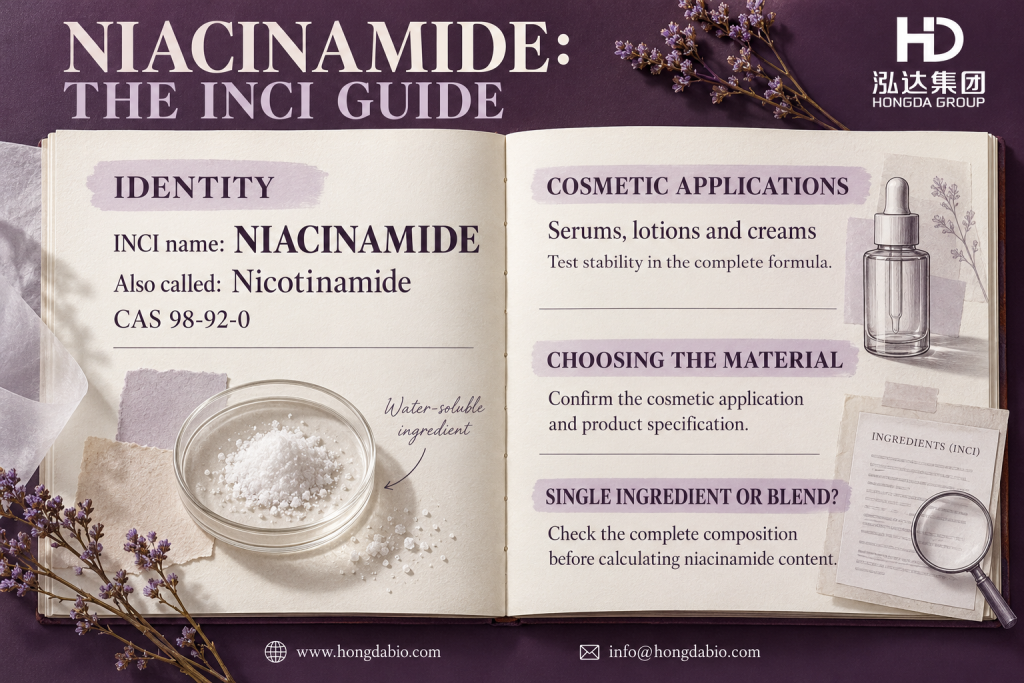
The INCI name for niacinamide is NIACINAMIDE, and its CAS number is 98-92-0. Nicotinamide is another name for the same substance.
These names often appear in different documents. An ingredient list may use Niacinamide, a supplier’s product sheet may say Nicotinamide, and a development brief may refer more broadly to vitamin B3.
For a cosmetic project, connect those names to the specific product being supplied. Then check its composition, intended application and quality specification.
What the INCI name tells you
INCI is an international naming system used to identify cosmetic ingredients. It gives brands, suppliers and formulators a shared name for discussing an ingredient.
For example, a supplier document headed “Nicotinamide” and a draft formula listing “Niacinamide” may refer to the same substance. If both identify CAS 98-92-0, the difference in wording does not, by itself, indicate a material mismatch. The next checks are the supplier’s product code, composition and specification.
“Vitamin B3” is useful as a general description. A material inquiry or purchase order benefits from the specific ingredient name.
Nicotinic acid also belongs to the vitamin B3 family, but it is a different substance. It should not be treated as a direct replacement when the formula calls for niacinamide.
Where niacinamide is used in skincare
Niacinamide is commonly used in products developed for moisturization, more even-looking skin tone and skin barrier care. Typical formats include serums, lotions and creams.
In an aqueous serum, development work may focus on dissolution, clarity and the appearance and feel of the complete formula. Lotions and creams also require assessment of the emulsion during storage, including changes in separation, colour or texture.
These applications help define a development brief. The performance of an individual product still depends on its complete formulation and supporting test results. An ingredient list declaring niacinamide does not establish its concentration or the extent of a finished product’s benefits.
Niacinamide solubility in water
Niacinamide is water-soluble, which makes it suitable for development in water-containing personal care formulations.
Use the selected material’s application guidance to plan incorporation, then assess it in the complete formula. The available water, other dissolved ingredients and processing conditions can affect the outcome.
A freshly prepared serum may be clear and meet its initial appearance specification. Storage testing should then establish whether it develops crystals, haze or other changes. If a change occurs, review the complete formula and manufacturing record rather than attributing it to niacinamide from appearance alone.
For systems containing substantial amounts of glycerin or propylene glycol, use the intended proportions in the trial. Information obtained in pure water is a starting point, rather than a prediction for every mixed-solvent system.
An anhydrous balm or predominantly oil-based product needs a separate incorporation assessment. A method used for an aqueous serum should not be transferred without checking its suitability.
Choosing niacinamide for skincare
The same substance name and CAS number can appear in product documents for different applications. For skincare development, state the cosmetic use and request information for the specific material being offered.
Useful checks include:
- Whether the ingredient name, CAS number and supplier product code agree.
- Whether the supplied product is a single ingredient or a blend.
- Whether its specification and batch test results meet the project requirements.
- Whether the handling and storage guidance applies to the selected product.
A cosmetic-grade description helps identify the relevant product category. Selection still depends on the supporting documents and application assessment.
Hongda lists a separate cosmetic-grade niacinamide product for personal care inquiries. The page provides a starting point for reviewing the product before confirming specifications and supporting documentation.
When the supplied material is a blend
Some products supply niacinamide as a single ingredient. Others combine it with water, moisturizing ingredients or additional materials.
A blend requires its own composition review. Obtain the complete ingredient declaration and the composition information needed for formulation calculations. The amount of blend added to a formula is not automatically the amount of niacinamide in the finished product.
A trade name containing “Niacinamide” is therefore insufficient to establish the composition of the purchased material. Prepare the finished product’s ingredient list from the actual formulation and the requirements of its intended market.
This also helps when comparing quotations. Products with different compositions need to be evaluated on a consistent basis before their quoted quantities or prices can be meaningfully compared.
Keep the product documents connected to the trial
Record the supplier product code and batch used in development, and retain the corresponding specification and test information. This makes later investigations and repeat trials easier to follow.
When changing supplier or specification, keep the existing formula and assessment methods consistent where practical. Changing several conditions at once makes differences harder to interpret.
For cosmetic-grade niacinamide inquiries, use Hongda Group’s contact page to share the intended product format, expected quantity and existing quality requirements. Confirm the documents associated with the proposed material before approving it for use.
Business inquiries: info@hongdabio.com