



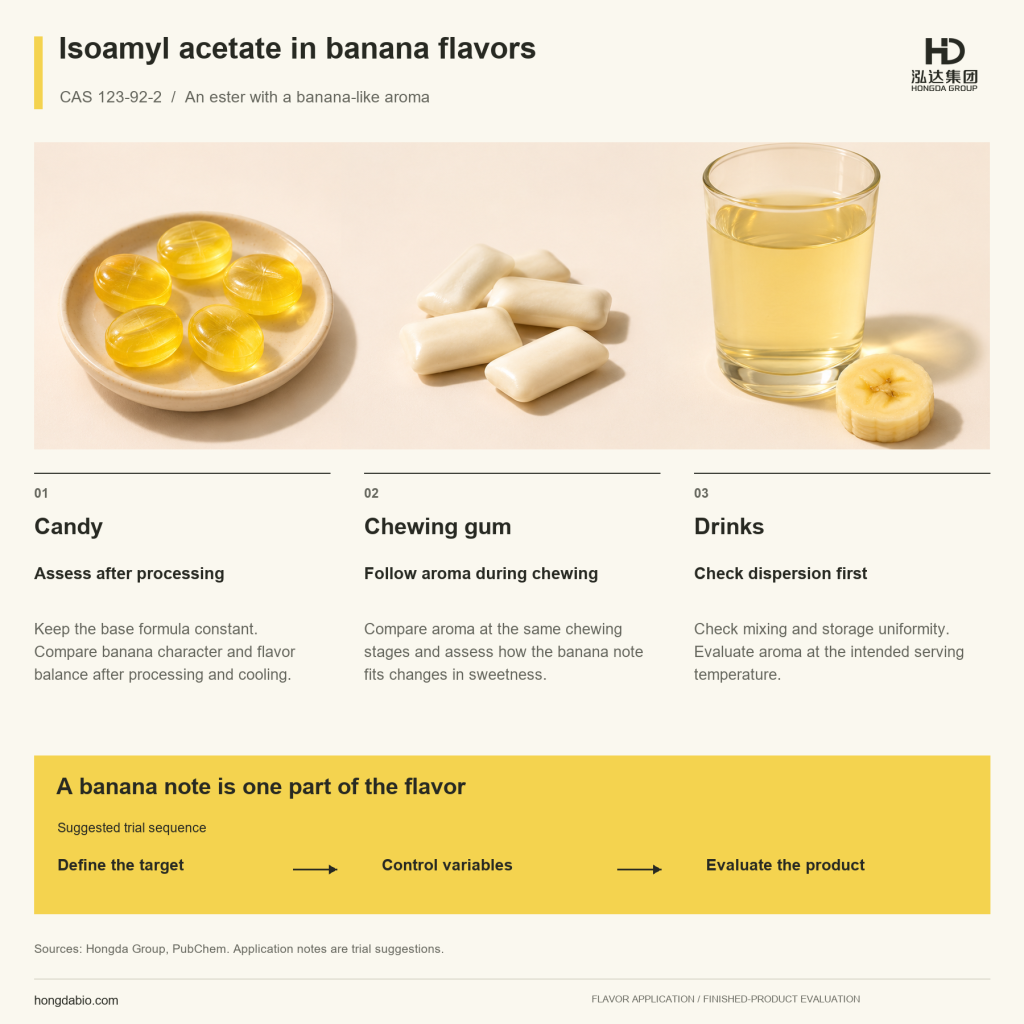
Isoamyl acetate has a distinctive banana-like aroma and can be used in flavors for banana candy, chewing gum and beverages. The first formulation decision is the target: a readily recognizable banana candy note or an aroma closer to fresh fruit. Each calls for a different balance with the other flavor ingredients.
Smelling a diluted sample helps establish what the ingredient contributes. Its performance in a sweetened, fat-containing or heat-processed food still needs to be assessed in the finished product.
What is isoamyl acetate?
Isoamyl acetate is also known as isopentyl acetate or 3-methylbutyl acetate. It is the ester corresponding to acetic acid and 3-methyl-1-butanol.
| Identification item | Information |
|---|---|
| Common name | Isoamyl acetate |
| Other names | Isopentyl acetate; 3-methylbutyl acetate |
| CAS number | 123-92-2 |
| Molecular formula | C₇H₁₄O₂ |
| Condensed structural formula | CH₃COOCH₂CH₂CH(CH₃)₂ |
PubChem’s isoamyl acetate record provides information on its identity, structure and banana-like odor, as well as its limited water solubility. These properties can guide material identification and initial trials; they do not establish an optimum addition rate for a particular food.
Hongda Group’s isoamyl acetate product information lists banana, pear, mixed-fruit and chewing-gum applications. The material specification should also be checked against the intended use.
Why is isoamyl acetate associated with banana aroma?
Isoamyl acetate produces an easily recognized banana-like fruity note and is one of the compounds found in natural banana aroma. This is why it often appears in answers to the question of which molecule smells like banana.
The complete aroma of a banana contains multiple volatile compounds. A study combining volatile analysis with sensory evaluation found that isoamyl acetate, isoamyl isovalerate and isoamyl butyrate contributed to the fruity aroma of the banana samples examined. Read the original banana aroma study.
That work helps explain the composition of natural banana aroma. It did not validate a candy or beverage formulation.
For a formulator, two questions follow: does isoamyl acetate provide a recognizable banana note, and does the complete flavor match the target? A clear banana note can answer the first question while leaving the second unresolved.
If a trial already has a strong banana character but remains far from the desired fresh-fruit profile, the next step is to examine the balance of the other aroma ingredients. Increasing isoamyl acetate alone may not close that gap.
Evaluating its role in candy and chewing gum
Candy: assess aroma after processing
For banana candy development, different proportions of isoamyl acetate can be compared in the same base formulation. Evaluate both the clarity of the banana character and its balance with sweetness and acidity.
Assess the candy after processing and cooling. In a heated process, a strong aroma at the point of addition does not establish how much of that character will remain in the finished product.
When comparing addition stages, hold the other processing conditions constant. Record the product temperature at addition, subsequent heat exposure and the finished flavor. This makes it easier to judge whether an addition method suits the product being developed.
Also distinguish between insufficient intensity and an unsuitable flavor profile. The former may require an addition-rate adjustment; the latter may call for changes in the flavor blend. Increasing the total flavor dose is not a reliable response to both problems.
Chewing gum: follow aroma through the chewing period
Chewing-gum evaluation should extend beyond the first few chews. Record when the banana character appears, how it changes and how it relates to the decline in sweetness.
One trial approach is to keep the gum base, sweetener system and total flavor dose constant while varying the proportion of isoamyl acetate in the flavor. Assess each sample at the same chewing stages. Changing both the gum base and flavor composition makes the cause of a difference harder to identify.
The chewing-gum application listed in product information is a development direction. Any particular claim about flavor duration needs support from finished-product testing.
In beverages, check dispersion first
Isoamyl acetate has limited water solubility. For water-based drinks, the intended concentration and flavor composition should guide the choice of a suitable carrier or dispersion system.
A mixture that looks uniform shortly after stirring has not yet demonstrated storage stability. Alongside banana aroma, check for haze, surface oil or separation, and compare aroma in samples taken from different locations within the mixture.
For clear beverages, appearance and flavor need to be assessed together. If the carrier or dispersion method is changed to improve clarity, recheck the flavor of the revised sample as well.
A banana milk drink and a water-based fruit-flavored beverage should be tested separately. Their base formulations differ, so the same flavor addition rate should not be assumed to produce the same sensory result.
Use an evaluation temperature close to the expected serving conditions. For a refrigerated drink, compare samples at the intended chilled temperature and record that temperature to avoid confusing temperature differences with formulation differences.
If aroma weakens during storage, review dispersion, processing records and packaging conditions. Smelling alone cannot establish whether a chemical change has occurred or identify the raw material as the cause.
Designing a useful formulation comparison
Start with a small trial that has a clear flavor reference. Controlling variables generally makes the results easier to interpret than replacing several ingredients at once.
Define the reference specifically: a particular banana candy, for example, or the aroma of ripe banana. Agree on descriptions of the reference before comparing samples so that evaluators are working toward the same target.
An initial comparison can use one base formulation, a control without isoamyl acetate and samples with different addition levels. Distinguish between the amount of neat ingredient, the amount of a diluted preparation and the actual concentration in the finished food.
Useful evaluation questions include:
- Is the banana character easy to recognize?
- Is the sample closer to the reference?
- Does the aroma fit the main sweetness, acidity or dairy note?
- Does the product still meet the target after processing and storage?
These are suggested trial methods, not evidence that a particular addition level has been validated. Once a formulation is selected, reassess it under the actual production process and intended storage conditions.
For food projects, confirm the material specification, intended conditions of use and applicable requirements in the destination market. An identical chemical name does not establish that different commercial grades are interchangeable.
To discuss material requirements for a banana flavor, candy or beverage project, contact Hongda Group with the target food, processing method and required product specification.
Frequently asked questions
Is isoamyl acetate the same as banana flavor?
Isoamyl acetate is a single compound that provides a banana-like fruity note. A banana flavor is a formulation designed for a particular sensory target and may contain multiple flavor ingredients and suitable carriers. Confirm whether a project requires the individual ingredient or a compounded flavor.
Can isoamyl acetate be added directly to a water-based drink?
Whether direct addition is suitable depends on the concentration and formulation. Because its water solubility is limited, check uniformity after mixing and changes in appearance or flavor during processing and storage. A suitable carrier or dispersion system may be needed.
Does its presence in bananas mean a purchased ingredient is a natural flavoring?
No. A molecule’s occurrence in a natural food is separate from the origin and labeling of a commercial ingredient. Any natural-origin claim needs to be assessed against production methods, source documentation and the applicable requirements in the destination market.