



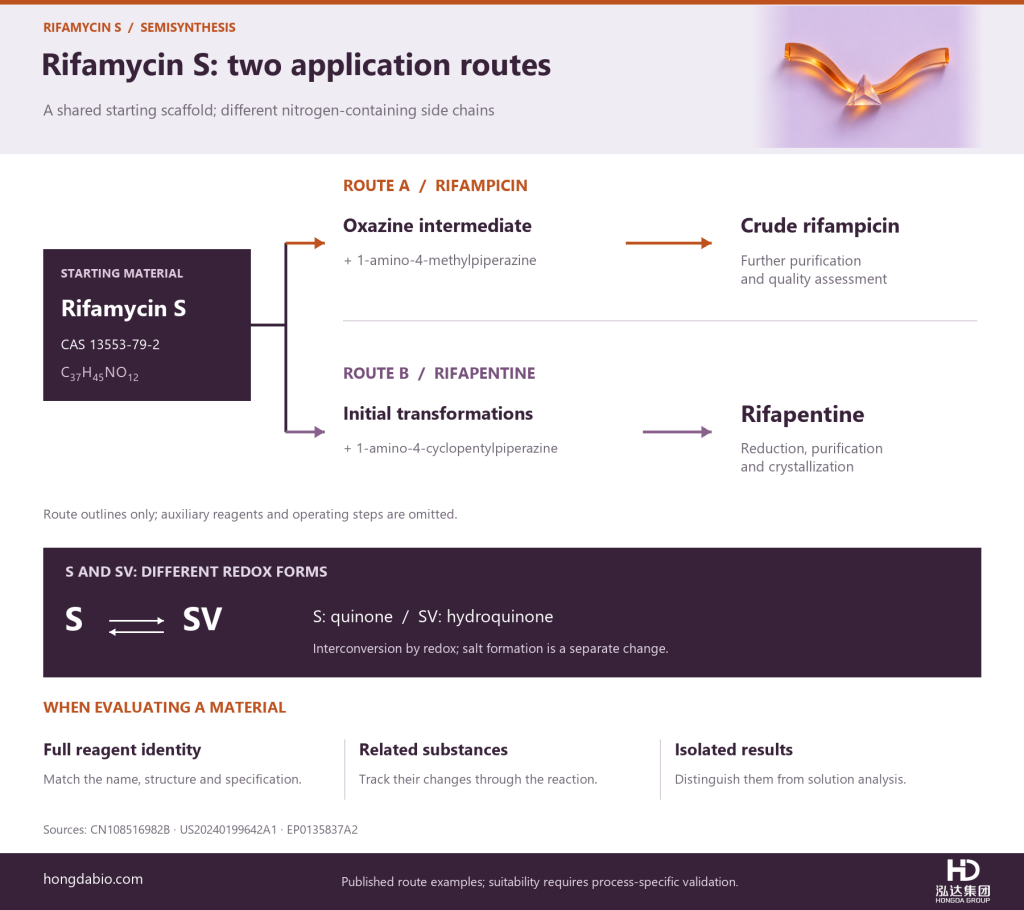
Rifamycin S can serve as a starting material for the semisynthesis of rifampicin and rifapentine. It supplies the existing rifamycin scaffold, which is modified to introduce the nitrogen-containing side chain of the intended product.
The two products can share this starting material, but their subsequent chemistry differs. The methyl-substituted piperazine reagent used in a rifampicin route and the cyclopentyl-substituted reagent used in a rifapentine route lead to different structures. Reaction and isolation conditions need to be evaluated for each route.
For process development and sourcing, these distinctions help establish which product information or trial results apply to the intended synthesis.
What is rifamycin S?
Rifamycin S has the CAS number 13553-79-2 and molecular formula C₃₇H₄₅NO₁₂. Hongda Group’s rifamycin S product information lists its use as an intermediate for semisynthetic rifamycins, including rifampicin and rifapentine.
| Identification | Information |
|---|---|
| Name | Rifamycin S |
| CAS number | 13553-79-2 |
| Molecular formula | C₃₇H₄₅NO₁₂ |
| Applications discussed here | Semisynthesis of rifampicin and rifapentine |
Semisynthesis uses an existing scaffold and further chemical reactions to obtain the intended derivative. In rifamycin chemistry, subsequent transformations must also preserve the required functional groups and stereochemical features.
Route evaluation therefore includes checking for unintended structural changes as well as confirming the intended modification.
Rifampicin synthesis: introducing the side chain through an intermediate
Patent CN108516982B describes a microchannel process starting from rifamycin S. An oxazine intermediate is formed and subsequently reacted with 1-amino-4-methylpiperazine. Crystallization and filtration yield crude rifampicin. Rifampicin preparation patent
The sequence can be summarized as:
Rifamycin S → oxazine intermediate → further reaction with 1-amino-4-methylpiperazine → crude rifampicin
This is a route outline; auxiliary reagents and operating steps are omitted.
In this process, the intermediate-containing solution passes into the next reaction stage. A useful evaluation should therefore consider the composition of that solution, including unreacted starting material, residual reagents and by-products.
Confirming that the intermediate has formed provides only part of the information needed to interpret the next reaction. When comparing feedstock batches, consistent reaction conditions and analytical methods make it easier to locate the stage at which a difference appears. These are process evaluation suggestions; the actual controls require experimental confirmation.
The reagent name 1-amino-4-methylpiperazine should be written in full. Omitting the amino group creates ambiguity and can identify a different material. Technical and purchasing documents should specify the structure and material requirements alongside the name.
The patent describes a particular process under stated conditions. Its results do not establish performance in another installation, and crude product still requires purification and quality assessment appropriate to the intended product.
Rifapentine synthesis: a cyclopentyl-substituted side-chain reagent
Published routes also use rifamycin S to prepare rifapentine.
Patent application US20240199642A1 describes a process beginning with rifamycin S, followed by transformations using 1-amino-4-cyclopentylpiperazine, reduction, purification and crystallization. Rifapentine preparation and crystalline-form patent application
The side-chain reagents distinguish the two examples:
| Comparison | Rifampicin route example | Rifapentine route example |
|---|---|---|
| Starting material | Rifamycin S | Rifamycin S |
| Side-chain reagent | 1-Amino-4-methylpiperazine | 1-Amino-4-cyclopentylpiperazine |
| Substituent on the piperazine ring | Methyl | Cyclopentyl |
These reagents lead to different target compounds. A process transfer therefore requires a fresh review of reaction and isolation conditions, even when the starting material is unchanged.
The rifapentine application also addresses crystalline form. This separates two questions in product evaluation: assay and related-substance testing assess chemical composition, while solid-state characterization establishes crystalline form. The required form and its controls depend on the intended product.
Why distinguish rifamycin S from rifamycin SV?
Rifamycin S is the quinone form; rifamycin SV is the corresponding hydroquinone form. Published rifamycin derivative chemistry distinguishes these structures and describes their interconversion through oxidation or reduction. Rifamycin S/SV structural relationship
This distinction matters when a route includes a redox step. The analytical approach should support identification of the relevant form in the starting material, intermediate or product.
Technical documents should use the full chemical name. Where a salt is involved, its identity and CAS number also need confirmation. Salt formation and redox conversion are different chemical changes and should be checked separately.
Evaluating feedstock for a specific route
The following suggestions follow from the route characteristics above. Acceptance limits should be established through project trials and the applicable quality requirements.
Consider assay together with the related-substance profile. Two samples with similar assay values can contain different related components. Trials are needed to determine whether those components react further or are removed during isolation.
Follow the material through isolation. A high proportion of target product in the reaction solution does not by itself establish a satisfactory outcome after filtration, washing and crystallization. Recording composition changes alongside isolated results gives a more useful comparison than conversion at a single time point.
For projects covering both rifampicin and rifapentine, maintain route-specific validation data. Performance in one route helps characterize the feedstock, but suitability for the other still depends on its side-chain reaction and subsequent processing.
Supplier analytical information, the project’s test methods and actual reaction records should be comparable enough to support a material decision.
Frequently asked questions
Can rifamycin S be used to produce both rifampicin and rifapentine?
Published routes exist for both products. Suitability of a particular batch or specification needs to be verified in the intended process; an application statement alone does not establish it.
Can rifamycin S and rifamycin SV be substituted directly?
They have different redox forms. Any substitution depends on whether the route accommodates the required conversion and how the change affects the reaction and impurity profile. Experimental confirmation is needed.
Does a higher feedstock assay always mean a higher final yield?
Assay alone cannot establish final yield. Reaction selectivity, related components and isolation losses also contribute. Compare materials under consistent conditions and distinguish reaction-solution analytical results from actual isolated yield.
To discuss rifamycin S requirements for a rifampicin or rifapentine project, contact Hongda Group with the target product, intended route and analytical requirements.