



Hexahydropyridine, commonly known as piperidine, can serve as a starting material for mepiquat chloride, a plant growth regulator. In these routes, the six-membered ring is retained while reactions at the nitrogen atom lead to the final quaternary ammonium salt.
Evaluating this application requires more than checking whether the starting material reacts. Intermediate residues and product recovery also matter. Two raw material batches with similar reported purity may still perform differently under the same process conditions.
1. Are Hexahydropyridine and Piperidine the Same Chemical?
Hexahydropyridine and piperidine are names for the same compound. The NIST Chemistry WebBook lists Hexahydropyridine as a synonym of Piperidine, with CAS number 110-89-4 and molecular formula C₅H₁₁N. NIST piperidine record
| Identification item | Information |
|---|---|
| Common name | Piperidine |
| Alternative name | Hexahydropyridine |
| CAS number | 110-89-4 |
| Molecular formula | C₅H₁₁N |
| Structural feature | A saturated six-membered ring containing five methylene groups and one NH group |
Piperidine is a cyclic secondary amine. Its nitrogen retains a hydrogen atom that can be replaced during subsequent reactions, providing the structural basis for its use in mepiquat chloride synthesis.
Piperidine should also be distinguished from pyridine, which is a different compound. Purchasing documents, analytical reports and process specifications should identify the material by both its chemical name and CAS number.
2. What Role Does Piperidine Play in Mepiquat Chloride Synthesis?
Hongda Group’s piperidine product information identifies mepiquat chloride synthesis as an agrochemical application. In routes that start with piperidine, it supplies the nitrogen-containing six-membered ring retained in the product.
The background section of patent CN106883196B describes a route through N-methylpiperidine, as well as a one-step approach without separate isolation of that intermediate. Published mepiquat chloride synthesis information
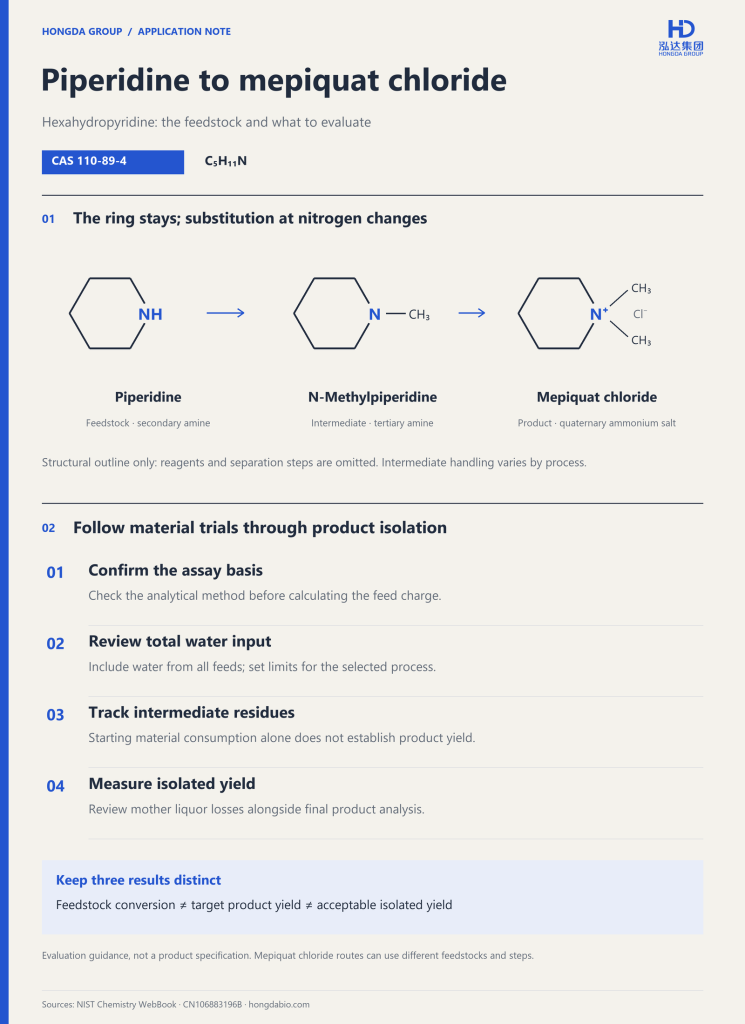
The structural relationship can be summarized as:
Piperidine → N-methylpiperidine → Mepiquat chloride
This outline omits reagents, acid–base treatment and separation operations.
| Substance | Change at nitrogen | Role in the outlined route |
|---|---|---|
| Piperidine | Nitrogen retains one hydrogen atom | Starting material |
| N-methylpiperidine | A methyl group replaces that hydrogen, forming a tertiary amine | Intermediate |
| Mepiquat chloride | An additional methyl group forms a quaternary ammonium cation, paired with chloride | Target product |
The ring is retained through these changes. Piperidine and mepiquat chloride are therefore related through synthesis, but they remain distinct substances. Piperidine’s use as a manufacturing feedstock does not make the raw material interchangeable with the finished plant growth regulator.
3. Why Monitor N-Methylpiperidine?
N-Methylpiperidine occupies an intermediate stage in the structural sequence above. Monitoring the starting material, intermediate and target product separately gives a clearer picture of reaction progress than measuring piperidine consumption alone.
For example, a substantial decrease in piperidine accompanied by significant N-methylpiperidine remaining in the mixture calls for further assessment of the subsequent conversion. Starting material conversion cannot be used directly as the yield of mepiquat chloride.
If N-methylpiperidine is detected in the final product, the reaction endpoint records and workup results should be reviewed together. The residue may relate to incomplete conversion or its removal during processing. One analytical result alone does not establish the cause.
Whether the intermediate requires separate isolation depends on the process. Different routes can arrange the reaction stages and material handling differently.
4. What Should Be Checked When Evaluating Piperidine Feedstock?
The following points are process evaluation recommendations. Analytical requirements and acceptance limits should be established for the selected route and final product specification.
Interpret assay results alongside the analytical method
Reported purity can be determined in different ways. A gas chromatography area-normalization result is not equivalent to a calibrated mass-fraction assay. Water and other components outside the scope of the method may not be represented in the reported area percentage.
Before comparing supplier reports, confirm the method and calculation basis. The value used to calculate the feed charge should also match the agreed assay procedure.
Match the water specification to the reaction system
Water should be included in the assessment, but its acceptable range depends on the route. Aqueous media, added base solutions and subsequent drying or separation operations all affect the process requirements.
When batches give different trial results, record the water introduced by the piperidine separately from water introduced by other materials, then review the total. Comparing only the water values on the raw material reports may overlook other contributions.
Investigate unexpected impurity peaks
If other amines or unidentified components are detected, their potential involvement in subsequent reactions should be assessed from their structures. Reactive impurities may form additional components during processing.
Retaining the original chromatograms and tracking unexpected peaks is often more useful for troubleshooting than comparing total impurity values alone. This does not imply that a particular impurity is necessarily present in any supplier’s material; the investigation should follow the actual analytical findings.
5. Extend Material Trials Through Product Isolation
The amount of target product formed in a reaction mixture and the amount recovered as acceptable isolated product should be recorded separately.
Raw material trials should use consistent process conditions and follow the material through the following stages:
| Evaluation stage | Results to review |
|---|---|
| Feed preparation | Charge calculated on the agreed assay basis and water introduced |
| Reaction | Changes in piperidine, intermediate and target product |
| Product isolation | Isolated yield and target product losses to mother liquor |
| Final product | Target assay, relevant residues and agreed quality attributes |
For example, two batches may reach similar reaction endpoints but give different isolated yields. That difference warrants further examination of the mother liquor composition and separation conditions. If reaction conditions, sampling times and analytical methods are changed together, attributing the result to the raw material becomes difficult.
These results can also inform purchasing decisions. A lower unit price should be assessed alongside actual material consumption, acceptable product yield and workup costs.
Frequently Asked Questions
1. Are Hexahydropyridine and Piperidine the same substance?
Yes. Both names refer to the compound with CAS number 110-89-4. The chemical name, CAS number and analytical documentation can be checked together when confirming material identity.
2. Is Piperidine the same as Mepiquat Chloride?
No. Piperidine is a cyclic secondary amine, whereas mepiquat chloride is a quaternary ammonium salt. Piperidine can be a starting material in its synthesis, but the two substances have different chemical identities and uses.
3. Does Every Mepiquat Chloride Process Start with Piperidine?
No. Published routes also use pyridine as the starting material. This article discusses piperidine-based synthesis and should not be read as a description of every manufacturing process.
To discuss piperidine requirements for mepiquat chloride synthesis, contact Hongda Group with the intended route, analytical requirements and sample evaluation needs so that the appropriate product specification can be reviewed.