



Fruit particles in a drink need to remain dispersed. A jelly needs the right bite. A dairy dessert may need a softer, more elastic texture. Gellan gum can be considered for each application, although the grade and processing conditions will often differ.
Gellan gum is a fermentation-derived polysaccharide hydrocolloid with CAS number 71010-52-1. It can form gels and contribute to suspension and stabilization. Before selecting a grade, define the finished product: a drink that pours freely, or a gel that holds its shape when cut or unmolded.
1. What Is Gellan Gum, and Why Does Its Structure Matter?
Gellan gum consists of sugar units linked into long chains. The JECFA specification for gellan gum describes a repeating unit containing two glucose units, one glucuronic acid unit and one rhamnose unit.
| Identification item | Information |
|---|---|
| Ingredient name | Gellan gum |
| CAS number | 71010-52-1 |
| Food additive identifier | INS 418; E418 in the European Union |
| Material category | Fermentation-derived polysaccharide hydrocolloid |
| Common forms | High-acyl and low-acyl gellan gum |
When reviewing gellan gum structure, consider both the repeating backbone and its substituent groups. Chain length, acyl content and ionic composition can vary between materials. A structural diagram alone cannot predict how a particular grade will perform in a food.
For formulation work, the distinction between high-acyl and low-acyl gellan is especially useful.
2. Choosing Between High-Acyl and Low-Acyl Gellan Gum
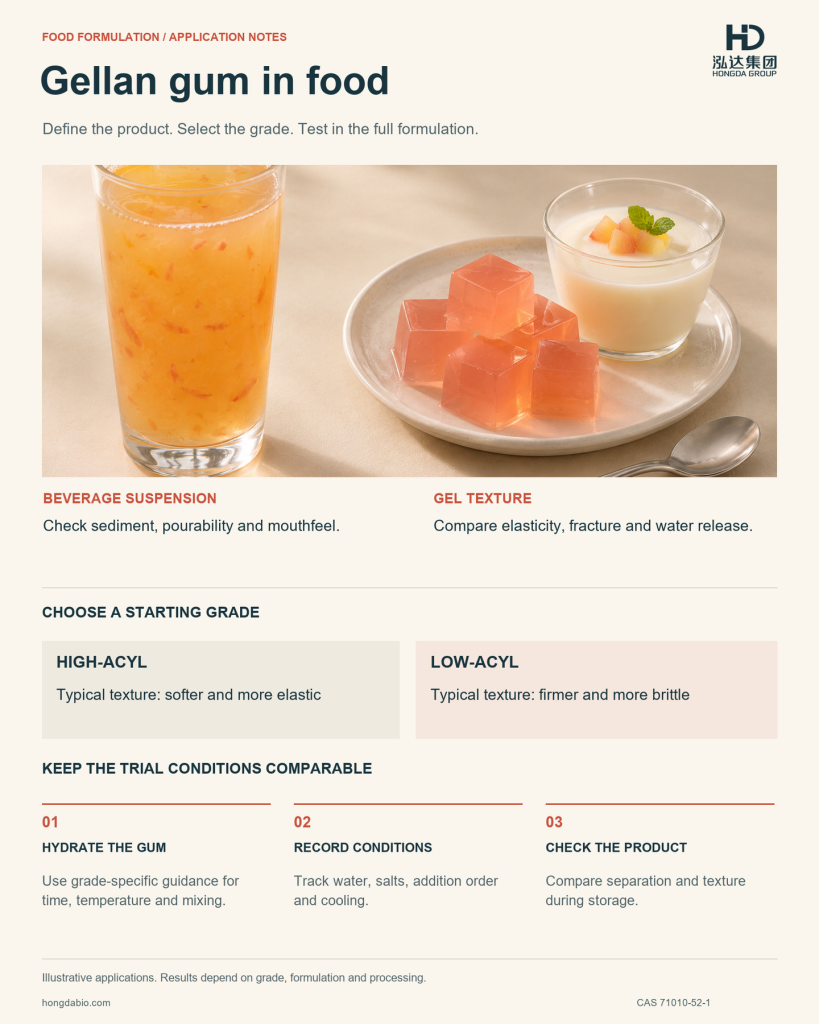
High-acyl gellan retains more acyl substituents. Low-acyl gellan undergoes deacylation during manufacture. Although their polysaccharide backbones are similar, their typical gel textures differ.
| Comparison | High-acyl gellan gum | Low-acyl gellan gum |
|---|---|---|
| Typical gel texture | Softer and more elastic | Firmer and more brittle |
| Applications to consider | Soft desserts and some dairy systems | Jellies, shaped gels and some suspension systems |
| Trial priorities | Softness, elasticity and mouthfeel | Firmness, fracture behavior and water separation |
Application material hosted by USDA discusses gellan in beverages, desserts and fillings, including fluid-gel applications for particle suspension.
These distinctions help narrow the initial selection. The outcome still depends on the commercial grade, concentration and complete formulation. High-acyl and low-acyl materials can also be blended. Compare setting behavior, texture and storage performance across the proposed blends.
Hongda Group’s gellan gum product information lists relevant food applications. When discussing samples, confirm the grade, product composition and suggested trial conditions.
3. Beverage Suspension: Assess Sedimentation Alongside Mouthfeel
Drinks containing fruit pulp, cocoa particles or other insoluble ingredients may develop sediment during storage. The formulation needs to keep those particles dispersed while retaining suitable flow. A drink with little sediment may still be unacceptable if it becomes too thick or develops gel fragments.
Under suitable conditions, gellan gum can create a weak structure that helps restrict particle movement. A single viscosity measurement gives only part of the picture. Observe how the drink behaves both at rest and when poured.
For a fruit-pulp beverage, useful trial records include:
- Separation height and the amount of sediment after standing.
- Pourability, visible gel fragments and coating on the container.
- Particle distribution and whether sediment redistributes easily.
- Appearance and mouthfeel after heating, cooling and storage.
Particle size and density also affect the result. A formulation that suspends fine particles may not perform the same way with larger fruit pieces.
If sediment develops, first check hydration and whether cooling and shear conditions were consistent between samples. Then assess changes to grade or concentration. Increasing the gum level alone may make the drink too thick before it provides the required suspension.
4. Jellies and Desserts: Look Beyond Firmness
A jelly may be judged by how it breaks during eating. A spoonable dessert may need softness and elasticity. Two samples with similar instrumental firmness can still feel different in the mouth.
For products that must hold a shape, examine unmolding, cut surfaces and water separation during storage. For dairy desserts, also compare breakdown during eating and the texture that remains afterward.
Ionic conditions affect gel behavior. In a study of dilute low-acyl gellan systems containing calcium, storage modulus—an indicator of elastic response—increased to a maximum and then declined within the tested range. Adding calcium therefore did not produce a continuous increase in that measure of gel strength. Original study: gelation and microstructure of dilute gellan solutions with calcium ions
In a food formulation, ions can come from process water, dairy ingredients and mineral additions. A change in water source or calcium ingredient is a reason to repeat the comparison, even when the gellan concentration remains the same.
5. Planning Hydration and Processing Trials
Dispersed powder is not necessarily fully hydrated gum. Hydration requirements vary with the type and commercial grade. Set temperature, time and mixing conditions using the technical guidance for the material being tested.
A useful trial sequence is to assess the gum in a simplified system before introducing the remaining ingredients. If it performs as expected in the initial water phase but develops particles or texture changes in the complete formulation, investigate acidity, salts and addition order.
| Trial record | Purpose |
|---|---|
| Process water, salts and their amounts | Compare ionic conditions between samples |
| Dispersion method, hydration temperature and time | Investigate incomplete hydration or lumps |
| Addition order for acid, minerals and other ingredients | Assess the effect of ingredient addition |
| Cooling rate and mixing conditions | Compare structure development |
| Separation, water release and mouthfeel during storage | Assess performance against finished-product requirements |
Acidified protein drinks need a separate assessment of protein stability. One study used pectin or carboxymethylcellulose (CMC) to protect proteins, with gellan and other hydrocolloids added to further adjust texture or stability. Protein protection and suspension through a hydrocolloid network served different roles in that system. Original study: stabilization of directly acidified protein drinks
When flocculation and sedimentation occur together, examine the protein system, acidification process and hydrocolloid conditions separately. Changing only the gellan concentration may leave the underlying problem unresolved.
6. What to Confirm When Sourcing Food-Grade Gellan Gum
Price and gel-strength results can support purchasing decisions, provided the test conditions are comparable. Gum concentration, salt composition, sample preparation and measurement temperature all need checking before numerical results are compared.
Confirm whether the material is high-acyl, low-acyl or a blend, then review the specification and batch certificate of analysis. For blended or standardized products, establish the ingredient composition so that addition rates and labeling can be assessed correctly.
Compare samples in the same base formulation and retain a control without added gellan. Record processing conditions before comparing mouthfeel and storage performance. This makes it easier to distinguish material differences from differences in sample preparation.
For a specific food product, confirm the applicable food category and conditions of use under current requirements in the target market.
Frequently Asked Questions
1. Is Gellan Gum Vegan?
Gellan gum is produced by microbial fermentation and can be considered for formulations that avoid animal-derived gelling ingredients.
A vegan claim for a finished product still requires verification of the specific ingredient’s fermentation media, processing aids, blend components and supplier declarations. Fermentation origin alone does not establish product-level vegan status or certification.
2. Can High-Acyl and Low-Acyl Gellan Gum Be Substituted at the Same Amount?
Do not assume that an equal-weight substitution will preserve texture or processing behavior. Reassess hydration, cooling, setting and storage performance when changing gum type.
If the aim is to adjust softness or brittleness, compare different blends while retaining the original formulation as a control.
3. Can Gellan Gum Replace Xanthan Gum Directly?
The formulation will usually need reassessment. Their rheological and gel-forming behavior differs, so an equal-weight substitution may give a different result.
First identify the problem: sedimentation, insufficient viscosity or unsuitable gel texture. Then compare performance in the complete formulation.
To discuss gellan gum for beverages, jellies or dairy desserts, contact Hongda Group with the base formulation, processing conditions and the issue you want to address. These details provide a starting point for discussing material specifications and sample requirements.