



Acid chlorides react with amines to form amides in some pharmaceutical and intermediate synthesis routes. Triethylamine can capture the hydrogen chloride generated during these reactions, limiting its effect on the reacting amine.
For a route conducted in an anhydrous organic medium, water introduced with triethylamine is another material-selection consideration. Acid scavenging and water control address different process requirements: acid–base conditions and acid chloride consumption. An assay result alone does not answer both questions.
1. Anhydrous triethylamine: name, CAS number and structure
Triethylamine is commonly abbreviated as TEA or Et₃N in organic synthesis. It is a tertiary amine with three ethyl groups attached to nitrogen, identified by CAS 121-44-8.
| Identification item | Information |
|---|---|
| Chemical name | Triethylamine |
| Common abbreviations | TEA, Et₃N |
| CAS number | 121-44-8 |
| Molecular formula | C₆H₁₅N |
| Condensed structural formula | N(CH₂CH₃)₃ |
| Role discussed here | Acid scavenging in acid chloride amidation |
“Anhydrous” describes a water specification and its control. It does not change the chemical identity or CAS number, nor does it mean an absolute absence of water. The applicable limit should be established from the product specification rather than the grade name alone.
Hongda Group’s triethylamine product information describes acid-binding and other organic synthesis applications. Material selection should address assay, water content and process-sensitive impurities separately.
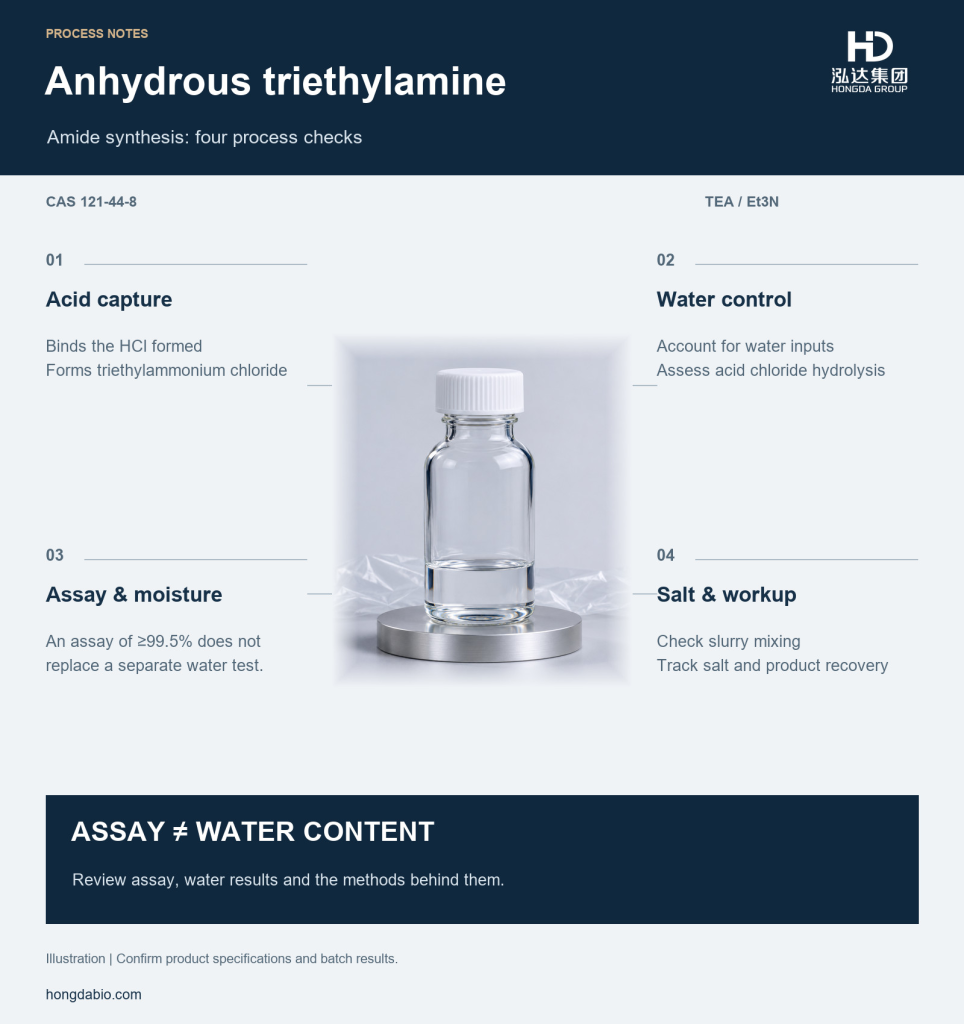
2. How does triethylamine scavenge acid during amide formation?
For an acid chloride reacting with a primary amine, the overall equation, including acid capture, can be simplified as:
RCOCl + R′NH₂ + Et₃N → RCONHR′ + [Et₃NH]Cl
The acid chloride supplies the acyl group, the primary amine forms the amide, and triethylamine accepts a proton to form triethylammonium chloride.
Acid generated during the reaction can protonate the amine, reducing the proportion present as free amine. An appropriate base charge captures this acid and helps maintain suitable acid–base conditions.
The triethylamine charge therefore depends on the sources of acid in the system. A free amine and its hydrochloride salt do not present the same acid balance. Acidic components carried over with the acid chloride may also consume additional base.
In this type of route, triethylamine primarily serves as an acid scavenger. Its charge should not simply follow the loading conventions of an acyl transfer catalyst.
3. A published amide preparation example
An Organic Syntheses procedure prepares N-methyl-N-phenylbenzamide from benzoyl chloride and N-methylaniline in the presence of triethylamine. The experimental notes describe column treatment of triethylamine by the submitting authors, while the checking group used its material as received. Original procedure and experimental notes
This example documents triethylamine in acid chloride amidation. It does not establish a universal water limit or show that a particular anhydrous grade is necessary. Those requirements need evidence from the intended process.
The amide is a precursor for subsequent research. The procedure should not be presented as evidence of an established commercial pharmaceutical manufacturing process.
4. Why assess water separately in an anhydrous route?
Acid chlorides can react with water to form the corresponding carboxylic acid and hydrogen chloride:
RCOCl + H₂O → RCOOH + HCl
In a route designed for anhydrous conditions, introduced water can consume acid chloride and increase the amount of carboxylic acid and acidic components. This may affect the material balance and workup.
Triethylamine is only one potential water source. Include water carried by the amine substrate, solvent and other reagents, as well as equipment and transfer operations, in the material balance.
The same measured water concentration represents different water quantities at different charge sizes. Converting a result into the amount introduced, then comparing it with the acid chloride charge, makes the assessment more useful. An acceptable range requires experimental support; it cannot be derived from the word “anhydrous.”
5. Why does a ≥99.5% assay not establish water content?
Assay and water content are separate quality attributes.
An assay describes composition or purity according to a particular analytical method. A water result measures moisture. Where assay is reported by GC area normalization, water may not be covered by the same detection and calculation procedure. The remaining 0.5% cannot simply be interpreted as water.
| Quality attribute | Information to confirm |
|---|---|
| Assay | Analytical method and reporting basis: mass fraction or chromatographic area percentage |
| Water content | Specification limit, measured result, units and method |
| Related impurities | Coverage of other amines or impurities relevant to the intended reaction |
| Batch information | A COA matching the delivered batch, with clear sampling and testing records |
Karl Fischer titration is an established water-analysis method, but the procedure must be suitable for a basic sample such as triethylamine. An instrument name alone does not establish analytical reliability. A study of water analysis in organic solvents also discusses Karl Fischer analysis and differences in the capabilities of alternative methods.
Specifying assay and water limits separately provides clearer acceptance criteria than relying on “high purity” or “anhydrous grade.”
6. Follow the salt through the workup
Capturing hydrogen chloride produces triethylammonium chloride. Whether it precipitates, how much solid forms and how it can be removed depend on the solvent, concentration, temperature and other conditions.
If a substantial slurry develops, check whether mixing remains effective, whether material accumulates near the addition point and whether heat transfer changes. Scale-up assessment should cover these effects alongside endpoint conversion.
During isolation, establish where the salt, residual triethylamine and product go:
- For filtration, assess dissolved components in the filtrate and product retained in the cake.
- For aqueous washing, examine product partitioning, emulsification and phase separation.
- For crystallization, track product purity, recovery and residual components.
These results help distinguish reaction problems from isolation losses. Complete substrate consumption does not establish an equivalent isolated yield.
7. Match purchasing documents to process requirements
Before selecting anhydrous triethylamine, define the acceptable water range, relevant impurity controls and agreed analytical methods.
For an established route, a new batch can be compared with a retained sample under the same conditions. Record the reaction profile, impurities and isolated yield. If performance changes, investigate the material data systematically rather than changing several operating conditions at once.
The SDS and COA serve different purposes. The SDS provides product-specific handling, storage and compatibility information. The COA reports batch test results. Material condition after opening and transfer requires appropriate internal sampling, storage and retesting arrangements.
For triethylamine specifications, samples or water-control discussions, contact Hongda Group with the intended reaction, charge scale and relevant quality requirements.
Frequently asked questions
1. Does anhydrous triethylamine have a different CAS number?
Triethylamine remains CAS 121-44-8 across different grades. “Anhydrous” concerns the water specification and its control. Compare product specifications and batch reports to establish the actual grade differences.
2. Can triethylamine with an assay of ≥99.5% automatically be treated as anhydrous?
No. Confirm the assay method and reporting basis, then review the separate water specification, analytical method and measured result.
3. Can triethylamine alone make a carboxylic acid and an amine form an amide?
That is not a general method. This article discusses acid chlorides reacting with amines. Starting directly from a carboxylic acid generally requires appropriate activation, coupling or other reaction conditions; adding triethylamine does not replace those requirements.