



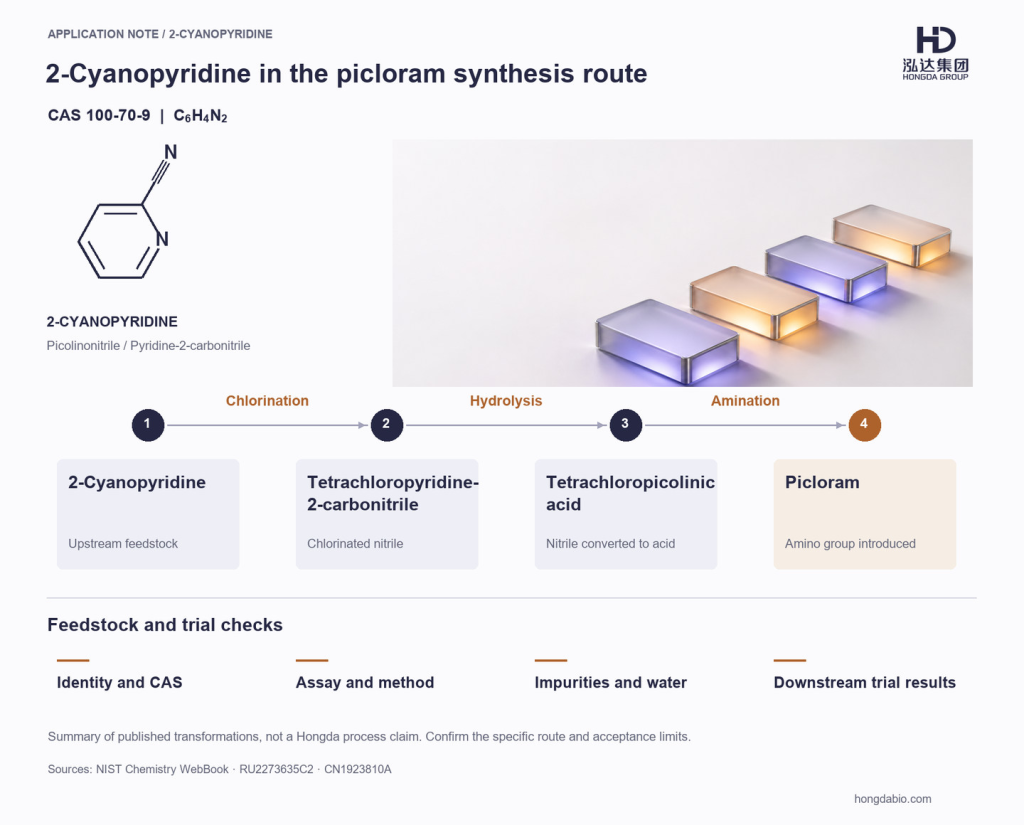
2-Cyanopyridine can serve as an upstream feedstock for picloram synthesis. A published patent describes its conversion into a chlorinated cyanopyridine, followed by hydrolysis to a tetrachloropicolinic acid intermediate. This intermediate can undergo further reactions to produce picloram. Patent reference: RU2273635C2
These transformations modify the substitution pattern on the pyridine ring and convert the nitrile group at the 2-position into a carboxyl group. When evaluating the starting material, its analytical results need to be considered alongside the requirements of the downstream intermediates.
1. What is 2-cyanopyridine?
2-Cyanopyridine is also known as picolinonitrile or pyridine-2-carbonitrile. Its CAS number is 100-70-9. The nitrile group occupies the 2-position of the pyridine ring, adjacent to the ring nitrogen.
| Identification item | Information |
|---|---|
| Chemical name | 2-Cyanopyridine |
| Synonyms | Picolinonitrile; pyridine-2-carbonitrile |
| CAS number | 100-70-9 |
| Molecular formula | C₆H₄N₂ |
| Structural feature | Nitrile group at the 2-position of the pyridine ring |
These names and identifiers can be checked in the NIST Chemistry WebBook.
The substitution position affects subsequent synthesis. Although 2-, 3-, and 4-cyanopyridine share the same molecular formula, they are different positional isomers. Purchasing documents should specify the position number and CAS number rather than simply state “cyanopyridine.”
2. How is its structure related to picloram?
Picloram is 4-amino-3,5,6-trichloropyridine-2-carboxylic acid.
A comparison of the two structures shows the relationship between their pyridine rings and the carbon-containing group at the 2-position. The relevant transformations retain the pyridine framework while chlorination, hydrolysis and subsequent substitution establish the required structure.
The patent cited above describes the conversion of 2-cyanopyridine into tetrachloropicolinic acid. A separate patent describes the preparation of picloram from tetrachloropicolinic acid or its salts through amination and acidification. Together, these documents establish a published connection between 2-cyanopyridine and picloram through chlorinated intermediates. Patent reference: CN1923810A
This connection combines transformations reported in separate documents. Each process must be assessed on its own terms; the references do not establish a single set of conditions used by every manufacturer.
3. What changes during chlorination, hydrolysis and amination?
The structural relationship can be summarized as:
2-Cyanopyridine → Tetrachloropyridine-2-carbonitrile intermediate → Tetrachloropicolinic acid intermediate → Picloram
The chlorinated nitrile is 3,4,5,6-tetrachloropyridine-2-carbonitrile. The corresponding acid is 3,4,5,6-tetrachloropyridine-2-carboxylic acid, also called tetrachloropicolinic acid.
| Stage | Main structural change |
|---|---|
| Chlorination | Introduces chlorine substituents onto the pyridine ring |
| Hydrolysis | Converts the nitrile group into a carboxyl group |
| Subsequent amination | Introduces the amino group needed for the picloram substitution pattern |
The arrows represent chemical transformations, rather than a single operation that produces the final compound. Intermediate isolation, the use of an acid or salt, and work-up arrangements depend on the specific reference and the confirmed process.
Material names are particularly important when discussing hydrolysis. Unsubstituted 2-cyanopyridine and a chlorinated cyanopyridine produce different carboxylic acids. Terms such as “pyridine carboxylic acid” or “chloropyridine” are too broad to establish whether a material fits the intended route.
4. Why is assay alone insufficient for raw material selection?
For a multistep synthesis, raw material acceptance should consider the main component, impurity profile and downstream reaction results.
Two certificates may both report a high assay, yet their figures may not be directly comparable if the analytical methods differ. A chromatographic area-normalization result should also be distinguished from a calibrated mass-fraction measurement.
Before a trial, the following points should be agreed with the supplier:
| Check | Information to confirm |
|---|---|
| Material identity | Consistency of the name, CAS number and agreed identification method |
| Assay | Analytical method, reporting basis and acceptance range |
| Impurity information | Identified impurities and relevant unidentified peaks |
| Water content | Test method and the range acceptable for the intended process |
| Batch records | Traceability between the sample, test date and subsequent supply batches |
Acceptance limits should be established for the user’s process. A raw material purity reported in a patent or an individual experiment is not automatically a purchasing specification for other routes.
Hongda Group’s 2-cyanopyridine product page provides product identification and application information. Project discussions can then address the applicable specification, batch certificate of analysis and any additional testing required by the customer.
5. Follow the trial through the downstream intermediates
A suitability trial should track how the downstream intermediates form and how they are isolated.
During chlorination, attention should be given to the formation of the target chlorinated intermediate. Hydrolysis and subsequent conversions should then be assessed for selectivity, isolated yield and changes in the impurity profile. High conversion in one stage does not necessarily produce a high overall yield.
When comparing raw material batches, keep reaction conditions, sampling procedures and analytical methods as consistent as possible. Recording the starting material results alongside the downstream results makes differences easier to investigate.
If a downstream impurity increases, establish its identity and the stage at which it appears before assigning a cause. An unusual chromatographic peak alone does not prove that the impurity entered with the starting material.
6. How should melting point, SDS and pricing inform procurement?
The NIST reference cited above reports a melting point near room temperature. Changes in ambient temperature can therefore affect the physical state observed on receipt. Crystals, liquid or a partially solidified material should be assessed against the material temperature, applicable specification and analytical results.
Sampling, transfer and any procedure used to restore flow should follow confirmed operating instructions and the supplier’s current safety data sheet. A brief physical-property summary on a website cannot replace the safety documentation needed for the intended handling conditions.
A quotation request should specify the quantity, target specification, packaging and delivery location, together with any additional analysis required. Prices are difficult to compare when testing requirements or delivery terms differ.
Frequently asked questions
1. Are 2-cyanopyridine, picolinonitrile and pyridine-2-carbonitrile the same substance?
Yes. These names refer to 2-cyanopyridine, CAS 100-70-9. Check the CAS number on orders, labels and certificates of analysis to avoid confusion with other cyanopyridine isomers.
2. Can 2-cyanopyridine directly replace 3-cyanopyridine?
They should not be treated as interchangeable raw materials. Their nitrile groups occupy different positions, which affects the structures obtained in subsequent reactions. Material selection and the synthetic route must be reassessed against the target compound.
3. What information is needed when sourcing it for upstream picloram synthesis?
Specify the reaction stage in which the material will be used, the acceptance methods and the main quality-control requirements. Include the purchase quantity and delivery terms. Once the supplier provides specifications and samples, suitability can be evaluated in the customer’s actual process.
To discuss 2-cyanopyridine specifications, samples or supply requirements, contact Hongda Group with the intended application and acceptance criteria.