



A drink can smell fruitier without smelling more like apple. When testing ethyl isovalerate in an apple-flavored beverage, start with a simple comparison: is the apple note easier to pick out in the test sample than in the control?
Ethyl isovalerate is a branched ester also known as ethyl 3-methylbutanoate, CAS 108-64-5. The FAO/WHO JECFA flavoring specification describes it as a colorless liquid with a strong fruity, wine-like odor and an apple-like note on dilution. That description is a useful starting point for choosing an ingredient. How clearly the apple note comes through depends on the finished beverage.
Ethyl Isovalerate Structure: How It Differs from Ethyl Pentanoate
| Property | Ethyl isovalerate |
|---|---|
| Common name | Ethyl isovalerate |
| Chemical name | Ethyl 3-methylbutanoate |
| CAS number | 108-64-5 |
| Molecular formula | C₇H₁₄O₂ |
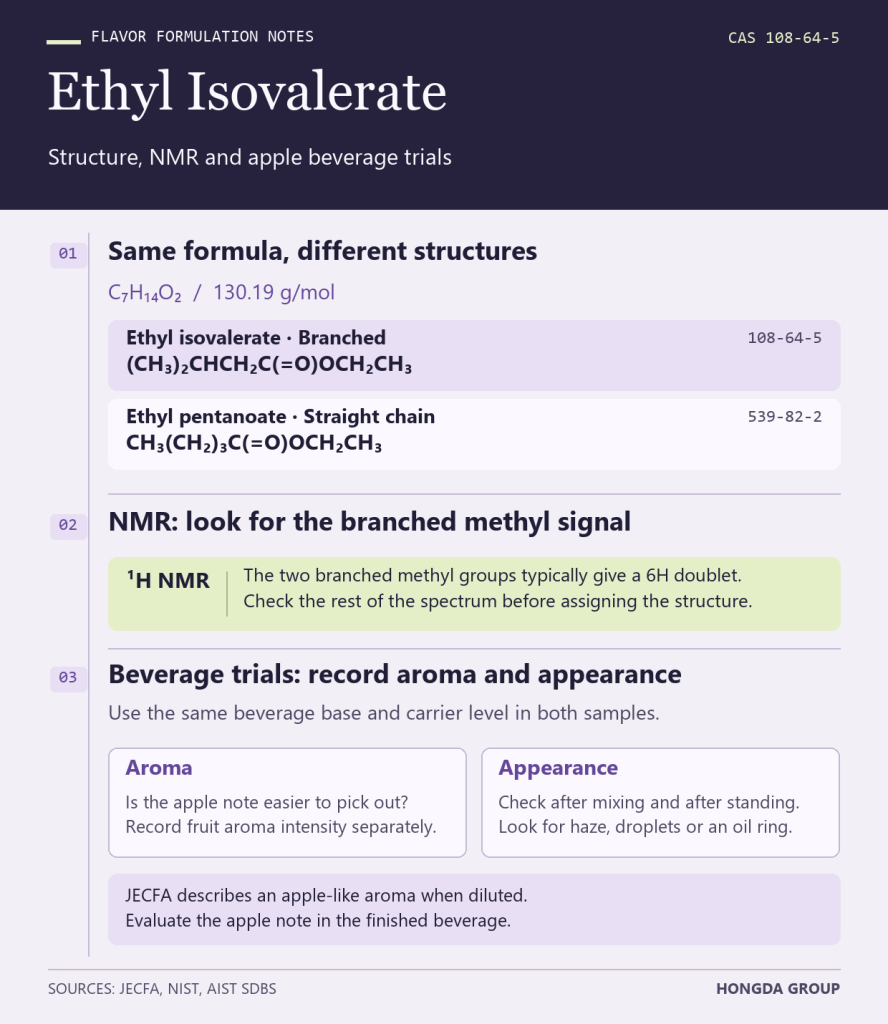
| Condensed structural formula | (CH₃)₂CHCH₂C(=O)OCH₂CH₃ |
| Molar mass | About 130.19 g/mol |
Look for the (CH₃)₂CH– group in the structural formula. Counting from the ester carbonyl carbon, there is a methyl branch at carbon 3. That is where the name ethyl 3-methylbutanoate comes from. NIST Chemistry WebBook: Ethyl isovalerate
Ethyl pentanoate, also called ethyl valerate, has CAS number 539-82-2. It has the same molecular formula and molar mass, but the chain on the acid side of the ester is straight. If a sample label or purchase order lists only C₇H₁₄O₂, check the full name and CAS number to tell the compounds apart. NIST Chemistry WebBook: Ethyl pentanoate
What to Look for in the Ethyl Isovalerate NMR Spectrum
Both esters contain an –OCH₂CH₃ group, so the ethoxy signals alone won’t tell them apart. Look at the branch instead: the two methyl groups on the branched part of ethyl isovalerate typically give a doublet that integrates to six protons in the ¹H NMR spectrum. Ethyl pentanoate lacks that pair of methyl groups. Check the positions, shapes, and integrals of the other signals before assigning the structure. AIST Spectral Database: Ethyl isovalerate NMR reference spectra
A reference spectrum can help identify the compound. For batch acceptance, identity and assay are separate checks. JECFA lists infrared spectroscopy (IR) as its identity test and specifies assay separately. A characteristic NMR signal alone can’t tell you whether a batch meets the assay specification.
Testing Ethyl Isovalerate in an Apple-Flavored Beverage
Use the same beverage base for the test and control samples. If you add ethyl isovalerate in a carrier, add the same amount of carrier to the control. Keep the sugar level, acidity, processing conditions, and evaluation temperature the same so you can compare the samples directly.
- Aroma: Is the apple note easier to recognize than in the control? Record overall fruit aroma intensity and how easy it is to pick out the apple note as separate observations.
- Appearance: If the goal is a clear drink, check it after mixing and again after standing. Look for haze, droplets, or a surface oil ring. If both samples change in the same way, start by checking the base and carrier they share.
JECFA reports a water solubility of 1 mL of ethyl isovalerate in 350 mL of water. That figure describes solubility in water and cannot be used to calculate an addition level. For a drink containing sugar, acid, and other flavorings, check clarity in the actual formulation.
Which Documents Should Buyers Check?
Match the product name to CAS 108-64-5, then ask for a certificate of analysis (COA) for the batch and a safety data sheet (SDS) for the product. The COA gives the batch test results. The SDS covers hazards, handling, and storage. For food applications, also check the supply specification and the requirements for the intended use in your target market.
For product information, see Hongda Group’s ethyl isovalerate product page.
Frequently Asked Questions
1. Are ethyl isovalerate and ethyl 3-methylbutanoate the same compound?
Yes. Both names refer to CAS 108-64-5. The name ethyl 3-methylbutanoate identifies the position of the methyl branch.
2. Does the apple-like aroma mean the ingredient comes from apples?
No. Apple-like describes the aroma. If the source matters for your project, check the supplier’s origin documentation.
3. Can I substitute ethyl isovalerate for ethyl pentanoate at the same level?
The shared molecular formula doesn’t justify a one-for-one substitution. If you’re considering a switch, run a side-by-side trial in the same formulation and compare the apple note, overall fruit aroma, and appearance after standing.