



2,3-Dichloropyridine (CAS 2402-77-9) is a starting material for intermediates used to make chlorantraniliprole. In a published route, chlorine at position 2 of the pyridine ring is replaced, while chlorine at position 3 stays in the molecule. Following those two positions shows which part of the starting material ends up in the final structure. Published patent application WO2022208149A1
CAS number, molecular formula and structure
The nitrogen atom in the pyridine ring is numbered 1. In 2,3-dichloropyridine, the two chlorine atoms are attached to adjacent carbons at positions 2 and 3.
| Property | Value |
|---|---|
| Chemical name | 2,3-Dichloropyridine |
| CAS number | 2402-77-9 |
| Molecular formula | C₅H₃Cl₂N |
| Molar mass | 147.99 g/mol |
| Substitution pattern | Chlorine at positions 2 and 3 of the pyridine ring |
Source: NIST Chemistry WebBook.
Other dichloropyridine isomers can share the same molecular formula and molar mass but have chlorine atoms in different positions. Use the full name and CAS number on sample labels and purchasing specifications. “Dichloropyridine” alone does not identify the material. Hongda Group describes its product as a white to light beige crystalline powder. See the 2,3-dichloropyridine product page for supply details.
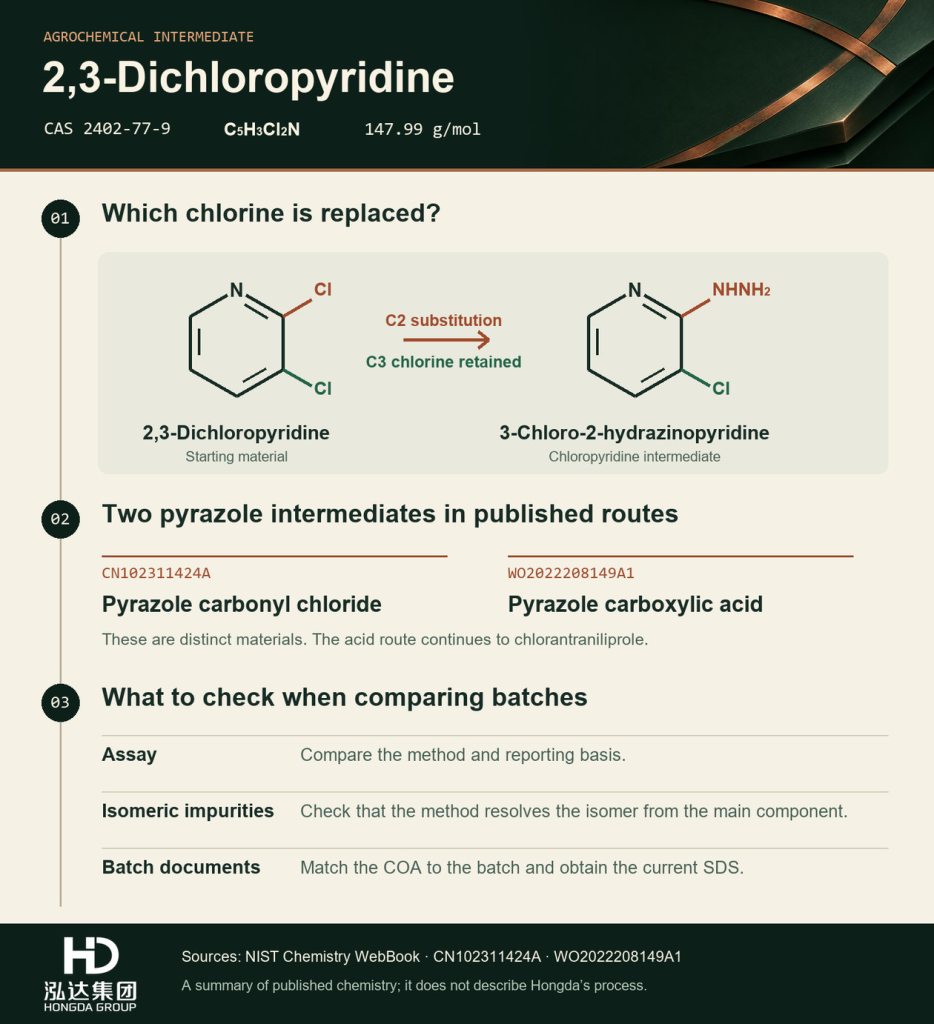
What part of the molecule carries through to chlorantraniliprole?
Published patent application CN102311424A describes the conversion of 2,3-dichloropyridine to 3-chloro-2-hydrazinopyridine. A hydrazino group replaces chlorine at position 2, and chlorine at position 3 remains in place. The two linked nitrogen atoms in the hydrazino group become part of the five-membered ring built later in the route.
3-Chloro-2-hydrazinopyridine and 2-amino-3-chloropyridine have similar names, but they are distinct compounds. The first has a hydrazino group (–NHNH₂) at position 2; the second has an amino group (–NH₂) at that position. The route described here uses the hydrazino compound.
The public documents also distinguish two later intermediates. CN102311424A describes a pyrazole carbonyl chloride, while WO2022208149A1 describes the corresponding pyrazole carboxylic acid and its use in subsequent synthesis. Check the full name or structure when comparing the documents: the acid and acyl chloride are different materials. These publications describe the chemistry; they do not identify the manufacturing route used by Hongda Group or any buyer.
What does the reported purity actually measure?
Two reports may both list “purity” while measuring different things. A value calculated by normalizing chromatographic peak areas is a share of the detected peak area. It is not automatically the mass fraction of the main component. Before comparing batches or suppliers, check the analytical method, calculation and reporting basis.
If a particular dichloropyridine isomer matters to the process, confirm that the method resolves it from the main component. Published preparation reference CN110818621A discusses other chloropyridines and positional isomers that can arise in certain preparation routes. That information can help decide what to test for. Only analysis of the supplied batch can establish what it contains.
During a downstream trial, record reaction results separately from isolation results. Suppose the reaction mixtures from two batches contain similar levels of the target intermediate, but one gives a lower isolated yield. Check for product remaining in the mother liquor and review filtration and washing before attributing the difference to poorer reaction performance.
Boiling-point data, SDS and quotation requests
When looking up boiling-point data, check the chemical name, CAS number and measurement pressure. A value measured under reduced pressure cannot be compared directly with a normal boiling point. Neither value, on its own, sets a downstream reaction temperature.
Request a certificate of analysis (COA) for the sample batch and the current safety data sheet (SDS, also called an MSDS) for the supplied product. The COA reports batch test results. The SDS provides hazard, storage and handling information.
For a quote or sample, contact Hongda Group with the intended application, required specification, quantity and delivery location. If your project sets a limit for a particular isomer, include the limit and the test method in the sample request.
Frequently asked questions
1. What are the CAS number and molar mass of 2,3-dichloropyridine?
The CAS number is 2402-77-9, and the molar mass is 147.99 g/mol. Use the full name and CAS number to identify the material, since positional isomers can have the same molar mass.
2. Can 2,3-dichloropyridine be converted directly into chlorantraniliprole?
The route discussed here involves several transformations. The starting material supplies the chloropyridine portion. The pyrazole structure is formed later and joined to the other part of the molecule.
3. Can two batches with the same stated purity be used interchangeably?
First compare the test methods and reporting bases, then review the impurity results relevant to your process. For an established process, compare the new sample with an approved batch and record reaction and isolation results separately.