



Ethyl isobutyrate (CAS 97-62-1) has a sweet, fruity aroma and can be used in strawberry, cherry and other fruit flavor blends. In formulation work, the questions are whether it improves the intended profile and whether that contribution remains after processing.
The same flavor blend may behave differently in a diluted evaluation sample, a beverage and a food containing fat. Assessment should therefore include the complete formulation and finished product. Chemical identity and physical-property data help formulators and buyers confirm the material and investigate differences between trials.
1. Are ethyl isobutyrate and ethyl 2-methylpropanoate the same substance?
Yes. Ethyl isobutyrate is the common name, while ethyl 2-methylpropanoate is the systematic name. Both refer to the compound with CAS number 97-62-1.
| Identification item | Information |
|---|---|
| Common name | Ethyl isobutyrate |
| Systematic name | Ethyl 2-methylpropanoate |
| Alternative name | Ethyl isobutanoate |
| CAS number | 97-62-1 |
| Molecular formula | C₆H₁₂O₂ |
| Condensed structural formula | (CH₃)₂CHC(=O)OCH₂CH₃ |
These names, the molecular formula and the structure can be checked in the NIST Chemistry WebBook.
The acid-derived portion of ethyl isobutyrate corresponds to isobutyric acid, while the alcohol-derived portion corresponds to ethanol. Its name resembles those of ethyl butyrate and isobutyl acetate, but they are different compounds:
| Compound | Corresponding acid and alcohol |
|---|---|
| Ethyl isobutyrate | Isobutyric acid and ethanol |
| Ethyl butyrate | Butyric acid and ethanol |
| Isobutyl acetate | Acetic acid and isobutanol |
All three share the same molecular formula, but their structures differ. Purchasing and formulation records should use the full chemical name and CAS number. A description such as “fruity ester” does not establish chemical identity.
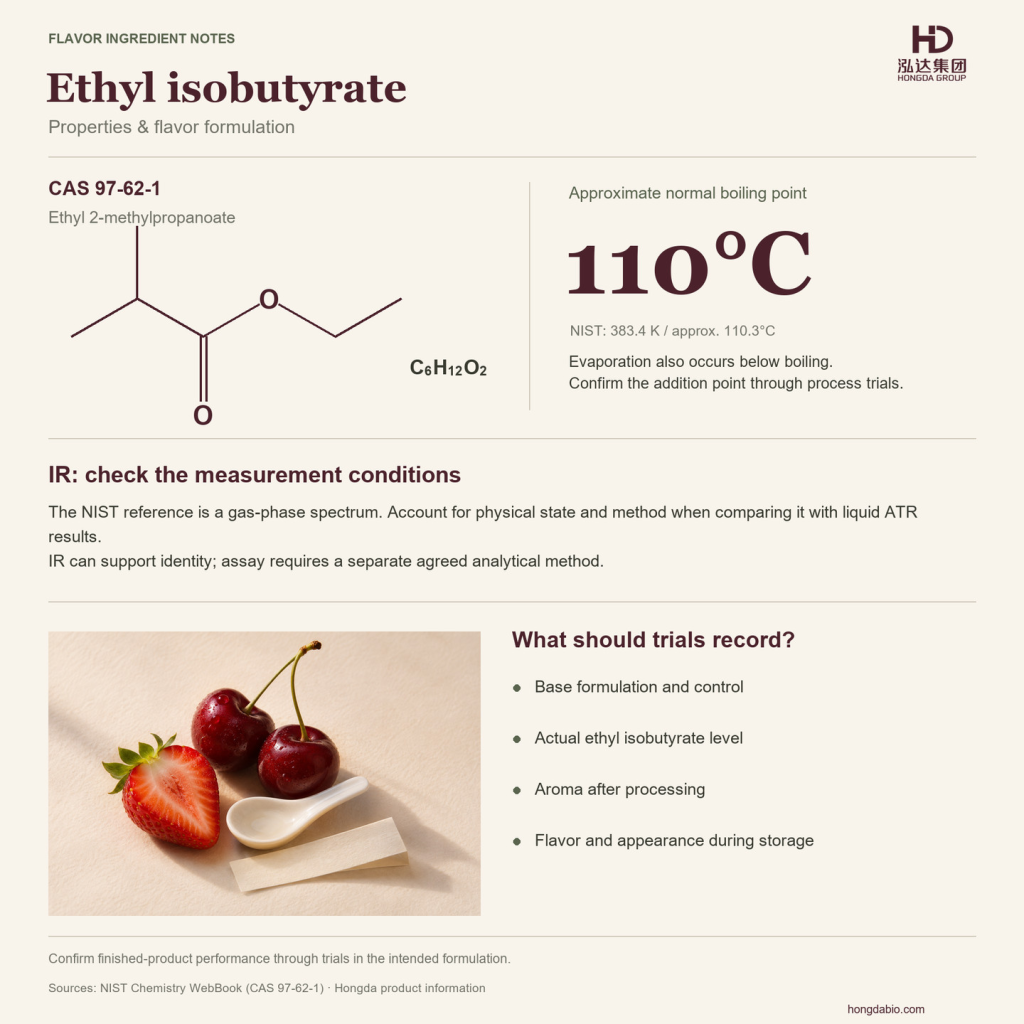
2. What does a boiling point of about 110°C mean for flavor addition?
NIST reports an average boiling point of 383.4 K, equivalent to approximately 110.3°C. This can be summarized as a normal boiling point of about 110°C. NIST phase-change data
This value describes the boiling behavior of the pure substance. It does not establish a suitable flavor addition temperature for food processing. Ethyl isobutyrate also evaporates below its boiling point. In a compounded flavor or food, its release depends on the carrier, formulation and operating conditions.
When comparing two flavor addition procedures, record the product temperature, mixing time and whether the equipment is open or closed. Comparing addition levels alone may lead to processing differences being mistaken for raw material batch differences.
Where the process allows, compare different addition points while keeping the formulation and ingredient level constant. Evaluate the finished product after cooling to establish whether the intended fruity note remains and whether the overall flavor is balanced.
Boiling point alone also cannot establish heat stability. Aroma changes during processing may involve evaporation, partitioning or chemical changes. Process records and analytical results are needed to investigate the cause.
3. What does it contribute to strawberry and cherry flavors?
Hongda Group’s ethyl isobutyrate product information describes a sweet, fruity aroma and lists creamy strawberry and cherry flavor applications.
Ethyl isobutyrate can serve as a fruity component in these blends. Its contribution depends on the proportions of the other ingredients. The odor description of a single substance cannot establish the fruit character of a complete flavor.
For a strawberry formulation, first identify the intended improvement. Is the fruity note too weak, or is the balance between sweetness, acidity and the main aroma unsatisfactory? If the issue lies in the complete formulation, increasing ethyl isobutyrate may simply make one part of the aroma more prominent.
Experiments by Barkat and colleagues found that some odor mixtures have an overall character different from their individual components. The assessors’ olfactory training also affected perception. This research helps explain why individual-ingredient odor assessment cannot replace evaluation of a complete blend; it did not validate the specific food applications discussed here. Research on perceptual blending in odor mixtures
Individual-ingredient assessment is useful for initial screening. Decisions to retain or adjust ethyl isobutyrate should then be based on its performance in the target formulation.
4. How can formulation trials produce useful comparisons?
Start with one base formulation and retain a control without added ethyl isobutyrate. Compare several trial levels selected by the formulator, using the same other flavor ingredients, preparation method and evaluation conditions.
Records should distinguish the amount of ethyl isobutyrate from the total amount of compounded flavor added. When a diluted stock is used, record its concentration and dilution medium. Equal weights of stock solution do not necessarily contain equal amounts of ethyl isobutyrate.
Different food systems raise different questions:
| Trial system | Points to assess |
|---|---|
| Water-based beverages | Balance of the fruity note and appearance after flavor dispersion |
| Dairy or dairy-flavored systems containing fat | Aroma intensity, release and changes at different serving temperatures |
| Confectionery | Fruity character after processing and cooling, and flavor development during consumption |
| Alcohol-containing systems | Balance between fruity and alcoholic notes, including changes after dilution or under different serving conditions |
These are questions for application trials, rather than claims that performance has already been demonstrated in every system.
Evaluation should continue during storage. A freshly prepared sample that meets expectations does not establish later performance. Compare the main aroma, aftertaste and appearance under the intended packaging and storage conditions before deciding whether to proceed to a larger trial.
5. What can an IR spectrum help confirm?
A search for “ethyl isobutyrate IR spectrum” generally seeks a reference infrared spectrum for structural interpretation or material identification.
NIST provides an IR reference spectrum for ethyl isobutyrate and identifies it as a gas-phase spectrum. If a sample is measured as a liquid using ATR or another method, differences in physical state and measurement conditions should be considered. NIST IR reference spectrum
Identification should consider the overall spectrum and its relevant features. An ester carbonyl absorption alone does not establish that a sample is ethyl isobutyrate, since other esters contain the same type of functional group.
IR identification and assay address different questions. A matching spectrum can support identity, while compliance with an agreed assay and impurity limits requires suitable analytical methods. An IR spectrum cannot directly replace the assay results in a batch certificate of analysis.
6. What should purchasing and acceptance specifications cover?
After chemical identity is confirmed, the supplied specification must be assessed against the intended application. Describing the target food, flavor carrier and main processing conditions before requesting samples helps establish which supporting documents are needed.
| Check | Information to confirm |
|---|---|
| Identity | Full chemical name, CAS number and agreed identification method |
| Assay | Test method, reporting basis and acceptance range |
| Related quality parameters | Whether free acid, water or other parameters require control under the applicable specification |
| Sensory requirements | Comparison with an agreed reference using consistent dilution and assessment conditions |
| Batch documents | Traceability between samples and supply batches, batch certificate of analysis and current SDS |
Specific limits should follow the specification agreed by both parties. Suggested addition levels found in general references also require assessment against the target food, complete formulation and applicable requirements.
To discuss ethyl isobutyrate specifications, samples or supply terms, contact Hongda Group with the intended application, expected quantity and delivery requirements.
Frequently asked questions
1. What is the difference between ethyl isobutyrate and ethyl 2-methylpropanoate?
They are different names for the same substance, CAS 97-62-1. Including both the chemical name and CAS number in orders and analytical documents helps avoid confusion.
2. Does its boiling point of about 110°C mean that aroma will not be lost below this temperature?
No. Ethyl isobutyrate also evaporates below its boiling point. Aroma retention depends on the formulation, addition point, temperature and equipment conditions. Assess it through comparisons of the finished product after processing.
3. Can ethyl isobutyrate directly replace ethyl butyrate because both have fruity aromas?
They should not be treated as interchangeable ingredients. Their structures differ, and their sensory contributions may differ within a formulation. Any substitution should be evaluated in the target system, with the actual ingredient level and post-processing performance recorded.