



2,2′-Bipyridine is used in diquat synthesis, metal-complex preparation and some electroless copper formulations. In coordination chemistry, it is commonly abbreviated as bpy. Its use as a ligand is familiar, but that describes only part of its application range.
In diquat production, it supplies the bipyridine framework of the target compound. In metal complexes, its nitrogen atoms participate in coordination. In an electroless copper bath, its effect must be evaluated within the full formulation. Each use calls for a different approach to material qualification.
1. What is a bpy ligand?
2,2′-Bipyridine, also abbreviated as bipy, has the CAS number 366-18-7. Its two pyridine rings are joined by a carbon–carbon bond at their respective 2-positions.
| Identification item | Information |
|---|---|
| Chemical name | 2,2′-Bipyridine |
| Common abbreviations | bpy, bipy |
| CAS number | 366-18-7 |
| Molecular formula | C₁₀H₈N₂ |
| Common ligand classification | Neutral bidentate nitrogen-donor ligand |
The identity, formula and ring connectivity are documented in the PubChem entry for 2,2′-bipyridine.
“Bidentate” means that a single ligand can bind through two sites. For bpy, these are the two pyridine nitrogen atoms. When both bind to the same metal centre, they form a chelate.
Denticity and charge describe different properties. The usual unprotonated form of bpy is neutral; having two binding sites does not give it a charge of −2.
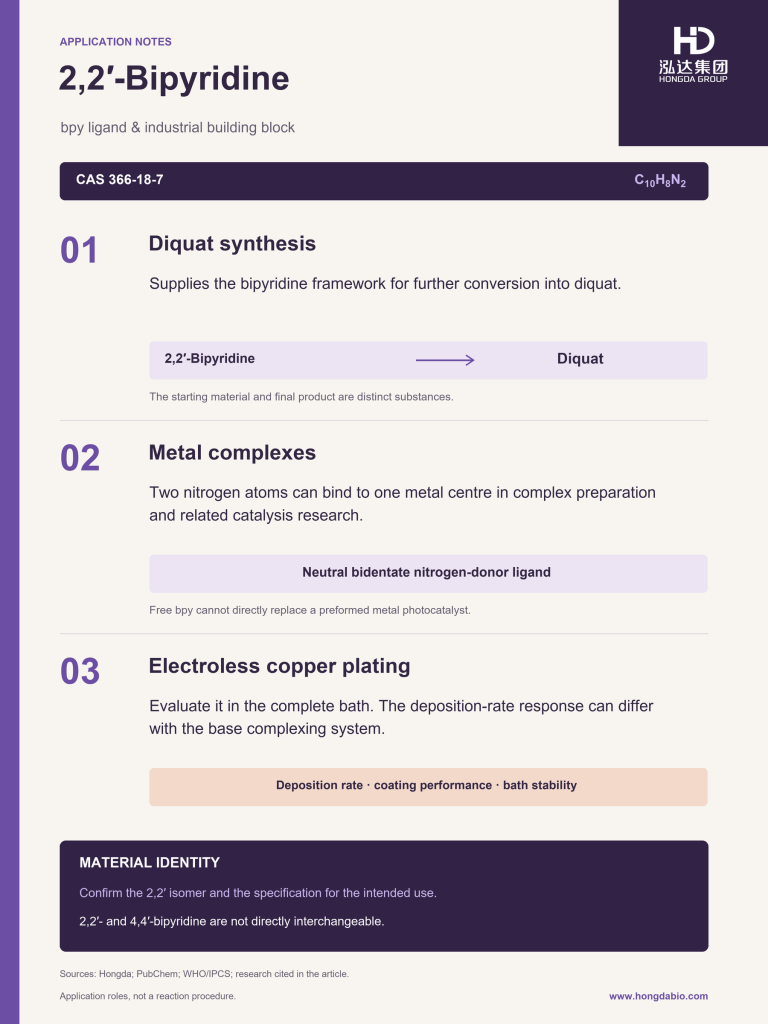
2. Diquat synthesis: supplying the bipyridine framework
2,2′-Bipyridine can serve as a starting material for diquat synthesis. It supplies the bipyridine framework that is incorporated into the final compound. The production section of the WHO/IPCS monograph on paraquat and diquat documents a route in which 2,2′-bipyridine is further converted into diquat. WHO/IPCS technical monograph
Here, the material undergoes chemical transformation and becomes part of the product structure. This role differs from its use as a ligand in a metal complex. 2,2′-Bipyridine and diquat are separate substances with different properties and uses.
Ring connectivity is an essential identity check. The designation “2,2′” specifies how the pyridine rings are joined. Other isomers, such as 4,4′-bipyridine, cannot simply replace the starting material in this route.
Quality requirements should follow the intended process. Assay, relevant impurities and their fate in subsequent steps all deserve consideration. Comparing samples under the same process conditions allows conversion, unreacted starting material and purification performance to be assessed together.
Published information establishes this application, but it does not show that a particular supplier’s material has been qualified in a specific plant. Production specifications need to be confirmed against the user’s own process.
3. Metal-complex preparation: coordination through two nitrogen atoms
The two nitrogen atoms of bpy allow it to act as a ligand in transition-metal complexes. These complexes are studied in catalysis, electrochemistry and luminescent materials. Their properties depend on the metal, the ligand structure and the overall coordination environment.
The full ligand name matters. A paper referring to a “bipyridine ligand” may use unsubstituted 2,2′-bipyridine or a derivative bearing methyl, carboxyl or other groups. Such structural changes can alter the resulting complex. The abbreviation alone is not enough to specify a material.
Photoredox catalysis provides a concrete example. In their study of asymmetric α-alkylation of aldehydes, Nicewicz and MacMillan combined a ruthenium–bipyridine complex with an organic catalyst for a visible-light-driven reaction. Original research paper
The photoredox catalyst in that study was the formed ruthenium complex. Free bpy is the ligand and cannot directly replace it. When reproducing a published reaction, first check whether the procedure uses a preformed complex or generates a catalytic system from a metal salt and ligand in situ. The materials and conditions should match that distinction.
4. Electroless copper plating: the bath composition matters
Hongda Group’s 2,2′-bipyridine product information lists electroless copper plating among its applications and describes its use with potassium ferrocyanide to control copper deposition rate.
Rate control does not mean that adding bpy will always accelerate or always suppress deposition. Its behaviour can change with the underlying complexing system.
A study in the Journal of The Electrochemical Society compared tartrate- and HEDTA-based electroless copper baths. Under the conditions tested, 2,2′-bipyridine reduced the deposition rate in the tartrate system. Changing its concentration in the HEDTA system did not produce the same rate effect. The study identified competition between complexing and stabilizing agents at the surface as an important factor in copper deposition. Study abstract and publication details
An addition level and result established in one formulation therefore cannot be transferred directly to another bath.
A useful comparison includes a control without bpy and keeps the base formulation, temperature, pH and substrate preparation consistent. Alongside deposition rate, assess coating appearance and bath stability. A single measurement may miss a change that matters during operation.
5. Qualifying the material for its intended use
For diquat synthesis, qualification starts with identity, assay and relevant impurities, followed by evaluation of reaction and purification performance within the chosen route.
For metal-complex preparation, confirm the exact ligand required by the procedure. If an analytical or catalytic project is sensitive to trace metals, additional residual-metal testing may be appropriate. Testing requirements should reflect the project rather than an assumed universal specification.
For electroless copper plating, link material batches and actual addition levels to the bath trial records. Changing the base formulation while changing the material sample makes the source of any performance difference harder to establish.
These applications do not share a single acceptance specification. Describing the target product or formulation helps define useful testing requirements more clearly than requesting “high purity” alone. To discuss 2,2′-bipyridine documentation and specifications, contact Hongda Group.
Frequently asked questions
1. What is the charge of a bpy ligand?
The usual unprotonated form of 2,2′-bipyridine is a neutral ligand with a charge of zero. “Bidentate” refers to its two binding sites, not its charge.
2. Is 2,2′-bipyridine used to make diquat?
Yes. Published technical information documents its further conversion into diquat. It supplies the bipyridine framework, while the material specification must be qualified for the selected production process.
3. Is a higher bpy addition always better in electroless copper plating?
No. The effect on copper deposition can differ between bath formulations. Establish a suitable addition level in the intended bath and assess deposition rate, coating performance and bath stability together.