



Acetonitrile (CAS 75-05-8) is a water-miscible organic solvent commonly used in the mobile phase for reversed-phase preparative chromatography. Two lots can meet the same purity specification and still give different baselines in a blank gradient run. When comparing lots, check UV absorbance at your detection wavelength and how each solvent performs under the gradient you actually use.
| Product information | Details |
|---|---|
| Product name | Acetonitrile |
| CAS number | 75-05-8 |
| Molecular formula | C₂H₃N |
| Appearance | Clear, colorless liquid |
| Packaging listed on the website | 150 kg per drum |
See the Hongda acetonitrile product page for product and packaging information. If you plan to use the solvent in preparative chromatography, check the grade offered, its technical specification, and the certificate of analysis (COA) for the lot under consideration.
What does acetonitrile do in peptide purification?
Water and acetonitrile are commonly used together in reversed-phase preparative chromatography. Peptides and impurities interact differently with the stationary phase. As the proportion of acetonitrile rises, more strongly retained components can elute. The chromatogram helps determine where to start and stop collecting, and testing the collected fractions helps determine which ones can be pooled.
Water–acetonitrile mixtures have relatively low viscosity, and acetonitrile typically has low absorbance at short UV wavelengths used in chromatography. These properties matter for system pressure and detector background. Whether the target peptide separates from a nearby impurity still depends on the sample, column, and gradient. Changing the organic solvent can shift retention, so check the collection window again before relying on it.
What should you check besides purity?
If your method uses UV detection, start with the detection wavelength. A COA that reports only purity, or reports absorbance at a different wavelength, leaves part of the comparison unanswered.
| What to check | How to assess it |
|---|---|
| UV absorbance | Check the wavelength, test conditions, and limit. A result at one wavelength does not establish performance at another. |
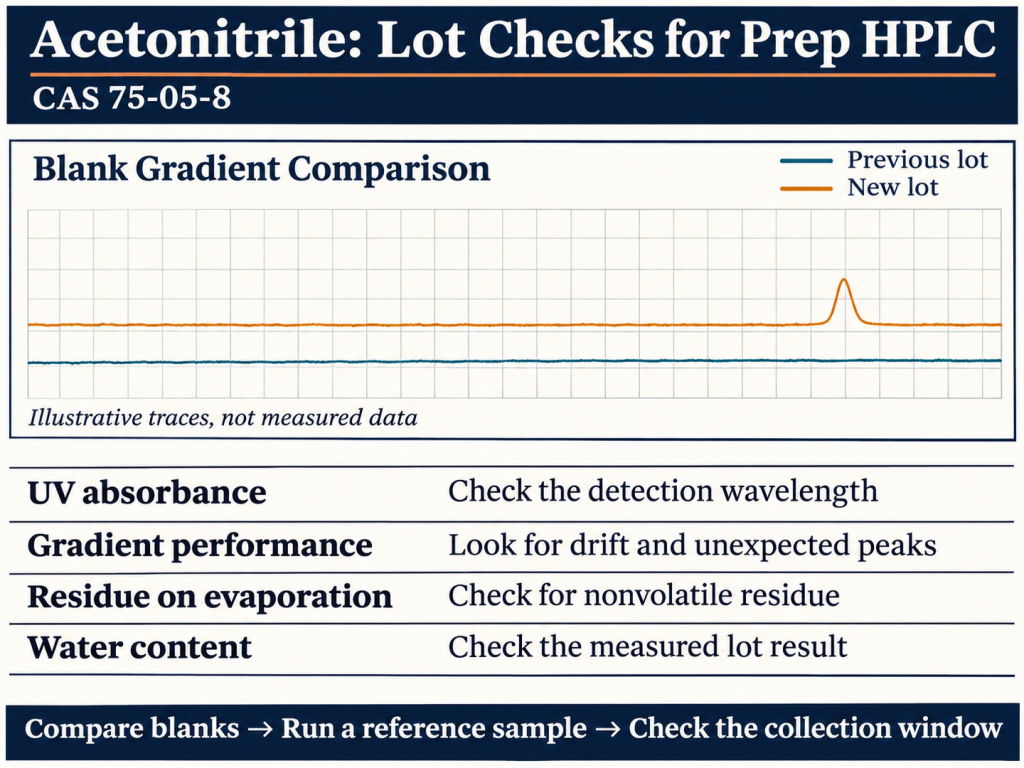
| Gradient performance | Look for gradient test data in the specification. In a blank gradient run, check for baseline drift or peaks that appear without a sample injection. |
| Residue on evaporation | If you plan to concentrate the collected fractions, check how much nonvolatile material the solvent can leave behind. |
| Water content | If your method is sensitive to water in the organic phase, check the measured lot result and the test method. |
Chromatography solvent specifications commonly list purity, UV absorbance, gradient performance, and residue on evaporation as separate items. Use those items to frame your questions for the supplier, then set acceptance limits for the method you run.
What if an unexpected peak appears after a lot change?
Start with a blank gradient. Suppose a small peak appears late in the gradient after you switch to a new lot of acetonitrile. Compare blank runs with the old and new lots, keeping the aqueous phase, additives, gradient, and detector settings the same. If repeat runs show the peak only with the new lot, start by checking the solvent and the containers it contacted. If the peak appears with both lots, check the aqueous phase, flow path, and possible carryover.
Once the blank meets your acceptance criteria, run a reference sample with an established chromatogram. Check whether the target peak is still resolved from the nearest impurity. For a preparative method, also check whether the collection window has shifted.
Frequently asked questions
What is the CAS number for acetonitrile?
The CAS number for acetonitrile is 75-05-8. It identifies the chemical. When buying a particular grade, also check the grade and lot number on the label against the corresponding COA.
What is the difference between HPLC-grade and gradient-grade acetonitrile?
An HPLC-grade label tells you the solvent is sold for HPLC use. The specification tells you which tests were performed. Gradient-grade solvents typically have a documented gradient test. Check the wavelength, test conditions, and acceptance limits before comparing results from different suppliers.
Can general-purpose acetonitrile be used for preparative peptide chromatography?
The name, purity, and drum size alone cannot answer that question. Compare the supplier’s specification with the requirements of your method. Then verify blank and sample performance with the lot you intend to use.
What is the difference between an acetonitrile SDS and a COA?
A safety data sheet (SDS) covers hazards, handling, storage, and emergency measures. A COA lists test results for a specific lot. Use the agreed technical specification to determine whether those results meet your acceptance limits.
To confirm the grade offered or request lot documentation, ask Hongda for acetonitrile specifications, a COA, or an SDS. Include the intended application and the test items you need to verify.