



Ethyl acetate (CAS 141-78-6) is a fast-evaporating ester solvent used in some solvent-based gravure and flexographic inks for flexible packaging. It dissolves compatible resins and can be part of the thinner blend. If you change the thinner, similar viscosity readings before the run tell you little about whether the two inks will transfer or dry the same way on press.
| Product information | Hongda product listing |
|---|---|
| Product name | Ethyl acetate |
| CAS number | 141-78-6 |
| Molecular formula | C₄H₈O₂ |
| Appearance and properties | Colorless, flammable liquid |
| Listed standard | GB/T 3728-2023 |
| Packaging | 25 kg per drum |
See the Hongda ethyl acetate product page for the listed specifications.
What does ethyl acetate do in flexible packaging inks?
In a compatible ink formulation, ethyl acetate helps dissolve the resin. A thinner blend that contains ethyl acetate can also be used to adjust the ink to its working viscosity. The European Commission JRC’s technical reference, Chapter 12, Table 12.2, lists ethyl acetate as a thinner for solvent-based packaging printing. It also notes that the ratio of ethanol to ethyl acetate depends on the drying time required.
Two inks can give similar flow times in a viscosity cup before a run. Once the solvent starts to evaporate, differences may show up in highlights and fine type, at the dryer exit, or after rewinding. The choice of thinner also depends on the resin system, the substrate, and, in flexo, the printing plate’s compatibility with the solvent blend.
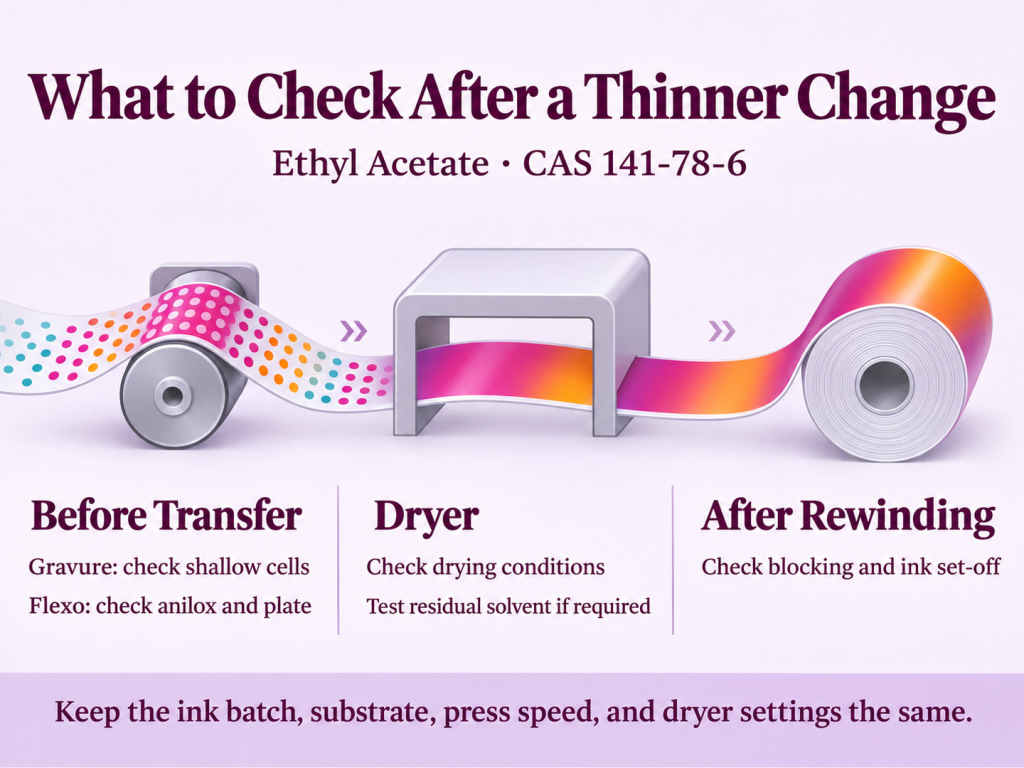
What should you check after changing the thinner?
Use the same ink and substrate batches where possible. Hold press speed and dryer settings steady for the first comparison, and measure the starting viscosity using the same method at a similar ink temperature. That gives you a better basis for deciding whether to adjust the press or dryer later.
- Ink transfer. In gravure, inspect highlight dots and the edges of fine type. If transfer is uneven in flexo, check ink delivery from the anilox roll and the condition of the plate before attributing the defect to the thinner.
- Drying. The U.S. EPA’s guidance on flexible package printing explains that most of the solvent on the printed substrate evaporates in the dryer in gravure and flexographic printing. If the job has a residual solvent requirement, use the agreed test method. A print that feels dry can still need testing.
- Rewinding. Rewind and store the trial rolls under comparable conditions. Unwind them after the agreed interval and check for blocking or set-off: layers sticking together, or ink transferring to the back of the adjacent layer.
Can ethyl acetate replace n-propyl acetate in a printing ink?
Both are used in some printing inks, but a similar viscosity reading does not establish that they can be substituted one for one. If the current blend uses n-propyl acetate, keep that blend as the reference. Compare resin compatibility, highlight transfer and the condition of the rewound roll. Prints that look alike at the dryer exit may behave differently when the rolls are unwound later.
Frequently Asked Questions
What is the CAS number and molecular formula of ethyl acetate?
Its CAS number is 141-78-6, and its molecular formula is C₄H₈O₂.
Can ethyl acetate be used in flexographic inks?
Yes, in some solvent-based flexographic inks. Check the ink supplier’s recommended thinner blend, plate compatibility and the results of a press trial.
Why can two inks with similar viscosity readings dry differently?
A viscosity cup measures how long the ink takes to flow out under the test conditions. Drying on press also depends on how the solvent blend evaporates, how fast the press runs and how the dryer is set. Record the viscosity and drying observations separately.
Can a batch COA tell me how much solvent remains in the finished print?
A batch COA reports test results for the ethyl acetate supplied. To determine residual solvent in the finished print, test a sample of the printed material using the applicable method.