



Isoamyl propionate has a fruity aroma with apricot and pineapple notes. It is a candidate for tropical fruit flavors, but choosing it takes more than matching an odor description. The carrier needs to dissolve the ingredient, and the aroma needs to work with the other components in the finished food.
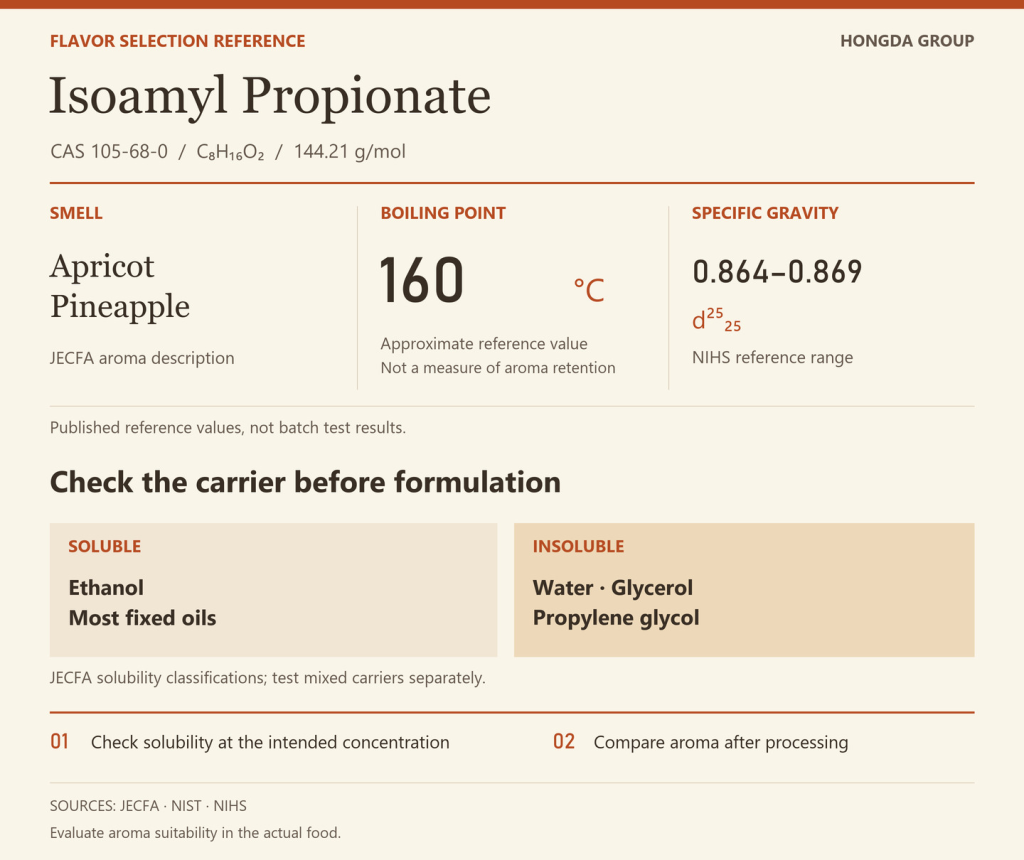
The FAO/WHO JECFA flavoring specification describes isoamyl propionate as a colorless liquid with a fruity, apricot- and pineapple-like odor. It also lists a boiling point of about 160°C. These are useful starting points for selecting a material. Aroma performance and retention during processing require separate evaluation.
What Is Isoamyl Propionate?
| Property | Information |
|---|---|
| Common name | Isoamyl propionate |
| Other names | Isopentyl propionate; isoamyl propanoate |
| Chemical name | 3-Methylbutyl propanoate |
| CAS number | 105-68-0 |
| Molecular formula | C₈H₁₆O₂ |
| Molar mass | Approximately 144.21 g/mol |
| Condensed structural formula | CH₃CH₂C(=O)OCH₂CH₂CH(CH₃)₂ |
The NIST Chemistry WebBook records these names and structural details. Isoamyl propionate and isopentyl propionate refer to the same compound, CAS 105-68-0.
In the structural formula, CH₃CH₂C(=O)– is the part derived from propionic acid, while –OCH₂CH₂CH(CH₃)₂ is derived from isoamyl alcohol. Isoamyl acetate and isoamyl butyrate share the alcohol-derived portion, but their acid-derived portions differ. Keep the full ester name on sample labels, purchase orders and formulation records to avoid confusing them.
What Does Isoamyl Propionate Smell Like?
Apricot and pineapple are the clearest reference notes in the JECFA description. They give a formulator a reason to include isoamyl propionate in an initial screening.
A pineapple-like scent does not make it a complete pineapple flavor on its own. Once added to a blend, it may work well with the existing fruit notes or make one part of the aroma too prominent.
For example, when a formulation already has a recognizable pineapple character, compare the original blend with a sample containing isoamyl propionate. Is the intended fruit note easier to recognize? Does the blend retain the freshness you want? Recording only “stronger aroma” leaves these questions unanswered.
Apricot and pineapple describe the sensory character. They do not establish where the ingredient was sourced. Projects with origin requirements should check the supplier’s supporting documents.
Isoamyl Propionate Boiling Point: What It Tells You
JECFA lists a boiling point of approximately 160°C. Several literature values collected by NIST are also close to this temperature. When comparing figures from different sources, check the pressure conditions.
The boiling point helps describe the material, but it cannot tell you how long its aroma will last in food. Evaporation occurs below the boiling point. Processing losses also depend on heating time, exposed surface area and the formulation.
For bread or another heated product, a process temperature below 160°C does not establish that the aroma will be fully retained. Process trial samples under the intended conditions, cool them to the same evaluation temperature and compare them with a control.
If you are testing different addition stages, keep the addition level, mixing procedure and processing conditions in the records. A suitable aroma in the freshly blended flavor still needs to be checked in the finished product.
Isoamyl Propionate Density: Check the Temperature
Density figures appear in technical data sheets and supply specifications. Before comparing them, check whether the document reports density or specific gravity.
The English food-additive monographs published by Japan’s National Institute of Health Sciences give a specific gravity of d²⁵₂₅ = 0.864–0.869 for isoamyl propionate. This compares the density of the sample at 25°C with that of water at 25°C. Specific gravity has no unit. NIHS food-additive monographs
A density reported in g/mL should also include the measurement temperature. Values obtained at different temperatures or expressed on different bases need to be checked before they are compared.
Recording additions by mass generally makes a trial easier to reproduce. If a process uses volume measurements, use a density appropriate to the measurement conditions when converting to mass.
Density can help flag a result that needs investigation. A value within a reference range, however, does not by itself establish identity or assay. The published range above is a reference specification; check the agreed supply specification and batch results for the material being purchased.
Check Carrier Solubility Before Formulating
JECFA describes isoamyl propionate as soluble in ethanol and most fixed oils, and insoluble in water, glycerol and propylene glycol. That information matters when choosing a carrier.
For a project using propylene glycol, it is worth checking solubility early. Being an ester does not mean an ingredient will dissolve readily in every carrier used for flavors. First assess it at the planned flavor-concentrate level, then evaluate that concentrate in the finished formulation. Mixed carriers also need to be tested.
Hongda’s product information lists apricot and pineapple flavor applications as well as frozen desserts, bread and chewing gum. Each application calls for a different comparison:
| Application | What to record in a trial |
|---|---|
| Apricot, pineapple or mixed-fruit flavors | Whether the intended fruit character is clear and works with the other ingredients |
| Frozen desserts | Aroma at the actual serving temperature |
| Bread and other baked products | Recognizable fruit notes after processing and cooling |
| Chewing gum | Changes between the initial fruit aroma and later stages of chewing |
These are suggested observations for formulation trials. Suitability depends on the actual product, its processing conditions and the requirements for the intended use.
Isoamyl Propionate SDS and COA: What to Check
Ask for the current safety data sheet (SDS) for the product being supplied. Use it to check hazards, handling precautions and storage requirements. If the purchase is a dilution or a blend, make sure the SDS covers that mixture.
A certificate of analysis (COA) serves a different purpose: it reports the tests and results for a particular batch. Distinguish published reference data from the supplier’s specification and the batch results. A boiling point listed in a database does not mean that the supplier has measured it for every batch.
For food applications, also check the supply specification and the requirements for the intended use in the target market. To discuss material requirements, see Hongda Group’s isoamyl propionate product page and provide details of the target food, carrier and processing conditions.
Frequently Asked Questions
1. Are isoamyl propionate and isopentyl propionate the same compound?
Yes. Both names refer to CAS 105-68-0. Use the full name and CAS number together when checking supplier documents.
2. What is the boiling point of isoamyl propionate?
The JECFA flavoring specification lists a reference value of approximately 160°C. Check the pressure and source when comparing boiling-point data. The figure does not directly predict aroma retention during food processing.
3. Can isoamyl propionate be added directly to a water-based drink?
Its water solubility is limited, so a carrier or dispersion approach needs to be assessed first. Check the beverage at the intended addition level and under the planned storage conditions. The absence of visible droplets immediately after mixing is not enough to establish stability.