



For a food manufacturer, choosing 0 gi food grade erythritol starts with more than its glycemic index. The ingredient must also deliver the right taste, work in the recipe and arrive with documentation that supports the intended market.
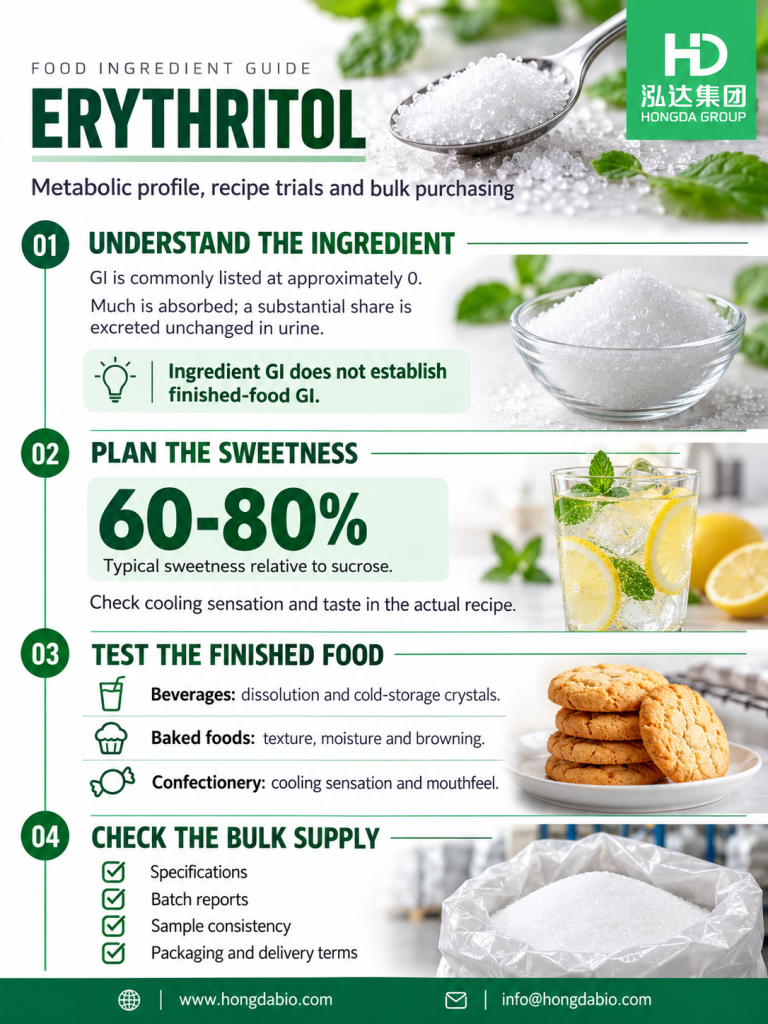
Erythritol is commonly listed with a glycemic index of approximately zero. In published human studies, erythritol alone produced little or no measurable rise in blood glucose under the conditions tested. That result describes the ingredient; it does not automatically determine the glycemic response of a finished drink, biscuit or dessert.
This guide looks at how erythritol behaves in the body, what formulators should expect when replacing sugar, and what buyers should confirm before placing a bulk order.
What is food-grade erythritol?
Erythritol is a sugar alcohol, also called a polyol. It occurs naturally in small amounts in some fruits and fermented foods. Commercial erythritol is commonly produced through fermentation, followed by purification and crystallization.
It is typically supplied as white crystals or powder and is soluble in water. The Hongda Group food-grade erythritol page describes an ingredient produced by fermenting glucose. The page lists a 25 kg bag; current packaging and availability should be confirmed when ordering.
“Food grade” identifies an intended use. Buyers still need to check the supplied specification and the requirements for the finished product in its destination market.
What does 0 GI mean for erythritol?
Glycemic index, or GI, describes how a carbohydrate-containing food affects blood glucose compared with a reference. Erythritol itself is commonly assigned a GI of approximately zero.
A finished food is a different matter. A drink sweetened with erythritol may contain sugar from fruit juice. A biscuit may contain flour and other ingredients that affect blood glucose. Serving size and the rest of a meal also matter.
For that reason, a manufacturer should distinguish among:
- The GI commonly reported for the ingredient.
- The composition and potential glycemic response of the finished food.
- A label claim such as “low GI,” which needs an appropriate basis under the rules of the target market.
A product containing erythritol should not be presented as suitable for every person with diabetes solely because of the ingredient. The complete food and individual circumstances matter.
Erythritol’s metabolic profile
After consumption, much of the erythritol is absorbed through the small intestine. A substantial proportion is later excreted unchanged in urine. The amount not absorbed continues through the digestive system.
This differs from the way the body handles ordinary sugar. In human studies, erythritol alone has generally shown little effect on blood glucose and insulin levels under the conditions tested. Responses to a complete food depend on what else it contains.
Erythritol is also described as low in energy, but the number used on a label depends on the applicable rules. For U.S. nutrition labeling, FDA guidance permits an energy value of 0 calories per gram for erythritol. Other markets may use different calculation or labeling rules.
A finished product’s calorie declaration must account for all its ingredients and the stated serving size.
Sweetness: can erythritol replace sugar one for one?
Erythritol is commonly described as approximately 60%–80% as sweet as sucrose. Perceived sweetness varies with the recipe and the method used to assess it.
Replacing 100 g of sugar with 100 g of erythritol is a possible starting point for a trial, but the result may be less sweet. Increasing the amount or blending it with another permitted sweetener may help reach the desired taste; either approach can change the recipe in other ways.
Erythritol can also create a cooling sensation as it dissolves. That may suit a mint confectionery product. In a cake or dairy dessert, the same sensation may need closer evaluation.
A controlled comparison is useful: keep processing conditions as consistent as possible, then assess sweetness, aftertaste, texture and appearance against the original recipe.
Formulation guide by application
| Application | What to check during development |
|---|---|
| Beverages | Dissolution, sweetness, clarity and changes after chilled storage |
| Baked goods | Sweetness, browning, texture, moisture and shelf-life changes |
| Confectionery | Cooling sensation, particle size, hardness and mouthfeel |
| Dairy products and desserts | Sweetness balance, texture and possible crystallization during storage |
| Tabletop sweeteners | Particle size, flow, taste and mixing in hot or cold drinks |
Beverages: test at the intended storage temperature
Erythritol dissolves in water, but a drink that looks clear when warm may develop crystals after cooling. Concentration, temperature and other ingredients affect the result.
For a refrigerated drink, test the finished recipe at the lowest expected storage temperature and observe it over the intended shelf life. If crystals appear, the team can review the concentration or overall recipe before moving to a larger production trial.
Baked goods: expect changes beyond sweetness
Sugar contributes to structure, moisture and browning as well as taste. Replacing it with erythritol may change how a biscuit colors in the oven or how a cake feels after storage.
The result depends on the full recipe. A replacement level that works in one product should be tested again before being used in another.
Confectionery and desserts: assess the full eating experience
Cooling sensation and crystal size can influence how a product feels in the mouth. A result that suits a mint sweet may be less suitable for a soft dessert.
Assess the product at its intended serving temperature. For chilled products, continue checking texture and crystallization during storage rather than relying only on the first sample.
Safety and labeling considerations
Erythritol is used in foods in multiple markets. Permitted uses, labeling requirements and claim rules should be checked for the destination market and product category.
Some people may experience digestive discomfort or a laxative effect after consuming large amounts. Tolerance varies, and total intake can come from more than one product.
Some studies have examined associations between blood erythritol levels and cardiovascular outcomes. EFSA concluded that the evidence assessed in its 2023 re-evaluation had not established a causal relationship between dietary erythritol exposure and cardiovascular disease; further research may help clarify the association.
Buying erythritol in bulk: what to confirm
Before requesting a quotation, describe the intended food or beverage, destination market, preferred particle size and estimated order volume. These details help the supplier identify the material and documentation for review.
| Item | Questions to ask |
|---|---|
| Specification | What are the identity, appearance, assay, particle-size and quality requirements? |
| Batch report | Can a certificate of analysis be provided for the supplied batch? |
| Application documents | What information is available for the intended food use and destination market? |
| Samples | Does the sample follow the same specification as the proposed commercial supply? |
| Packaging and delivery | What packaging, storage conditions, lead time and delivery terms apply? |
| Change notification | How will changes to the material or its production be communicated? |
A sample that performs well is a useful starting point. Before scaling up, confirm that the material planned for production matches the approved specification and that the recipe performs under production and storage conditions.
Price comparisons should use the same requirements. Differences in particle size, documentation, packaging or delivery terms can affect the suitability and total cost of an order.
Frequently asked questions
Does 0 GI erythritol make the finished food a 0 GI product?
No. Other ingredients, processing and serving size affect the finished food. A claim about the complete product requires its own appropriate basis.
Is erythritol always calorie-free?
Energy calculations and labeling rules differ by market. U.S. guidance permits 0 calories per gram for erythritol, while the finished food’s declaration also includes its other ingredients.
Can erythritol fully replace sugar in baking?
It can be tested as a replacement, but sweetness, color, moisture and texture may change. The suitable amount depends on the recipe and trial results.
Why might crystals appear after chilled storage?
The amount of erythritol that remains dissolved depends on the recipe and temperature. Cooling can lead to crystallization, so the finished product should be tested under its expected storage conditions.
How do I request a bulk quotation?
Contact Hongda Group with the intended application, destination market, desired specification, sample needs and estimated order volume. Confirm current packaging, documentation, pricing and delivery terms during the inquiry.