



Formamide is a colourless liquid that is miscible with water. Also called methanamide, it has CAS number 75-12-7 and molecular formula CH₃NO, commonly written as HCONH₂.
Its industrial applications fall into two broad groups: use as a solvent in material processing, and use as a raw material in chemical synthesis. Search results also feature laboratory reagents, often supplied with requirements specific to an experimental method.
Before selecting a product, establish what formamide will do in the process and which quality requirements follow from that use.
Formamide vs formaldehyde
Formamide and formaldehyde have similar-looking names, but they are different substances.
| Identification | Formamide | Formaldehyde |
|---|---|---|
| CAS number | 75-12-7 | 50-00-0 |
| Molecular formula | CH₃NO | CH₂O |
| Common application areas | Industrial solvents and chemical synthesis | Resin manufacture and certain fixation or disinfection applications |
Formalin, a term often encountered in laboratory work, refers to an aqueous formaldehyde solution. It is not formamide.
Use the full chemical name and CAS number on purchasing records, labels and supporting documents. The materials cannot be substituted on the basis of their similar names, and each requires its own safety information.
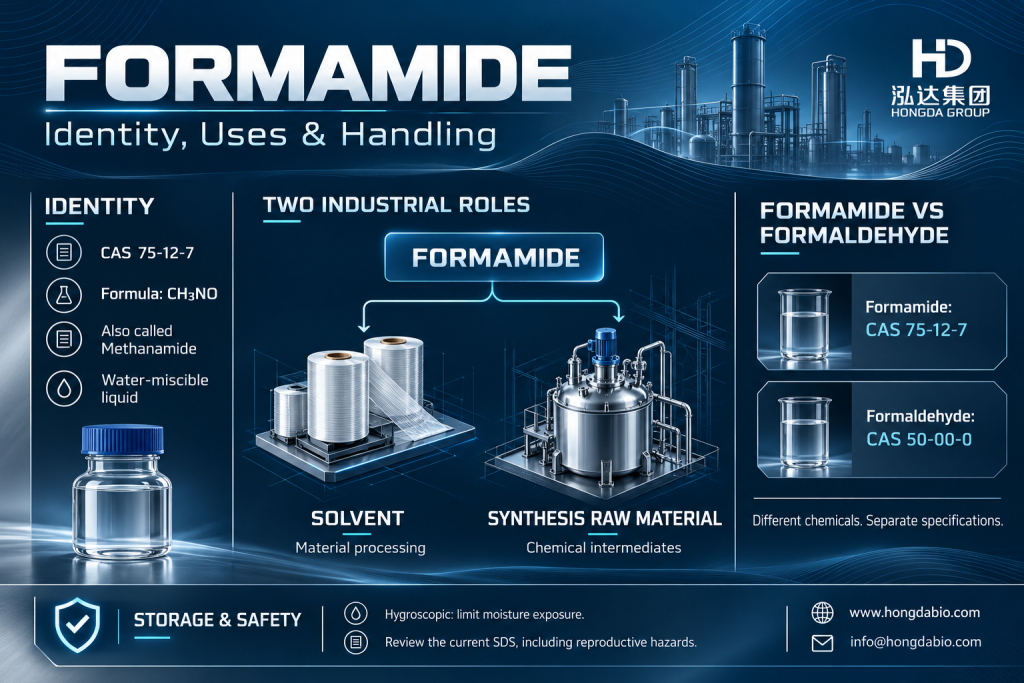
Two different roles in production
When used as a solvent, formamide provides a medium for dissolving or processing other materials. Applications include certain fibre, plastic and resin processes.
Dissolution tests are only part of the assessment. The process must also work with the existing equipment and meet the finished product requirements. Compatibility with other process materials and subsequent separation or treatment need consideration as well.
When used as a synthesis raw material, formamide takes part in a chemical reaction. It is used in the manufacture of certain pharmaceutical, agrochemical and other fine-chemical intermediates. Buyers need to establish which quality characteristics affect the process and how those characteristics will be measured.
A material-processing project and an intermediate-manufacturing project may therefore have different acceptance requirements, even when both purchase formamide.
Product identification and published packaging information are available on Hongda Group’s Formamide product page. Confirm the specification and supply conditions against the requirements of the actual project.
Why laboratory applications appear in formamide searches
Formamide is also used in certain DNA and RNA laboratory methods. Reagents supplied for these applications may undergo specific treatment and carry additional test requirements.
A laboratory method mentioning formamide does not establish that any industrial product is suitable for the procedure. The method may depend on impurity limits, treatment or storage conditions absent from a general industrial specification.
A production project should likewise identify its actual quality needs before selecting a laboratory-labelled product. Additional tests have value when they address the intended use.
For impurity-sensitive applications, including some electronic-material processes, request explicit requirements and supporting evidence for the proposed grade. A general industry reference does not establish that a supplier’s product meets a specialist specification.
Moisture, storage and formamide hydrolysis
Formamide is hygroscopic: it can absorb moisture from the air. Where a process is sensitive to water, storage and dispensing practices can affect the material after delivery.
In the presence of water, formamide can hydrolyse to formic acid and ammonia, which can also form ammonium formate. Hydrolysis is generally slow under neutral conditions at room temperature; elevated temperatures and acidic or alkaline conditions accelerate it.
Assess stored material against its actual temperature, storage duration and exposure conditions. For sensitive processes, water content and acidity may warrant separate acceptance or retest requirements.
A clear appearance cannot establish whether these characteristics remain within specification, and odour is not an analytical test. Equipment compatibility likewise needs assessment against the actual material composition and contact surfaces rather than moisture uptake alone.
Agree the relevant tests and methods with the supplier. At the production site, opening, dispensing and storage records can help investigate changes in performance.
What a formamide SDS tells you
A safety data sheet, or SDS, describes a product’s hazards and the precautions needed for handling, storage and incident response.
The ILO/WHO International Chemical Safety Card for formamide identifies health hazards, including reproductive and developmental concerns. Formamide should not be presented as a harmless solvent. Review the supplied product’s current SDS before use and establish workplace controls appropriate to the operation.
A batch test report serves a different purpose. It records the measured quality results for a particular batch and helps determine whether the material meets the agreed purchase specification.
Check that the chemical name, CAS number and supplier product details correspond across these documents. Equipment suitability also needs attention: compatibility of tanks, seals and other contact materials should be confirmed for formamide rather than assumed from previous solvent service.
Compare what the formamide quotation includes
Before comparing prices, check that the quotations cover the same specification, packaging net weight, delivery destination and accompanying documents. Differences in these terms can change the purchasing decision.
For an existing process, share the current material specification and acceptance requirements. For an initial trial, explain how formamide will be used. Product and supply details can then be discussed through Hongda Group’s contact page.
Quotation inquiries: info@hongdabio.com