



3,5-Dimethylpyridine (CAS 591-22-0), also known as 3,5-lutidine, has methyl groups at positions 3 and 5 of the pyridine ring. It is a starting material in a published route to omeprazole intermediates. The route includes two distinct N-oxides and a downstream hydrochloride known as omeprazole chloride. Each has its own chemical name and CAS number.
| Item | Details |
|---|---|
| Product name | 3,5-Dimethylpyridine |
| Common synonym | 3,5-Lutidine |
| CAS number | 591-22-0 |
| Molecular formula | C₇H₉N |
| Appearance | Colorless liquid |
| Standard listed by Hongda | T/CPCIP-0162-2021 |
| Packaging listed by Hongda | 180 kg per drum |
The standard and pack size are listed on Hongda’s 3,5-Dimethylpyridine product page. Refer to the certificate of analysis (COA) for the specific lot to see which tests were performed and what results were reported.
How to distinguish 3,5-dimethylpyridine from related compounds
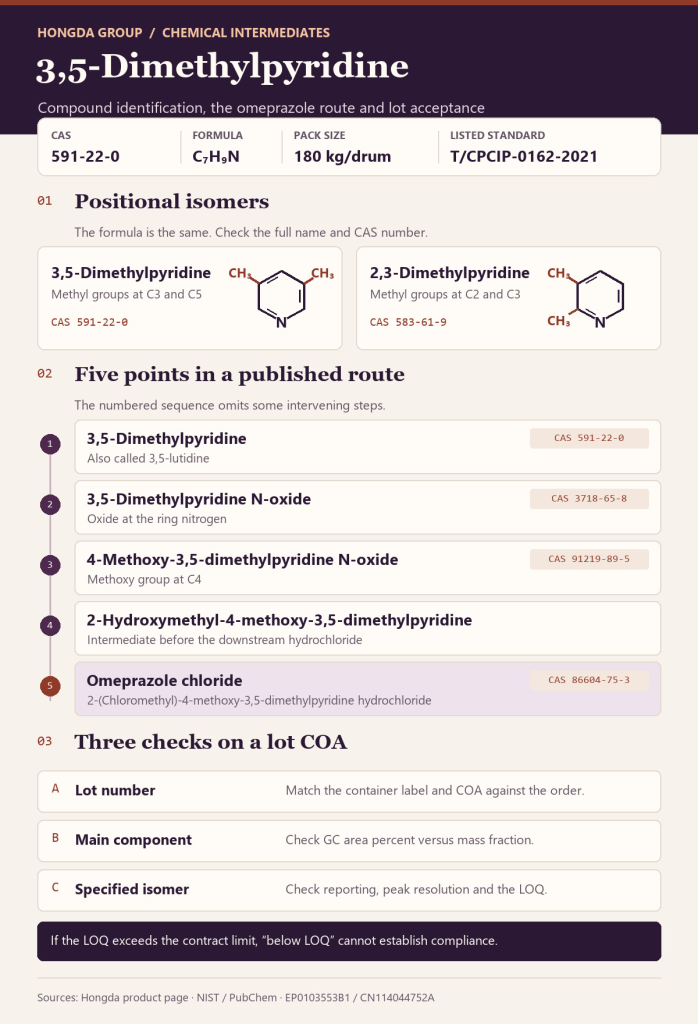
“Dimethylpyridine” alone is too broad for a purchase order. 2,3-Dimethylpyridine has the same molecular formula, C₇H₉N, but its methyl groups are at positions 2 and 3, and its CAS number is 583-61-9. Check the full name and CAS number against the purchase order, container label and COA. The molecular formula alone cannot distinguish the two positional isomers.
The N-oxide names are easy to confuse as well. The NIST Chemistry WebBook lists 3,5-dimethylpyridine N-oxide under CAS 3718-65-8, with the formula C₇H₉NO. 4-Methoxy-3,5-dimethylpyridine N-oxide, CAS 91219-89-5, has an additional methoxy group at position 4. If an inquiry omits “4-methoxy,” confirm the full name and CAS number before quoting.
Where 3,5-dimethylpyridine fits in an omeprazole route
Example 2 of European patent EP0103553B1 starts with 3,5-dimethylpyridine, proceeds through its N-oxide and describes the preparation of 4-methoxy-3,5-dimethylpyridine N-oxide. The same patent also describes the conversion of that methoxy N-oxide to the corresponding 2-hydroxymethyl intermediate.
Chinese patent CN114044752A describes the preparation of 2-(chloromethyl)-4-methoxy-3,5-dimethylpyridine hydrochloride from that hydroxymethyl intermediate. The hydrochloride is commonly referred to as omeprazole chloride (CAS 86604-75-3). An inquiry for an “omeprazole intermediate” may refer to either the upstream starting material or the downstream hydrochloride, so ask for the full name and CAS number.
Three checks when reviewing a lot COA
- Match the lot number. Compare the container label with the COA, then check the full product name and CAS number. A representative COA can show the report format and the tests typically listed. Use the COA for the delivered lot when deciding whether to accept it.
- Check how the main component is reported. A gas chromatography (GC) area percentage expresses a share of peak area. A mass fraction expresses a share of sample mass. Compounds can give different detector responses, so the two figures cannot be used interchangeably. If the purchase specification calls for a mass fraction, confirm that the method and reporting basis meet that requirement.
- Check any positional isomer with its own limit. Confirm that the report lists the named isomer separately, that the method resolves it from nearby peaks, and that the limit of quantification (LOQ) supports the acceptance decision. For example, a result reported as “below LOQ” does not establish compliance if the LOQ is higher than the agreed maximum.
Frequently asked questions
What is the CAS number for 3,5-dimethylpyridine?
The CAS number is 591-22-0. The compound is also known as 3,5-lutidine and is listed under PubChem CID 11565.
How do I tell the two 3,5-dimethylpyridine N-oxides apart?
3718-65-8 identifies 3,5-dimethylpyridine N-oxide, while 91219-89-5 identifies 4-methoxy-3,5-dimethylpyridine N-oxide. Keep “4-methoxy” in the second material’s name when checking an order or specification.
Can the main-component result on a COA confirm compliance with an individual isomer limit?
The main-component result alone cannot establish compliance. If a positional isomer has its own limit, compare its individual result, reporting basis and method LOQ with the purchase specification.
For a representative COA or the current SDS, or to check whether a specific positional isomer is included in routine lot testing, contact Hongda’s technical team at info@hongdabio.com. For impurity inquiries, include the isomer name, the required limit and the reporting basis.