



Shortening “2-chloropyridine” to “chloropyridine” removes information that matters to chemical identity: the position of the chlorine atom.
2-Chloropyridine has CAS number 109-09-1 and molecular formula C₅H₄ClN. It is typically a colourless or pale yellow liquid used in pharmaceutical, agrochemical and other fine-chemical synthesis.
Before discussing specifications or purchasing terms, establish exactly which material the project requires.
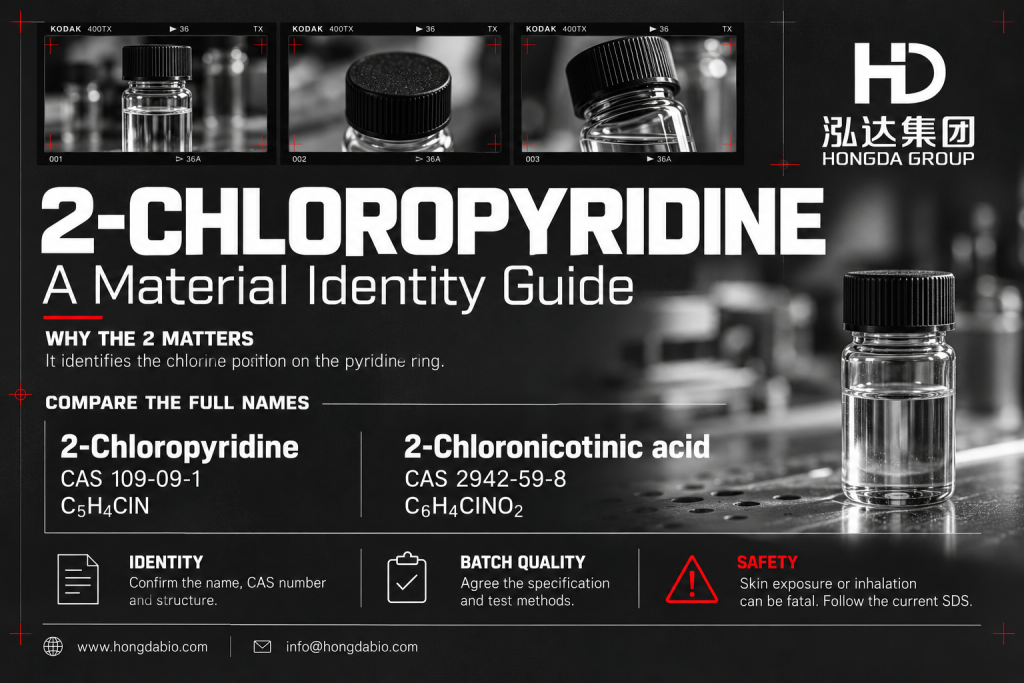
What the “2” in 2-chloropyridine means
The “2” identifies where chlorine is attached to the pyridine ring. In 2-chloropyridine, it is attached to the carbon next to the ring nitrogen. It does not indicate two chlorine atoms.
The distinction from 3-chloropyridine and 4-chloropyridine is the position of that attachment. These compounds can share a molecular formula while differing in structure, reaction behaviour and suitability for a synthetic route.
The formula therefore provides only part of the identification. Check the complete chemical name, CAS number and structural information together.
Keep the position number in internal records as well. If development specifies 2-chloropyridine, the purchase request and order should retain that full name.
Start with the target compound
2-Chloropyridine is used as a starting material for further synthesis. It provides a pyridine ring with a defined substitution position and can be used to prepare further substituted pyridine compounds.
This explains its presence in pharmaceutical and agrochemical intermediate catalogues. Whether a project requires it depends on the target compound and selected route.
Two crop-protection projects, for example, may require pyridine materials with different substitution patterns. Describing both requirements as “agrochemical intermediates” is insufficient to identify the product.
Hongda’s 2-Chloropyridine product page provides product identification and application information. It lists a colourless or pale yellow liquid and packaging of 60 kg/drum. Confirm the supplied specification and packaging against the relevant product documents and order.
The pharmaceutical and agrochemical applications refer to downstream synthesis. They do not establish that the supplied intermediate can be used directly as a finished medicine or crop-protection product.
2-Chloropyridine and 2-chloronicotinic acid are different materials
Search results for 2-chloropyridine may include “2-chloropyridine-3-carboxylic acid.” This longer name refers to 2-chloronicotinic acid.
Both compounds contain a pyridine ring and a chlorine atom. However, 2-chloronicotinic acid also contains a carboxyl group, making it a different compound.
| Comparison | 2-Chloropyridine | 2-Chloronicotinic acid |
|---|---|---|
| CAS number | 109-09-1 | 2942-59-8 |
| Molecular formula | C₅H₄ClN | C₆H₄ClNO₂ |
If a requirement specifies 2-chloropyridine-3-carboxylic acid, retain the complete name in inquiries and orders. Removing “3-carboxylic acid” changes the identity of the requested material.
Both products may appear in chemical synthesis projects. That does not make them interchangeable in a particular process. Selection must follow the required structure and route.
From identity confirmation to batch acceptance
Structural identification answers “Which compound is this?” The specification and batch results answer “Does this batch meet the project’s requirements?”
Resolve any conflict between the name, CAS number and structural information before discussing quality limits. Once the identity is consistent, review the purity test method, specified impurities and other process-relevant characteristics.
Supplier reports also need a consistent basis for comparison. Similar purity figures do not necessarily use the same methods or reporting conventions.
Where an impurity could affect the next reaction or separation stage, define the relevant requirement in the specification. “High purity” may describe a product broadly, but it is insufficient as a complete acceptance criterion.
A clearly documented requirement can then support both development assessment and purchasing acceptance.
Using solubility information in a process assessment
2-Chloropyridine has limited solubility in water and should not be treated as freely miscible with it.
In processes involving aqueous mixtures, phase separation or washing, behaviour also depends on temperature, proportions and the other materials present. General solubility information can help plan an assessment; distribution and separation in the complete process need separate evaluation.
Check the solvent and temperature conditions before comparing published values. Trials should be conducted by the responsible process team under appropriate safety controls.
Supply responsibility and safety information also matter
When evaluating a 2-chloropyridine manufacturer or supplier, confirm the supplying entity, production source and responsibility for quality documentation and batch inquiries.
Product-origin information, sample identification and batch records should connect to the material being offered. A general factory presentation can provide company background, but it cannot replace product-specific quality information.
2-Chloropyridine also presents serious acute toxicity hazards; skin exposure or inhalation can be fatal. Receiving, sampling and handling arrangements should follow the supplied product’s current safety data sheet. A clear appearance or an absence of noticeable odour is not evidence of safe exposure conditions.
Confirm packaging, transport and storage arrangements against the product documents and applicable requirements.
Keep the approved material identifiable
Once a material has been accepted for a project, retain its full name, CAS number, product code and agreed quality requirements in the purchasing records. This keeps the development assessment and subsequent order based on the same material description.
For projects moving from selection into sample or order discussions, use Hongda Group’s contact page to explain the current stage and the product questions that remain open.
Project inquiries: info@hongdabio.com