



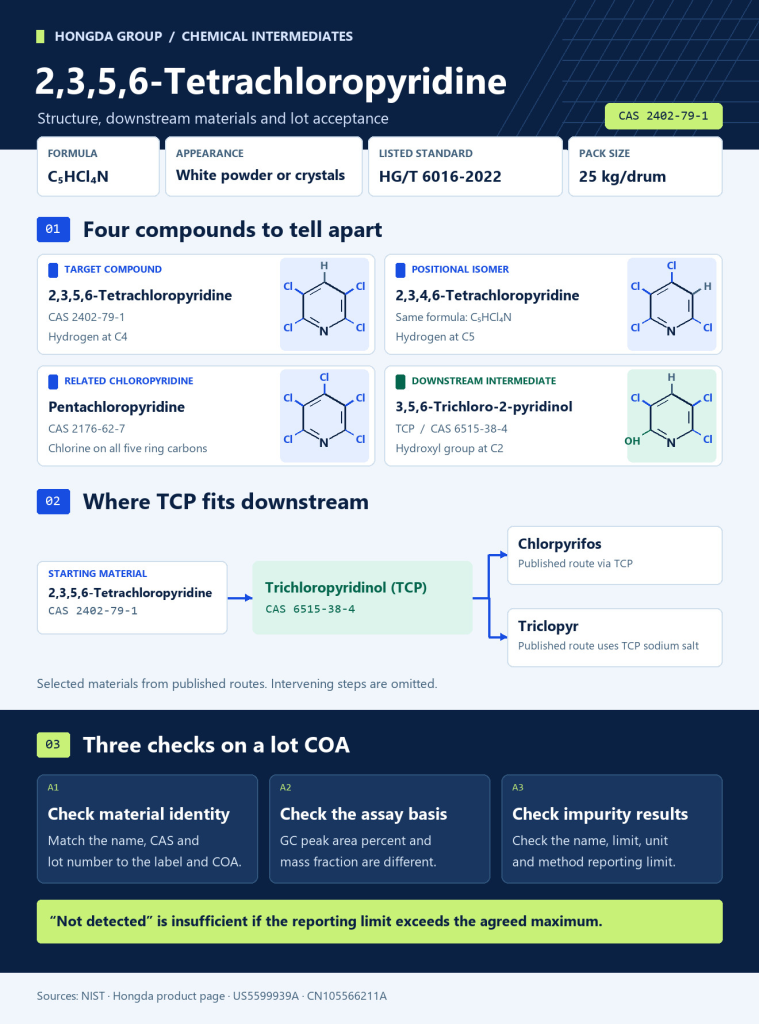
2,3,5,6-Tetrachloropyridine (CAS 2402-79-1) is a chlorinated pyridine intermediate. Its chlorine atoms occupy positions 2, 3, 5 and 6 of the ring, leaving a hydrogen at position 4. Published agrochemical routes describe its use as a precursor to 3,5,6-trichloro-2-pyridinol (TCP, CAS 6515-38-4). TCP and its sodium salt appear in routes to chlorpyrifos and triclopyr.
| Item | Details |
|---|---|
| Product name | 2,3,5,6-Tetrachloropyridine |
| CAS number | 2402-79-1 |
| Molecular formula | C₅HCl₄N |
| Appearance | White powder or crystals |
| Standard listed by Hongda | HG/T 6016-2022 |
| Packaging listed by Hongda | 25 kg per drum |
The NIST Chemistry WebBook records the compound’s identity and structure. Appearance, standard and pack size are listed on Hongda’s Tetrachloropyridine product page. Refer to the certificate of analysis (COA) for the tests and results for the specific lot.
Why the position numbers matter on a purchase order
“Tetrachloropyridine” tells you how many chlorine atoms are on the ring. The position numbers tell you which isomer you are ordering. With the ring nitrogen numbered 1, 2,3,5,6-tetrachloropyridine has a hydrogen at position 4, while 2,3,4,6-tetrachloropyridine has a hydrogen at position 5. Both have the formula C₅HCl₄N, so the formula alone cannot distinguish them.
Pentachloropyridine has a chlorine atom on all five ring carbons. It has the formula C₅Cl₅N and CAS number 2176-62-7. When an order includes several chlorinated pyridines, use the full name and CAS number on each line. That gives the receiving team a clear reference for checking the label and COA.
Where TCP fits in the chlorpyrifos and triclopyr routes
TCP differs from 2,3,5,6-tetrachloropyridine at position 2: TCP has a hydroxyl group where the starting material has chlorine. Both retain chlorine at positions 3, 5 and 6. A process specification may call for TCP itself or for its sodium salt, so check which form is named.
Chlorpyrifos. U.S. patent US5599939A describes a route in which 2,3,5,6-tetrachloropyridine is an upstream input and TCP is a downstream intermediate. Starting with tetrachloropyridine means the pyridine ring is already present, so the downstream process does not need the ring-building stage used in the trichloroacetyl chloride and acrylonitrile route. To compare wastewater performance across the full routes, measure wastewater volume and chloride discharge load per unit of product using the same process boundaries. Public process documentation
Triclopyr. Chinese patent CN105566211A describes a route that uses 3,5,6-trichloro-2-pyridinol sodium salt. If the process calls for the sodium salt, state that form on the purchase order. Tetrachloropyridine, TCP and the sodium salt are separate materials.
What to check on the COA besides the assay
Match the full chemical name, CAS number and lot number on the label to the COA. Then check how the assay is reported. If the COA gives a gas chromatography (GC) peak area percentage but the purchase specification calls for a mass fraction, confirm that the analytical method can provide the required result. A share of peak area cannot be read directly as a share of sample mass.
If your process has a separate limit for a positional isomer or another chlorinated pyridine, specify the impurity name, limit and reporting unit and confirm whether the COA reports it individually. A passing assay does not establish that an individual impurity meets its limit. For example, a result of “not detected” is insufficient if the method reporting limit is above the agreed maximum.
Frequently asked questions
What is the CAS number for 2,3,5,6-tetrachloropyridine?
The CAS number is 2402-79-1. Its molecular formula is C₅HCl₄N.
Is TCP another name for 2,3,5,6-tetrachloropyridine?
No. In this article, TCP refers to 3,5,6-trichloro-2-pyridinol (CAS 6515-38-4). TCP has hydroxyl at position 2, where tetrachloropyridine has chlorine. If the specification calls for the sodium salt, state the salt form explicitly.
Does HG/T 6016-2022 replace a lot COA?
No. The standard identifies the stated specification basis. The COA records the tests and results for the delivered lot. If your purchase specification sets a separate limit for an isomer, confirm that the COA lists it and that the method reporting limit supports acceptance.