



Pyridine: How Its Structure Shapes Its Role in Industrial Synthesis
Pyridine can accept acid during acylation, serve as a reaction medium, or undergo hydrogenation to produce piperidine. These roles place different demands on the material. Water content matters in moisture-sensitive reactions, while solvent selection also requires attention to solubility and downstream separation.
Understanding pyridine’s structure and physical properties helps explain its role in a process and which specification data deserve closer attention.
Pyridine at a glance
| Property | Information |
|---|---|
| Chemical name | Pyridine |
| CAS number | 110-86-1 |
| Molecular formula | C₅H₅N |
| Molar mass | 79.10 g/mol |
| Structure | Six-membered aromatic ring containing one nitrogen atom |
| Appearance | The pure substance is typically a colorless liquid with a pronounced, unpleasant odor |
| Density | Approximately 0.9819 g/cm³ at 20°C |
| Boiling point | Approximately 115.2°C at atmospheric pressure |
| Melting point | Approximately −41.6°C |
| Water solubility | Miscible with water |
| Standard listed on Hongda’s product page | GB/T 27567-2011 |
| Packaging listed on Hongda’s product page | 200 kg steel drum |
Density, boiling point, melting point, and water miscibility are reported in IARC’s pyridine monograph. The standard and packaging details are listed on Hongda’s product page.
These physical properties are reference values. Assay, water content, and impurity results for a supplied batch should be checked against its analytical report.
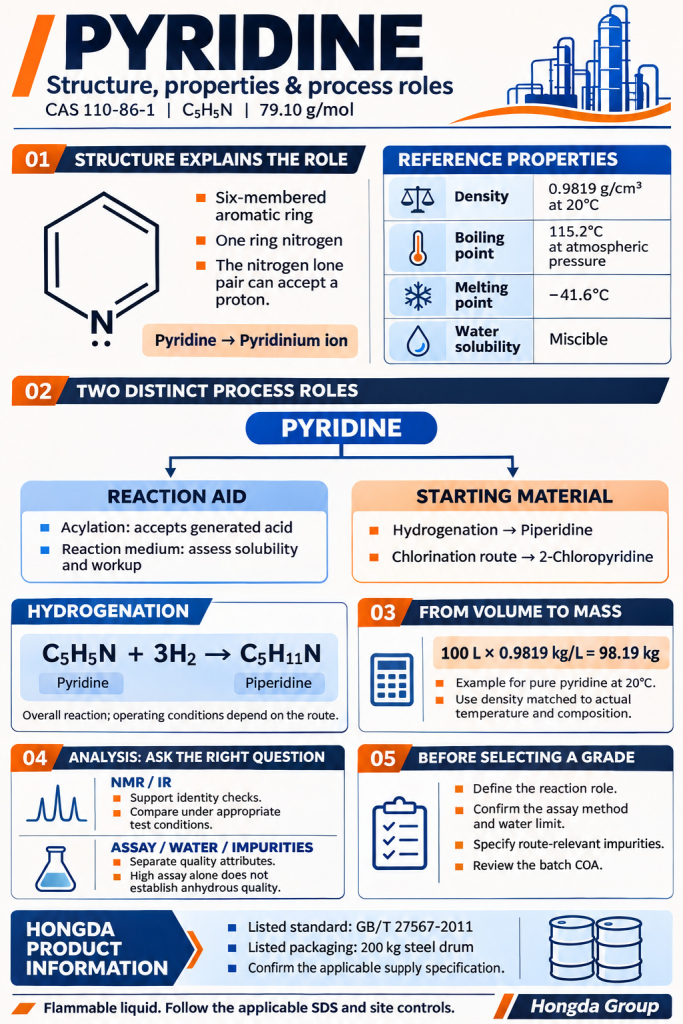
What the nitrogen atom changes
Pyridine contains five carbon atoms and one nitrogen atom in an aromatic six-membered ring. Its ring framework resembles benzene, but the nitrogen changes the molecule’s electron distribution.
The nitrogen lone pair is separate from the six-electron aromatic π system. It can accept a proton to form a pyridinium ion, explaining pyridine’s basicity and its ability to accept acid.
This behavior also affects workup. Adding acid converts some free pyridine into a salt and changes its separation behavior. Acid washing in certain processes makes use of this property.
Pyridine also differs from triethylamine and 4-dimethylaminopyridine, or DMAP. Even when these materials appear in similar reactions, their roles and required amounts may differ. Substitution calls for a fresh assessment.
What pyridine does in acylation
An acid chloride reacts with an alcohol to form an ester and hydrogen chloride. Pyridine can accept the acid formed. Preparing cyclohexyl benzoate from benzoyl chloride and cyclohexanol is one textbook example using pyridine. Acid halide reaction reference
For acid acceptance, the charge must account for acid formation. When pyridine also serves as the medium, solubility, mixing, and workup affect the quantity required.
Acid chlorides also react with water. Moisture-sensitive processes therefore need water data for the feed materials, including pyridine.
A starting material for piperidine and chloropyridine intermediates
Hydrogenation converts pyridine’s aromatic ring into the saturated nitrogen-containing ring of piperidine:
C₅H₅N + 3H₂ → C₅H₁₁N
Here, pyridine itself undergoes conversion. A 2024 paper in the Journal of the American Chemical Society discusses pyridine hydrogenation and reports an electrocatalytic approach. Research on hydrogenation of nitrogen-containing aromatic compounds
Beyond hydrogenation to piperidine, pyridine can also serve as a starting material for halogenated pyridine intermediates such as 2-chloropyridine.
For pharmaceutical and agrochemical intermediate projects, material evaluation should follow the actual route. Is pyridine the substrate being converted, or is it a base or solvent used in one step? That distinction helps determine which quality attributes need attention.
Why density and water miscibility matter in practice
Density should be quoted with its temperature. The reference value of approximately 0.9819 g/mL applies to pure pyridine at 20°C.
Using that value, the estimated mass of 100 L is:
100 L × 0.9819 kg/L = 98.19 kg
This is a mass–volume conversion example. Operational calculations should use data appropriate to the material’s temperature and composition. Recovered pyridine or a mixed process stream requires its own density assessment.
Water miscibility affects separation. Mixing pure pyridine with water does not produce an oil-like layer above or below an aqueous layer. In a reaction mixture containing other organic solvents, phase formation and pyridine distribution depend on the overall composition and acid–base conditions.
Solvent evaluation should include removal, recovery, and residual control in the product. Successful conversion does not necessarily mean straightforward workup.
What NMR and IR can establish
Pyridine NMR and IR references help with identity checks and the investigation of residual pyridine after a reaction.
Molecular symmetry gives unsubstituted pyridine three proton environments: positions 2 and 6, positions 3 and 5, and position 4. Coupling produces splitting, so this does not mean three singlets.
NMR comparison should account for solvent, measurement conditions, and protonation. IR assessment should use an overall comparison with a reliable reference spectrum rather than a single absorption band.
Identity testing and batch quality assessment answer different questions. Once identity has been established, assay, water content, and relevant impurities still need to be determined using agreed methods.
Matching the specification to the process
When purchasing pyridine, analytical requirements should reflect the intended application rather than a comparison of assay figures alone.
| Item to review | Process relevance |
|---|---|
| Assay and analytical method | Supports charge calculations and meaningful comparison between reports |
| Water content | Particularly relevant when moisture-sensitive reagents are used |
| Related impurities | Identifies components that need control for the selected route |
| Batch consistency | Requires comparable methods and acceptance criteria |
| Packaging | Must suit receiving, storage, and handling arrangements |
Hongda’s pyridine product page lists the basic product information, GB/T 27567-2011, and 200 kg steel-drum packaging. Projects with specific moisture or impurity requirements should state those limits before comparing the supply specification and batch report.
Pyridine is flammable, and vapor exposure and liquid contact require control. Storage, transfer, and protective measures should follow the applicable SDS and site assessment.
Frequently asked questions
What are the formula and CAS number of pyridine?
Pyridine has the formula C₅H₅N and CAS number 110-86-1. Its molar mass is approximately 79.10 g/mol.
What is the structure of pyridine?
Pyridine is a six-membered aromatic heterocycle containing one nitrogen atom and five carbon atoms. The nitrogen lone pair can accept a proton.
What is the density of pyridine?
A reference value is approximately 0.9819 g/cm³ at 20°C. Temperature and material composition should be stated when density is used for charge calculations.
What are pyridine’s industrial applications?
Pyridine can serve as a base, reaction medium, or starting material in organic synthesis. Examples include acid acceptance during acylation, hydrogenation to piperidine, and preparation of chloropyridine intermediates.
Are pyridine and pyrimidine the same substance?
No. Pyridine contains one ring nitrogen, while pyrimidine contains two. Pyrimidine has the formula C₄H₄N₂. Their identities, specifications, and reaction properties differ.
Does high-purity pyridine mean anhydrous pyridine?
Assay alone does not establish anhydrous quality. Check the measured water content and the water limit defined for the grade.
To discuss material suitability, contact Hongda Group with the intended process role, required quantity, and any moisture or impurity limits so the relevant product documentation can be reviewed.